

Every time you come to a stop at a traffic light, your engine continues running smoothly at a consistent, controlled speed without any input from your right foot. That effortless idling — the engine humming quietly at 700 to 900 RPM while the car sits stationary — is not accidental. It is the result of a small but critically important component called the idle air control valve, constantly monitoring and adjusting airflow to keep your engine stable every moment you are not pressing the accelerator.
When this component fails, the consequences are immediate, unmistakable, and can quickly escalate from an annoyance to a genuine safety concern. This complete guide covers everything you need to know about the idle air control valve — what it is, how it works, every major symptom of IAC valve failure, how to test it, and when to clean versus replace it.
What Is an Idle Air Control Valve?
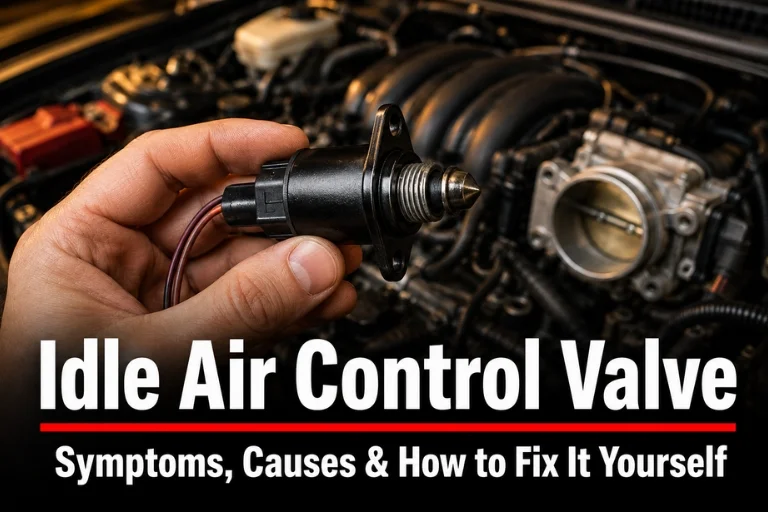
The idle air control valve — commonly abbreviated as IAC valve or IACV — is a small electromechanical device mounted on or near the throttle body of fuel-injected engines. Its sole purpose is to regulate the amount of air that enters the engine while the throttle plate is closed — meaning any time the driver’s foot is completely off the accelerator pedal and the engine is idling.
The reason a dedicated valve is needed for idle control comes down to engine physics. When the throttle plate closes completely at idle, it blocks the primary air intake path. However, the engine still needs a precise, controlled quantity of air to maintain combustion at idle speed. The IAC valve provides this air through a bypass passage — a secondary air channel that routes around the throttle plate entirely — opening and closing on command from the engine control module to deliver exactly the right volume of air for stable, consistent idling under all conditions.
The IAC valve is also referred to as the idle speed control valve in some manufacturer documentation. Despite the different name, it is the same component performing the same function — managing the air supply that determines engine idle speed and stability.
How Does an Idle Air Control Valve Work?
The IAC valve operates as part of a continuous feedback loop between the engine and its electronic control module. Understanding this feedback loop explains why the valve is so important and why its failure produces such specific, recognizable symptoms.
The engine control module — sometimes called the ECM, PCM, or ECU depending on the manufacturer — receives continuous real-time data from multiple engine sensors: the throttle position sensor confirms the throttle is closed, the crankshaft position sensor reports current engine RPM through the tachometer signal, the coolant temperature sensor reports engine warm up status, and additional sensors monitor accessory loads like air conditioning compressor engagement and power steering pump demand.
The ECM processes all of this incoming data simultaneously and calculates the precise idle RPM target for the current operating conditions. A cold engine on a winter morning needs a higher idle speed to generate heat quickly and stabilize combustion before the catalytic converter reaches operating temperature. A fully warmed engine on a hot summer day with the air conditioning active needs a slightly higher idle than the same engine without AC engaged, because the AC compressor draws power directly from the engine and would cause it to drop below target idle without compensation.
Once the ECM determines the target idle RPM, it sends an electrical signal to the IAC valve — a stepper motor-actuated device in most applications — commanding it to open or close the bypass passage by a precise, calculated amount. The stepper motor inside the valve moves the valve stem in small, controlled increments in response to each ECM command pulse, adjusting the opening size of the bypass passage with high precision.
As the bypass passage opens wider, more air enters the engine and RPM rises. As it closes, less air enters and RPM falls. The ECM monitors actual RPM through the crankshaft sensor and continuously adjusts the IAC valve position to maintain the target idle speed within a narrow, stable range. This entire cycle repeats multiple times per second throughout every moment the throttle is closed.
Where Is the IAC Valve Located?
The idle air control valve is almost universally found mounted directly on the throttle body housing or on the intake manifold in close proximity to the throttle body. On most vehicles, it is a cylindrical or rectangular component — typically black or metal-colored — with a two-wire or three-wire electrical connector on one end and one or two threaded ports that connect it to the intake air passages.
On older carbureted engines, a functional equivalent called an idle speed control motor or idle mixture screw served a similar purpose, but the electronic IAC valve as described in this guide is specific to fuel-injected engines equipped with traditional throttle body designs.
It is important to note that many vehicles manufactured from approximately 2005 onward use electronic throttle control — commonly called drive-by-wire — which eliminates the mechanical throttle cable and replaces the traditional throttle body with an electronically actuated unit. On these drive-by-wire systems, the throttle body motor itself handles idle speed control, and a separate IAC valve is not present. If your vehicle uses electronic throttle control, idle speed problems will point toward the throttle body assembly, throttle position sensor, or related electronic components rather than a traditional IAC valve.
Idle Air Control Valve Symptoms — 8 Warning Signs
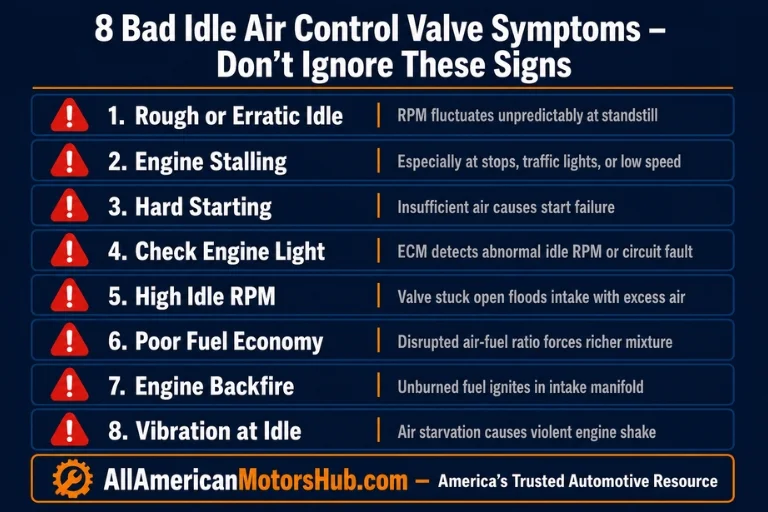
Recognizing idle air control valve symptoms early prevents minor valve issues from causing engine stalling in dangerous traffic situations or escalating into more complex drivetrain problems. Here are the eight most reliable indicators of IAC valve failure:
1. Rough or Erratic Idle The most common and most recognizable of all idle air control valve symptoms is an unstable idle. The engine RPM fluctuates irregularly — climbing and dropping repeatedly without stabilizing — while the vehicle is stationary with the throttle fully closed. This erratic behavior reflects the valve’s inability to maintain a consistent bypass air opening, causing the air-fuel mixture to vary continuously rather than holding steady. The tachometer needle visibly hunts up and down instead of sitting at a fixed RPM point.
2. Engine Stalling A failing IAC valve frequently causes the engine to stall — completely shut off — at traffic lights, stop signs, or during low-speed maneuvering. This occurs when the valve fails to supply sufficient air to keep combustion alive at idle speeds. Stalling while turning is particularly common because power steering pump engagement draws engine load at precisely the moment the IAC valve should be compensating with additional air. An engine that stalls consistently in traffic or at slow speeds should be suspected of IAC valve failure until proven otherwise, as this symptom represents a genuine safety hazard.
3. Hard Starting or No-Start Condition An IAC valve that is stuck in the fully closed position prevents any bypass air from entering the engine during the start sequence. The engine cranks but cannot generate the air-fuel mixture needed to initiate and sustain combustion. This produces hard starting — requiring multiple extended cranking attempts before the engine catches — or a complete no-start condition on severely affected valves.
4. Illuminated Check Engine Light The engine control module continuously monitors the IAC valve’s electrical circuit and compares actual idle RPM to its calculated target. When the IAC valve circuit shows an open or short circuit fault, or when actual idle RPM deviates significantly from the target that the ECM commanded the valve to achieve, the ECM stores a diagnostic trouble code and illuminates the check engine light. Common IAC-related diagnostic codes include P0505 for idle control system malfunction, P0506 for idle RPM lower than expected, and P0507 for idle RPM higher than expected. Retrieving these codes with a scan tool is the fastest way to confirm IAC valve involvement.
5. Abnormally High Idle Speed If the IAC valve sticks in the open position or the valve stem fails to close fully, excess air continuously enters the engine through the open bypass passage regardless of operating conditions. The engine responds to this excess air by running at elevated RPM — sometimes as high as 1,500 to 2,500 RPM — even when fully warmed up and at complete standstill. High idle RPM in a warmed engine is almost always a sign of either an IAC valve stuck open, a vacuum leak allowing unmetered air into the intake, or both occurring simultaneously.
6. Engine Backfire When the IAC valve delivers an inconsistent, insufficient air supply at idle, unburned fuel accumulates in the intake manifold during the lean phases of the disrupted air-fuel cycle. If this accumulated unburned fuel encounters a spark — either from normal ignition or from a hot surface in the intake — it ignites explosively, producing a backfire through the intake. Backfiring associated with an IAC valve failure tends to occur most noticeably during deceleration from higher speeds or immediately after the engine drops back to idle from a rev.
7. Poor Fuel Economy A malfunctioning IAC valve that allows excess air into the engine forces the ECM to add compensating fuel to maintain the correct air-fuel ratio. The resulting richer-than-necessary fuel mixture at idle consumes more fuel than a properly calibrated system requires — degrading fuel economy noticeably over time. Drivers who suddenly observe reduced miles per gallon without any change in driving habits should add IAC valve inspection to their diagnostic checklist alongside fuel pressure and injector testing.
8. Vibration and Shaking at Idle When the IAC valve restricts airflow below the minimum level needed for stable combustion, individual cylinders begin misfiring at idle. These misfires produce a violent, rhythmic shaking or vibration through the engine and chassis that is clearly felt from the driver’s seat. The vibration typically diminishes or disappears at higher RPM when the throttle is open and the primary air path is no longer dependent on the IAC bypass — a reliable diagnostic clue that the idle circuit specifically is affected rather than a broader ignition or fuel delivery problem.
For additional guidance on related symptoms that overlap with IAC failure, our car shaking check engine guide provides a comprehensive walkthrough of every common cause of engine vibration and rough idle.
Idle Speed Control Valve Problems — Common Root Causes
Understanding what causes IAC valve failure in the first place helps you prevent premature replacement and address the actual source of the problem rather than simply replacing a valve that may have been damaged by an underlying issue:
Carbon and Varnish Deposits The most common cause of IAC valve failure is the gradual accumulation of carbon deposits and fuel varnish inside the valve body and on the valve stem. As the bypass air passage routes air past the throttle body — an area heavily exposed to oil vapor from the PCV system and carbon from combustion blow-by — these contaminants accumulate on the valve’s internal surfaces over time. As the deposits build up, they restrict the range of motion of the valve stem, causing it to stick at a fixed position rather than moving freely in response to ECM commands.
Electrical Faults The ECM communicates with the IAC valve through an electrical connector and wiring harness. Corrosion at the connector terminals, damaged wiring from heat exposure or abrasion, and internal stepper motor coil failure all produce electrical faults that prevent the valve from responding correctly to ECM commands. Electrical failures typically produce a stored fault code and check engine light immediately, unlike mechanical sticking from carbon deposits which often develops gradually over time.
Coolant Contamination On some engine designs, a coolant passage routes through the throttle body housing adjacent to the IAC valve mount to assist cold-weather warmup. If the coolant passage develops a leak at its gaskets or fittings, coolant can contaminate the IAC valve passage and the surrounding electrical connections, causing both electrical and mechanical failure simultaneously.
Physical Damage Improper torque during installation, cross-threaded mounting, or physical impact from road debris can crack or deform the IAC valve body, permanently disrupting its sealing capability and bypass flow characteristics.
IAC Sensor — Is It the Same as the IAC Valve?
The term IAC sensor is sometimes used interchangeably with IAC valve in online discussions, but it is important to understand the distinction. The IAC valve itself is an actuator — a device that performs a mechanical action in response to an electronic command. The sensors involved in the idle control system are separate components: the throttle position sensor confirms closed throttle, the crankshaft position sensor reports RPM, and the mass air flow sensor measures incoming air volume.
When mechanics refer to the IAC sensor or to testing the IAC sensor, they are typically referring to testing the electrical characteristics of the IAC valve’s stepper motor or solenoid windings with a multimeter — measuring resistance across the valve’s connector pins to determine whether the internal motor coils are within specification or have failed open or short circuit. This electrical testing is the most reliable way to confirm internal IAC valve electrical failure before committing to replacement.
How to Test an Idle Air Control Valve
Testing the IAC valve requires minimal tools and takes under 15 minutes. Here is the reliable procedure:
Step 1 — Retrieve Diagnostic Codes Connect an OBD-II scan tool to the diagnostic port and check for stored codes. P0505, P0506, or P0507 all point directly toward the idle control circuit. Additional codes for the throttle position sensor, mass air flow sensor, or vacuum leaks can help identify whether the IAC valve is the primary cause or a secondary victim of another underlying problem.
Step 2 — Visual Inspection Locate the IAC valve on the throttle body and inspect the electrical connector for corrosion, bent pins, or broken locking tabs. Inspect the vacuum and air hoses connected to the valve for cracks, splits, or loose connections. A disconnected or damaged hose bypasses the IAC valve’s control entirely and can produce identical symptoms without any fault in the valve itself.
Step 3 — Electrical Resistance Test Disconnect the IAC valve’s electrical connector and connect a digital multimeter set to the ohms resistance function across the valve’s terminal pins according to your vehicle’s service manual pin configuration. A functioning IAC stepper motor typically shows resistance values between 10 and 14 ohms per coil winding, though the exact specification varies by manufacturer. A reading of zero ohms indicates a short circuit inside the valve. An infinite resistance reading — no continuity — indicates an open circuit with a broken winding. Either extreme confirms internal electrical failure and necessitates replacement.
Step 4 — Carbon Deposit Inspection With the valve removed, shine a light into the bypass passage and visually inspect the valve stem tip and the passage walls for heavy carbon or varnish buildup. If deposits are present but the valve’s electrical tests pass, cleaning may restore full function without requiring replacement.
How to Clean an Idle Air Control Valve
Cleaning the IAC valve is the appropriate first intervention when carbon deposits are the cause of the symptoms and the valve’s electrical tests show values within specification.
Remove the IAC valve by unplugging the connector, removing the mounting screws or bolts, and carefully pulling the valve from the throttle body. Spray the valve’s ports, stem, and internal passages thoroughly with carburetor and throttle body cleaner — never use harsh solvents that may damage the valve’s internal seals or motor windings. Allow the cleaner to soak for several minutes, then use a clean soft cloth or fine brush to remove loosened deposits from accessible surfaces. Avoid inserting anything into the valve’s electrical connector port.
Reinstall the valve, reconnect the connector securely, clear any stored fault codes with the scan tool, and start the engine. Allow it to reach full operating temperature and evaluate whether the idle symptoms have resolved. If cleaning does not resolve the symptoms within one full warm-up cycle, proceed to replacement.
How Much Does IAC Valve Replacement Cost?
IAC valve replacement is a relatively straightforward job for most vehicles. The valve itself typically costs between $25 and $120 depending on the vehicle make, model, and whether you choose an OEM or aftermarket equivalent. Professional labor adds $75 to $150 in most cases, bringing the total repair cost to between $100 and $270 at a reputable shop.
For most drivers with basic mechanical confidence, IAC valve replacement is a straightforward DIY task — remove the two to four mounting screws, unplug the connector, transfer the new valve with a fresh gasket, and reconnect. The entire process typically takes under 30 minutes for most applications.
If your vehicle has been exhibiting IAC symptoms alongside other developing engine issues, understanding the full scope of needed repairs is important before investing in component replacement. Our 10 warning signs you need to replace your engine guide helps you evaluate whether targeted repairs remain cost-effective or whether a broader solution is more appropriate.
IAC Valve and Related System Checks
The IAC valve does not operate in isolation — it works as part of a broader idle management system. When IAC valve replacement does not fully resolve idle symptoms, the following related components should be inspected:
Throttle Body Cleaning Heavy carbon deposits inside the throttle body bore — particularly around the throttle plate edges — restrict airflow in ways that disrupt the IAC valve’s ability to maintain stable idle. Throttle body cleaning is often recommended simultaneously with IAC valve service.
PCV Valve Inspection A failed PCV valve that vents excessive oil vapor into the intake manifold is one of the primary sources of the carbon deposits that cause IAC valve sticking in the first place. Addressing a failing PCV valve before or alongside IAC service prevents the new valve from developing the same deposit buildup prematurely.
Vacuum Leak Check Unmetered air entering the intake through cracked vacuum hoses, a leaking intake manifold gasket, or a split intake boot produces symptoms nearly identical to a failing IAC valve. Always perform a vacuum leak inspection before and after IAC replacement to ensure the diagnosis is accurate.
Mass Air Flow Sensor Cleaning A contaminated MAF sensor provides the ECM with inaccurate incoming air volume readings that cause incorrect IAC valve commands. MAF sensor cleaning with dedicated cleaner spray is a low-cost step that should accompany any idle control system service. For more detail on how ignition and sensor faults overlap with idle symptoms, our ignition coil guide covers how ignition-related failures produce symptoms that mirror IAC valve problems.
Conclusion
The idle air control valve is one of the most important yet least discussed components in your engine’s management system. It works invisibly every moment the engine runs at idle — continuously adjusting air supply through a bypass passage to maintain the precise RPM your engine needs under every load condition, temperature extreme, and accessory demand. When the IAC valve fails through carbon buildup, electrical fault, or physical damage, the resulting symptoms — rough idle, engine stalling, hard starting, and check engine codes — are immediate, unmistakable, and demand prompt attention.
Whether you clean a carbon-fouled valve, test the electrical resistance of the stepper motor, or replace a fully failed unit, addressing IAC problems early protects your engine from the cumulative wear that rough, unstable idling causes over time. For more essential maintenance knowledge, explore our conventional oil change guide and browse our full selection of quality used engines for sale to keep any vehicle running at its best.
Frequently Asked Questions
What is an idle air control valve?
An idle air control valve is a small electromechanical device mounted on or near the throttle body that regulates airflow into the engine through a bypass passage when the throttle is closed. It receives commands from the engine control module and opens or closes the bypass to maintain consistent, stable idle RPM under all operating conditions.
What does an IAC valve do?
The IAC valve manages idle speed by controlling the volume of air that bypasses the closed throttle plate and enters the engine. It continuously adjusts this bypass airflow in response to ECM commands to compensate for changing conditions — cold starts, air conditioning engagement, power steering load, and battery charging demand — maintaining a stable target idle RPM throughout.
What are the most common idle air control valve symptoms?
The most common IAC valve symptoms include rough or erratic idle with fluctuating RPM, engine stalling at stops or traffic lights, hard starting or no-start conditions, an illuminated check engine light with codes P0505, P0506, or P0507, abnormally high idle RPM, poor fuel economy, engine backfire during deceleration, and noticeable vibration or shaking at idle speed.
What is the IAC sensor and how is it tested?
The IAC sensor refers to the electrical testing of the IAC valve’s internal stepper motor or solenoid windings using a multimeter. Measuring resistance across the valve’s terminal pins confirms whether the internal motor coils are within the manufacturer’s specified resistance range. Values significantly outside specification confirm electrical failure requiring replacement.
Can I clean an IAC valve instead of replacing it?
Yes, in many cases. If the IAC valve’s electrical resistance tests within specification and the primary cause of symptoms is carbon or varnish deposit buildup on the valve stem and bypass passages, cleaning with carburetor and throttle body cleaner can restore full function without replacement. However, if cleaning does not resolve symptoms within one full warm-up cycle, replacement is necessary.
What causes idle speed control valve problems?
The most common causes are carbon and varnish deposits accumulating on the valve stem over time — often accelerated by a failing PCV system — electrical faults from connector corrosion or broken stepper motor windings, coolant contamination from leaking throttle body passages, and physical damage from improper installation or road debris impact.
How much does it cost to replace an IAC valve?
Most IAC valve replacements cost between $100 and $270 total — $25 to $120 for the part depending on make and model, plus $75 to $150 in professional labor. For drivers with basic mechanical skills, IAC valve replacement is a straightforward DIY repair that typically takes under 30 minutes and eliminates the labor cost entirely.
Does every car have an idle air control valve?
No. Traditional IAC valves are found on fuel-injected engines with conventional mechanical throttle bodies. Vehicles manufactured from approximately 2005 onward that use electronic throttle control — drive-by-wire systems — do not have a separate IAC valve. On these vehicles, idle speed is managed electronically by the throttle body actuator motor, and idle problems point toward the throttle body assembly or its sensors rather than a standalone IAC valve.

