
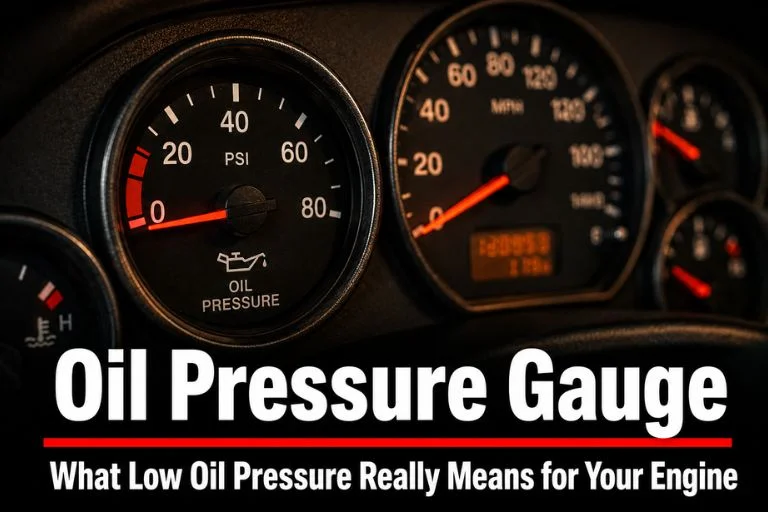

Of all the gauges on your dashboard, the oil pressure gauge is the one you can least afford to ignore. While it sits quietly alongside the speedometer and temperature gauge during normal driving, the moment that needle drops into the danger zone or the low oil pressure warning light illuminates, your engine is sending an urgent distress signal. Ignoring it — even for a few minutes — can result in bearing failure, engine seizure, and a repair bill that dwarfs the cost of almost any other vehicle problem.
This complete guide explains exactly what an oil pressure gauge is, how it works, what low oil pressure means, what causes it, and the correct steps to take the moment you see a dangerously low reading.
What Is an Oil Pressure Gauge?
The oil pressure gauge is a dashboard instrument that measures and displays the hydraulic pressure of engine oil as it circulates through your vehicle’s lubrication system in real time. It is one of the most critical monitoring instruments in any vehicle because it directly reflects whether your engine’s moving internal components — bearings, camshafts, pistons, and timing components — are receiving adequate lubrication at every moment of operation.
The gauge is typically displayed in one of two formats. The first is a numeric dial, usually ranging from 0 to 80 or 0 to 100 PSI, with an indicator needle that sweeps across the face as pressure changes. The second is a simplified arc design marked with L on the low end and H on the high end, giving a general pressure indication without specific numeric values. Both formats serve the same purpose — alerting the driver to pressure conditions that fall outside the safe operating range for their engine.
It is critically important to understand the difference between what an oil pressure gauge measures and what a dipstick tells you. The dipstick measures oil volume — how much oil is in the sump. The oil pressure gauge measures oil pressure — the force at which the oil pump is pushing oil through the passages to reach the engine’s components. It is entirely possible to have a full sump of oil but dangerously low pressure if the pump is failing or the passages are compromised. Both measurements matter and neither one alone tells the complete story.
How Does an Oil Pressure Gauge Work?
Oil pressure gauges operate through one of two systems depending on the age and design of the vehicle: mechanical or electrical.
Mechanical Oil Pressure Gauges Mechanical gauges, found primarily on older vehicles, work by physically routing a small-bore copper or plastic pipe from a tapping in the engine’s main oil gallery directly to the gauge mounted in the dashboard. Engine oil under live pressure travels through this pipe to a coiled flexible tube inside the gauge called a Bourdon tube. As oil pressure increases, the Bourdon tube attempts to straighten, and this mechanical movement drives a needle across the calibrated scale. The pressure shown on the face is the actual real-time oil pressure from the engine — no conversion or electrical signal required.
The limitation of mechanical gauges is that the oil-filled pipe runs through the firewall into the passenger cabin. If the pipe develops a leak or fractures, engine oil escapes continuously and the gauge reading drops below reality. In severe cases, the oil loss can be rapid and significant before the driver realizes anything is wrong.
Electrical Oil Pressure Gauges The vast majority of modern vehicles use electrical oil pressure gauges. A pressure-sensing unit threaded into the engine block detects changes in oil pressure through an internal diaphragm connected to a variable resistor. As oil pressure increases, the diaphragm deflects and moves a wiper across the resistor, changing the electrical resistance in the circuit. The gauge in the dashboard receives this variable resistance and translates it into a needle position or digital display reading.
Oil Pressure Warning Light Many modern vehicles supplement the gauge — or replace it entirely on economy models — with a simple oil pressure warning light. When engine oil pressure drops below a manufacturer-set threshold, a diaphragm inside the oil pressure switch closes an electrical circuit that illuminates the warning light on the dashboard. The warning light is binary — it either illuminates or it does not — while a full gauge provides continuous real-time pressure data that allows the driver to observe gradual trends before a crisis develops.
What Is Normal Oil Pressure? — Reading Your Gauge Correctly
Understanding what your oil pressure gauge is telling you requires knowing what normal looks like for your specific vehicle. While exact specifications vary by engine design, a reliable general guideline for most passenger vehicles is:
At Idle (warm engine): 20 to 30 PSI is typical and acceptable for most engines. Pressure drops at idle because the oil pump is driven by engine speed and produces less output at low RPM.
At Highway Speed (warm engine): 40 to 60 PSI is the ideal operating range for most gasoline engines at normal operating temperature.
Cold Start: Oil pressure spikes briefly at cold start as the oil pump pushes thick, cold oil through the system before the engine warms. Readings well above 60 PSI immediately after starting in cold weather are normal and will drop as the oil reaches operating temperature.
Danger Zone: Any reading below 20 PSI at idle or below 10 PSI at any RPM is a critical warning that requires immediate action. A common rule of thumb among engine engineers is a minimum of 10 PSI of oil pressure for every 1,000 RPM of engine speed.
If your needle consistently sits in the lower quarter of the gauge or the warning light illuminates during normal driving, do not delay investigation. Persistent low readings rarely resolve themselves and almost always indicate a worsening underlying problem.
Low Oil Pressure Meaning — What Your Engine Is Actually Experiencing
When the oil pressure gauge shows a low reading, the low oil pressure meaning is precisely this: the hydraulic force pushing oil through your engine’s passages, galleries, and journals is insufficient to maintain a protective film of lubrication between the moving metal components inside your engine.
Every bearing surface, camshaft lobe, connecting rod journal, and piston wrist pin in your engine operates on a microscopic film of oil that physically separates the metal surfaces from direct contact. When oil pressure is adequate, this film is maintained continuously and the surfaces never touch. When pressure drops below the minimum threshold, the oil film begins to break down. Metal contacts metal. Friction accelerates. Heat builds. Within minutes of oil starvation, bearing surfaces begin to score, camshaft lobes begin to wear rapidly, and if the condition persists, bearings seize — locking the engine.
This is why low engine oil pressure is treated as a genuine emergency rather than a cautionary warning. The window between a low pressure reading and catastrophic engine failure can be measured in minutes under certain conditions.
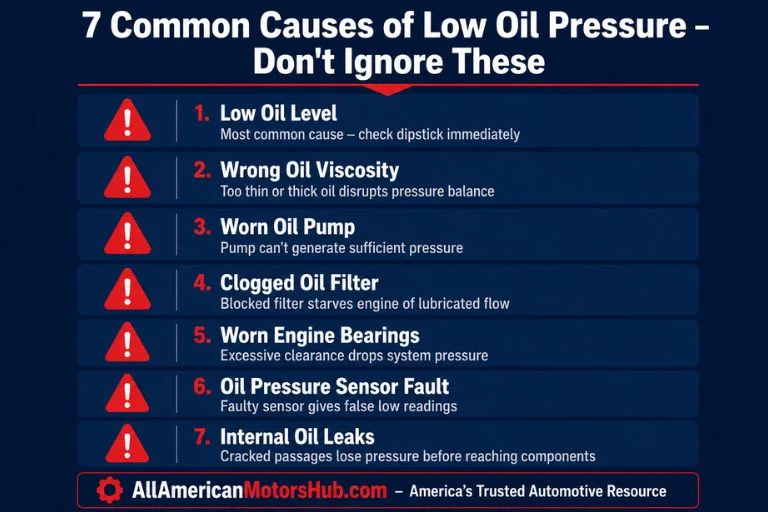
What Causes Low Oil Pressure? — 7 Most Common Causes
Understanding what causes low oil pressure allows you to diagnose the problem accurately rather than guessing and risking expensive misdiagnosis.
1. Low Oil Level This is the single most common cause of low oil pressure in passenger vehicles. Oil is consumed gradually through combustion, absorbed by seals, and lost through minor seepage points over time. If the oil level drops below the minimum mark on the dipstick, the oil pump begins drawing air along with oil from the sump, dramatically reducing system pressure. Always check the dipstick first when the gauge reads low — it takes thirty seconds and costs nothing.
2. Wrong Oil Viscosity Using engine oil with a viscosity rating that does not match your engine’s specification significantly affects pressure readings. Oil that is too thin flows too easily through the system, generating less resistance and lower pressure at the gauge. Oil that is too thick struggles to flow through tight bearing clearances efficiently, starving components despite adequate volume in the sump. Always use the oil viscosity grade specified on your oil filler cap or in your owner’s manual.
3. Worn Oil Pump The oil pump is responsible for generating all hydraulic pressure in the lubrication system. Over time, the pump’s internal gears or rotors wear and develop clearances that allow oil to slip backward past the pumping chamber rather than being pushed forward under pressure. A worn pump cannot generate sufficient pressure even with a full sump of fresh oil. When a worn pump is the cause, professional replacement is the only resolution.
4. Clogged or Bypassed Oil Filter A severely clogged oil filter restricts oil flow from reaching the engine through the normal filtered circuit. Most engines have a bypass valve that opens when filter pressure differential becomes excessive, allowing unfiltered oil to flow directly to the engine. However, if the bypass valve itself malfunctions and fails to open, the filter restriction can create a genuine pressure drop downstream. Regular oil and filter changes at manufacturer-recommended intervals prevent this entirely.
5. Worn Engine Bearings As an engine accumulates high mileage, the bearing surfaces — particularly main and rod bearings — gradually wear and develop greater clearance between the bearing shell and the crankshaft journal. These wider gaps allow more oil to escape from the pressurized gallery before it can build resistance, dropping system-wide pressure. Low pressure caused by worn bearings at high mileage often indicates the engine is approaching the end of its serviceable life. If you are experiencing this situation, our when engine repair is no longer worth it guide helps you decide whether repair or replacement is the smarter financial decision.
6. Faulty Oil Pressure Sensor or Gauge Not every low pressure reading represents an actual lubrication crisis — sometimes the measuring instrument itself is the problem. A failing oil pressure sensor can send inaccurate signals to the gauge, causing it to read falsely low even when actual oil pressure is within normal range. If the gauge reads zero at all times or shows wildly inconsistent readings while the engine runs smoothly with no unusual noises, suspect the sensor before assuming the worst. Replacement oil pressure sensors are typically inexpensive and straightforward to install.
7. Internal Oil Leaks or Blocked Passages Engine oil passages can become partially blocked by sludge deposits from neglected oil changes, or oil can escape internally through cracked passages before reaching its intended destinations. Both scenarios reduce the pressure available to downstream components. This cause is most commonly associated with engines that have experienced extended oil change intervals or have been run with severely degraded oil over long periods.
What to Do When the Oil Pressure Gauge Shows Low
When the oil pressure gauge needle drops or the warning light illuminates during driving, a specific response sequence prevents the maximum amount of engine damage:
Step 1 — Do Not Panic, But Act Immediately Remain calm and begin safely moving toward the shoulder or a safe stopping area. Do not make sudden maneuvers. Reduce throttle input immediately to lower engine RPM and reduce load on the lubrication system while you find a place to stop.
Step 2 — Pull Over and Switch Off the Engine Stop the vehicle and turn the engine off as quickly as safely possible. Do not continue driving to reach a service station, even if the distance seems short. One minute of engine operation with critically low oil pressure can cause permanent bearing damage that transforms a minor repair into a complete engine replacement.
Step 3 — Wait for the Engine to Cool, Then Check the Dipstick Allow the engine to cool for five to ten minutes before opening the hood. Check the oil level with the dipstick. If the level is extremely low, add the correct grade of oil from a spare bottle if available and check whether this restores normal gauge readings when the engine is restarted.
Step 4 — If Oil Level Is Normal, Do Not Restart If the dipstick shows adequate oil and the pressure reading was genuinely low, do not attempt to restart and drive. The cause is mechanical — pump failure, worn bearings, or blocked passages — and driving further risks catastrophic damage. Call for roadside assistance and have the vehicle towed to a qualified mechanic.
For detailed knowledge on recognizing when engine damage has already occurred, review our full 10 warning signs you need to replace your engine guide.
Low Engine Oil Pressure Prevention — Best Practices
Preventing low oil pressure is far less expensive and stressful than dealing with the consequences of it. These habits keep your lubrication system functioning correctly over the full lifespan of your engine:
Change Oil and Filter on Schedule Fresh oil of the correct viscosity is the single most powerful preventive measure. Degraded oil loses its viscosity and lubricating film strength, both of which directly reduce effective oil pressure. Follow your manufacturer’s recommended oil change interval religiously — whether that is every 3,000 miles for conventional oil or up to 10,000 miles for full synthetic. Our conventional oil change guide walks you through everything you need to know about intervals, viscosity grades, and correct procedure.
Check Oil Level Monthly Develop the habit of checking your dipstick at least once a month or before any long trip. Catching a gradual oil level decline early prevents the low-level pressure emergencies that catch most drivers off guard.
Address Oil Leaks Immediately Minor seeps from valve cover gaskets, oil pan gaskets, or rear main seals seem insignificant when the leak is small. But every oil drop leaving the engine is reducing your safety margin against low pressure events. Repair minor leaks promptly before they escalate.
Use the Correct Oil Viscosity Never substitute a different viscosity than specified by your manufacturer, even temporarily. The correct specification is printed on the oil filler cap and listed in your owner’s manual. Using the right oil from the start eliminates one of the most preventable causes of low pressure readings.
Listen to Your Engine A knocking, ticking, or rattling sound at startup or under load is one of the earliest audible warnings of insufficient lubrication. If the oil pressure gauge reads normal but you hear unusual mechanical noises, have the engine inspected by a professional mechanic before the noise progresses to visible gauge readings.
When Low Oil Pressure Means Engine Replacement
In some situations, persistent low oil pressure — particularly in high-mileage engines — indicates wear that has progressed beyond the threshold where maintenance or minor repair can restore normal function. When bearing clearances are excessively worn, oil passages are chronically sludged, or the oil pump is failing in an otherwise tired engine, the most cost-effective solution is often a quality used engine replacement rather than incremental repairs that address symptoms without resolving underlying wear.
If you have reached that point, explore our full selection of quality used engines for sale and used transmissions to find reliable, inspected replacements at a fraction of the cost of new components. Choosing a quality used engine from a verified source restores your vehicle’s performance and reliability at a cost that makes genuine financial sense.
Conclusion
The oil pressure gauge is not a decorative dashboard instrument — it is your engine’s most direct communication channel, reporting in real time whether the lubrication system that protects every internal moving component is functioning correctly. Understanding what normal oil pressure looks like, recognizing low oil pressure meaning when the gauge drops, knowing the seven most common causes of low engine oil pressure, and responding with the correct emergency procedure every time the warning appears gives you the knowledge to protect one of the most expensive mechanical systems in your vehicle.
Keep your oil fresh, check your level regularly, and never dismiss a low pressure reading as a minor inconvenience. Your engine depends on it — and so does your wallet.
Frequently Asked Questions
What is an oil pressure gauge?
An oil pressure gauge is a dashboard instrument that measures and displays the hydraulic pressure of engine oil circulating through the lubrication system in real time. It indicates whether the oil pump is generating sufficient pressure to deliver adequate lubrication to all internal engine components at every operating condition.
What does low oil pressure mean?
Low oil pressure means the hydraulic force pushing oil through the engine’s passages and bearing surfaces has dropped below the minimum level needed to maintain a protective lubrication film between moving metal components. This condition causes accelerated wear, overheating, and — if not addressed immediately — catastrophic engine failure including bearing seizure.
What causes low oil pressure?
The most common causes of low oil pressure include low oil level in the sump, using the wrong oil viscosity, a worn or failing oil pump, a clogged oil filter, worn engine bearings with excessive clearance, a faulty oil pressure sensor giving false readings, and internal oil leaks or blocked oil passages from sludge buildup.
What is a normal oil pressure reading?
For most passenger vehicles, normal oil pressure at operating temperature ranges from 20 to 30 PSI at idle and 40 to 60 PSI at highway speed. A reliable minimum guideline is 10 PSI for every 1,000 RPM of engine speed. Always verify the specific normal range for your vehicle in the owner’s manual.
What should I do when the oil pressure gauge reads low while driving?
Stop the vehicle safely as quickly as possible and turn off the engine immediately. Do not continue driving even short distances. Wait for the engine to cool, then check the oil level with the dipstick. If the oil level is low, add the correct grade of oil and recheck the gauge. If the oil level is adequate but pressure was genuinely low, do not restart — call for a tow and have a mechanic diagnose the cause.
Can a faulty oil pressure sensor cause a false low reading?
Yes. A failing oil pressure sensor can send incorrect signals to the gauge, causing it to read falsely low even when actual oil pressure is completely normal. If the gauge reads zero constantly or fluctuates wildly while the engine sounds normal with no unusual noises, the sensor is a likely cause. Always verify with a mechanical gauge before assuming genuine pressure loss.
What is low engine oil pressure at idle?
Oil pressure naturally drops at idle because the oil pump is belt or gear-driven by engine speed and produces less output at low RPM. Readings between 20 and 30 PSI at warm idle are typically normal. Readings below 20 PSI at warm idle warrant investigation, and anything below 10 PSI at any RPM is a critical emergency requiring immediate engine shutdown.
How does low oil pressure damage an engine?
Low oil pressure breaks down the protective film of oil that separates moving metal surfaces inside the engine. Without this film, bearing surfaces, camshaft lobes, connecting rod journals, and piston components make direct metal-to-metal contact. This generates intense heat and friction that scores bearing surfaces within minutes, potentially seizing the engine completely and requiring full replacement.

