
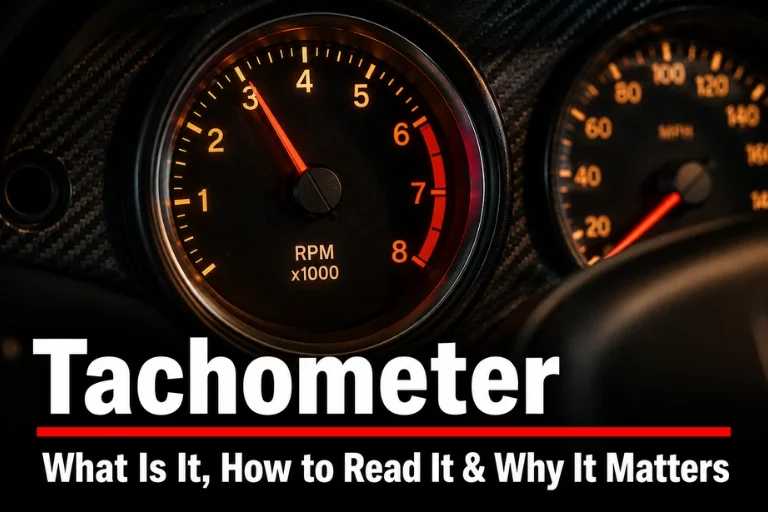

Every time you sit behind the wheel and turn on your engine, a cluster of precision instruments comes to life on your dashboard. Most drivers immediately recognize the speedometer — but the gauge sitting right beside it, marked with numbers from 1 to 8 and bearing the label RPM, is equally important and far less understood. That gauge is the tachometer, and it provides one of the most direct windows into the internal health and real-time workload of your engine.
Whether you drive a manual or automatic, understanding your tachometer transforms you from a passive observer into an informed driver who can protect the engine, improve fuel efficiency, and extend the life of your vehicle. This complete guide explains everything — what a tachometer is, how it works, how to read it correctly, and why every driver should pay attention to it.
What Is a Tachometer?
A tachometer is an instrument that measures the rotational speed of your engine’s crankshaft, expressed in revolutions per minute — commonly abbreviated as RPM. In plain language, it tells you how many times your engine’s crankshaft completes a full 360-degree rotation every single minute during operation.
The word tachometer itself originates from two Greek roots: “tachos,” meaning speed, and “metron,” meaning measure. Translated directly, a tachometer is a speed-measurer — specifically the internal rotational speed of your engine rather than the forward road speed shown by the speedometer.
The tachometer is also widely referred to as the RPM gauge, rev counter, or simply the tach. Regardless of what you call it, its function is the same across every vehicle it appears in — to give the driver precise, real-time information about how hard the engine is working at any given moment.
The Brief History of the Tachometer
Tachometers have a surprisingly long history that predates the automobile entirely. The first tachometer-like devices were used in the early 19th century to measure the rotation speed of industrial machinery and steam engines — critical information for engineers managing the mechanical limits of early industrial equipment.
When internal combustion engines arrived, the need to monitor rotational speed became equally important in vehicles. Early automotive tachometers used centrifugal weight mechanisms physically connected to the engine’s crankshaft — as the engine spun faster, the weights spread outward under centrifugal force, moving a needle across a calibrated scale.
By the mid-20th century, electromagnetic technology replaced mechanical connections, allowing the tachometer to measure RPM through electrical impulses without needing a physical shaft linkage. By the 1980s and 1990s, fully electronic tachometers had become standard equipment across the automotive industry, integrated into the engine management system and capable of providing highly accurate readings that updated continuously in real time.
Today, tachometers appear as analog dial gauges in traditional instrument clusters, digital numerical displays in modern driver information screens, and hybrid configurations in performance vehicles that show both formats simultaneously.
What Is a Tachometer in a Car — The RPM Gauge Explained
In the context of a car, the tachometer is the circular gauge on the dashboard, typically positioned to the left of the speedometer. The face of the gauge displays numbers ranging from 0 to 7 or 0 to 8 in most passenger vehicles, with each number representing 1,000 RPM of engine speed. A needle sweeps across the dial face in real time as engine speed changes.
When you read the number 3 on the tachometer face and the needle is pointing at it, your engine is running at 3,000 revolutions per minute. When the needle drops to 1 at idle with the car stationary, the engine is completing approximately 700 to 1,000 complete revolutions every single minute just to keep itself running. When you accelerate hard onto a highway on-ramp and the needle climbs to 5 or 6, the engine is spinning at 5,000 to 6,000 RPM — working considerably harder to generate the power demanded by your right foot.
At the far right of the dial, every tachometer has a distinctly marked danger zone — almost universally displayed in red. This area is called the redline, and it represents the upper limit of safe engine RPM. Exceeding the redline exposes the engine’s valvetrain, pistons, connecting rods, and bearings to stress levels beyond what they were designed to sustain for any meaningful duration. Consistently running at or above redline accelerates internal wear and increases the risk of catastrophic component failure.
How Does a Tachometer Work?
Modern tachometers in cars operate entirely electronically through the engine management system. The process involves three core stages:
Stage 1 — Signal Generation The engine’s crankshaft position sensor — a critical component already present in every modern engine for ignition and fuel injection timing purposes — generates electrical pulses as the crankshaft rotates. Each pulse corresponds to a specific number of degrees of crankshaft rotation. The frequency of these pulses is directly proportional to how fast the crankshaft is spinning — more pulses per second means higher RPM.
Stage 2 — Signal Processing The engine control module receives the stream of pulses from the crankshaft position sensor and calculates the exact RPM in real time by measuring the frequency and interval of incoming pulses. This calculation happens continuously and updates multiple times per second, giving the tachometer its characteristic real-time responsiveness to throttle inputs.
Stage 3 — Display The calculated RPM value is transmitted to the tachometer gauge driver circuit, which converts the signal into the physical needle movement of an analog gauge or a numerical readout on a digital display. On analog gauges, the driver circuit controls a galvanometer coil that deflects the needle in proportion to the incoming signal strength. On digital displays, the RPM value is directly rendered as a number or a graphic sweep bar that updates continuously.
On older vehicles from the pre-electronic era, analog tachometers used a contact-breaker pulse from the ignition distributor — each time the distributor points opened to fire a spark plug, a pulse was sent to the tachometer. The frequency of these pulses per revolution varied by the number of engine cylinders, which is why older tachometers required calibration for a specific cylinder count.
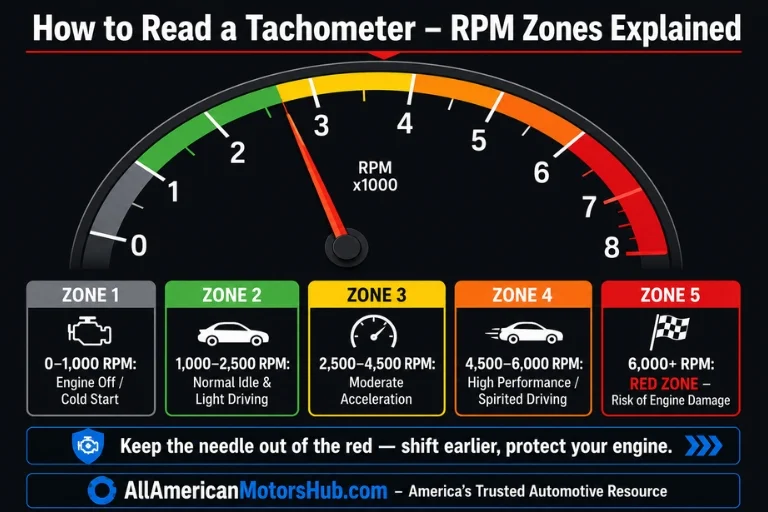
How to Read a Tachometer — RPM Zones Explained
Reading the tachometer correctly gives you actionable information at every moment of driving. Here is what each RPM range actually means for your engine:
0 to 1,000 RPM — Idle and Cold Start Range With the engine running but no throttle applied, the engine idles between approximately 600 and 1,000 RPM in most passenger vehicles. Cold engines may idle slightly higher — between 1,000 and 1,500 RPM — as the engine management system enriches the fuel mixture and raises idle speed to warm the catalytic converter and stabilize combustion during warm-up. This is normal and the idle RPM will drop once the engine reaches operating temperature.
1,000 to 2,500 RPM — Light Load and City Driving This is the typical operating range for casual urban driving, coasting, and light acceleration. The engine is working comfortably within its efficiency range, fuel consumption is moderate, and mechanical wear is minimal. Most modern automatic transmissions target this range during normal flat-road cruising.
2,500 to 4,500 RPM — Moderate Load and Active Driving Merging onto highways, overtaking other vehicles, climbing grades, and carrying passenger loads typically places the engine in this range. The engine is working meaningfully but still well within safe parameters. For manual transmission drivers, this is typically the most active shifting zone during spirited but responsible driving.
4,500 to 6,000 RPM — High Performance Range This range is used during hard acceleration, track driving, or when the engine is called upon for maximum output. The engine is working intensely in this zone and mechanical wear rates increase. Brief operation in this range is entirely within design tolerances for most engines — sustained operation accelerates wear and increases heat generation significantly.
Above Redline — Danger Zone The redline varies by engine — most naturally aspirated passenger car engines redline between 6,000 and 7,500 RPM, while performance and high-revving sport engines may redline at 8,000 RPM or higher. Operating the engine above redline even briefly risks valve float — where intake and exhaust valves cannot physically close fast enough to keep pace with piston movement — and piston-to-valve contact that can destroy an engine in a single event.
Why the Tachometer Matters for Manual Transmission Drivers
For drivers of manual transmission vehicles, the tachometer is an indispensable tool for smooth, efficient, and mechanically sympathetic gear shifting.
When accelerating from a standstill, the clutch must be engaged progressively as engine RPM rises above idle. Attempting to release the clutch with the engine below 1,000 RPM almost always results in stalling. A tachometer tells you precisely when the engine has sufficient RPM to absorb the clutch engagement smoothly.
During upshifting, most passenger vehicles shift most smoothly between 2,000 and 3,000 RPM depending on speed. Waiting until 4,000 RPM or higher before upshifting wastes fuel and places unnecessary mechanical stress on the drivetrain. Shifting too early — below 1,500 RPM in most vehicles — causes the engine to labor under load in too high a gear, generating heat and torque stress on the drivetrain that accelerates wear.
Downshifting to a lower gear while the vehicle is traveling too fast for that gear — a technique known as rev-matching — is made dramatically easier with a tachometer. The driver blips the throttle to raise engine RPM to match the expected RPM in the lower gear before releasing the clutch, producing a smooth, jolt-free downshift that eliminates transmission shock and clutch wear.
For deeper understanding of transmission types and how RPM management differs across gearbox designs, our full AMT vs manual transmission guide explains exactly how automated and manual systems handle engine speed management differently.
Does the Tachometer Matter for Automatic Transmission Drivers?
Many automatic transmission drivers assume the tachometer is irrelevant to them since the transmission manages gear changes automatically. This assumption underestimates what the RPM gauge reveals even in automatic vehicles.
The tachometer in an automatic vehicle tells you whether the transmission is shifting correctly and at appropriate RPM points for the driving conditions. If the transmission is holding a gear too long and RPM climbs excessively before upshifting, the transmission may be developing problems with its shift logic or solenoids.
The tachometer also reveals torque converter lockup status. When the torque converter locks up on the highway, you will see a slight RPM drop and stabilization on the gauge — confirmation that the drivetrain is operating in its most fuel-efficient configuration. If the converter is not locking up when expected, the gauge will show slightly elevated, fluctuating RPM at cruising speeds.
Additionally, RPM behavior at idle is one of the earliest indicators of developing engine issues. A tachometer that shows rough, fluctuating idle RPM — oscillating between 500 and 1,200 RPM repeatedly without a consistent steady reading — points toward issues with fuel delivery, ignition, the mass air flow sensor, or intake vacuum leaks. Catching these patterns early can prevent progressive damage.
If your vehicle is showing abnormal RPM behavior alongside other symptoms, our car shaking check engine guide can help you identify whether the issue is engine-related or something more specific to the drivetrain.
Types of Tachometers in Modern Vehicles
Tachometers come in several formats across different vehicle types and generations:
Analog Tachometer – The traditional round dial gauge with a sweeping needle — still the most common format in modern vehicles. Analog gauges are easy to read at a glance without requiring focus on a specific number, making them well-suited to dynamic driving environments.
Digital Tachometer – Displays RPM as a changing numerical value on an LCD or LED screen, often integrated into a multi-function digital instrument cluster. Digital displays provide precise numerical readings but require a momentary focus to interpret the specific number.
Bar Graph Tachometer – Found in some performance and sport vehicles, this format displays RPM as a sweeping horizontal or arc-shaped bar that grows or contracts in real time. The visual sweep can be faster to interpret under dynamic driving conditions than a numerical display.
Virtual Tachometer – In fully digital instrument clusters and EV-derived displays, the tachometer is rendered as a software graphic that mimics the appearance of an analog gauge on a high-resolution screen. The virtual format allows complete customization of gauge layout, sizing, and placement.
Tachometer and Engine Health — What Unusual Readings Reveal
Beyond its role in shift timing, the tachometer provides early warning of several developing mechanical conditions:
High Idle RPM Consistently elevated idle RPM — above 1,200 RPM when fully warmed up — can indicate a vacuum leak, a faulty idle air control valve, or a throttle body that is not closing fully. Addressing these issues early prevents fuel waste and potential throttle control problems.
Fluctuating Idle RPM An unstable idle that hunts up and down repeatedly suggests issues with the mass air flow sensor, fuel pressure, ignition timing, or a failing PCV system disrupting intake vacuum stability. For more on PCV-related idle problems, our ignition coil guide covers how ignition component failures directly affect RPM stability.
RPM Drop Under Load If the tachometer shows RPM dropping significantly when accessories like air conditioning or power steering are engaged, the engine may be struggling to maintain idle stability under accessory load — pointing toward a weak idle control system or a developing alternator issue.
Sudden RPM Spike Without Acceleration A sudden, unexpected RPM climb without pressing the throttle — particularly in automatic vehicles — can indicate a slipping transmission that is no longer effectively transferring power to the wheels. This symptom warrants immediate transmission inspection to prevent further damage.
For related guidance on identifying drivetrain problems before they become catastrophic, our signs your transmission is going bad article covers all the critical warning signs in detail.
Tachometer Tips for Better Fuel Economy
Beyond engine protection, the tachometer is one of the most effective tools for improving real-world fuel economy — particularly in manual transmission vehicles.
The fuel economy sweet spot for most naturally aspirated gasoline engines lies between 1,500 and 2,500 RPM during steady-state driving. Operating consistently in this range minimizes fuel consumption per mile while maintaining adequate power for safe highway driving. Turbocharged engines often deliver their best efficiency slightly lower — between 1,500 and 2,000 RPM — because the turbocharger allows the engine to produce strong torque at lower RPM than a naturally aspirated equivalent.
Using the tachometer to upshift earlier — moving to the next gear before RPM climbs above 2,500 during normal acceleration — consistently reduces fuel consumption over any journey. This technique, sometimes called economy shifting, extends the interval between fill-ups meaningfully over thousands of miles of regular driving.
Conclusion
The tachometer is far more than a decorative dial that enthusiasts occasionally admire during spirited driving. It is a precision instrument that reveals exactly how hard your engine is working at every moment — giving you the information to shift more smoothly, protect your engine from excessive stress, identify developing mechanical problems early, and drive more fuel-efficiently every single day.
Understanding what a tachometer is, how the RPM gauge operates, what each zone of the dial means, and what unusual readings reveal empowers you as a driver and vehicle owner in a way that no other dashboard instrument can match. Whether you drive a manual or automatic, learning to read and respond to your tachometer is one of the simplest and most rewarding skills you can develop behind the wheel.
For comprehensive vehicle maintenance knowledge alongside your driving skills, explore our full car maintenance checklist and discover our full range of quality used engines for sale to keep your vehicle running at its peak for years to come.
Frequently Asked Questions
What is a tachometer?
A tachometer is a dashboard instrument that measures and displays the rotational speed of an engine’s crankshaft in revolutions per minute — RPM. It tells the driver how fast the engine is spinning at any given moment, providing critical real-time information about engine workload, shift timing, idle stability, and overall mechanical health.
What does a tachometer do in a car?
In a car, the tachometer shows the current RPM of the engine in real time. For manual transmission drivers, it indicates when to shift gears for smooth acceleration and optimal fuel efficiency. For all drivers, it provides early warning of idle instability, transmission slip, and other developing engine issues that would otherwise go unnoticed until symptoms become severe.
What is an RPM gauge?
An RPM gauge and a tachometer are the same instrument — both terms refer to the dashboard gauge that displays engine speed in revolutions per minute. The numbers on the face represent thousands of RPM, so a needle pointing at 3 indicates the engine is spinning at 3,000 RPM.
What is the redline on a tachometer?
The redline is the red-colored zone at the far right or top of the tachometer dial that marks the maximum safe RPM for the engine. Operating consistently at or beyond the redline risks valve float, piston-to-valve contact, connecting rod failure, and other catastrophic internal damage. Most passenger car engines redline between 6,000 and 7,500 RPM.
What should my tachometer read at idle?
Most passenger vehicles idle between 600 and 1,000 RPM with the engine fully warmed up. Cold starts may show idle RPM between 1,000 and 1,500 RPM temporarily as the engine management system warms the catalytic converter. Consistent idle readings above 1,200 RPM on a fully warmed engine suggest a potential issue with the idle air control valve or vacuum system.
Does a tachometer matter in an automatic car?
Yes. In automatic vehicles, the tachometer reveals whether the transmission is shifting at appropriate RPM points, whether the torque converter is locking up correctly at highway speeds, and whether idle RPM is stable and within normal range. Unusual RPM behavior — such as climbing without throttle input or fluctuating at idle — is one of the earliest detectable signs of transmission or engine problems.
How does a tachometer work?
Modern tachometers work by reading electrical pulses generated by the crankshaft position sensor as the crankshaft rotates. The engine control module calculates RPM from the frequency of these pulses and transmits the value to the tachometer gauge driver circuit, which moves the needle or updates the digital display in real time. The entire process updates multiple times per second, giving the gauge its responsive, real-time behavior.
What does high RPM at idle mean?
Consistently elevated idle RPM — above 1,200 RPM when fully warmed up — typically indicates a vacuum leak allowing unmetered air into the intake manifold, a faulty idle air control valve, a throttle body that is not fully closing, or a malfunctioning throttle position sensor. These issues waste fuel, cause rough idling, and can trigger check engine codes if left unaddressed.

