
Table of Contents
It is one of the most irritating things that the Check Engine Light (CEL) appears before your eyes, particularly when you feel that your car is actually performing well. You scan it and the tool spews out P0128. It is not like the other misfire codes or transmission codes that are intentionally frightening; this is more of an exception, where your car is not running too hot, instead, your vehicle is running too cold.Although it may sound as a good thing (who does not want an engine that is cool), P0128 code is in fact a reminder that your engine is not getting to its optimal operating temperature fast enough.
This may not leave you stuck on the shoulder of the road right now but in the long run, neglecting it may kill your fuel economy as well as harm your engine. This comprehensive guide will walk you through everything you need to know about the P0128 code, from its meaning to effective solutions.
What Does the P0128 Code Mean?
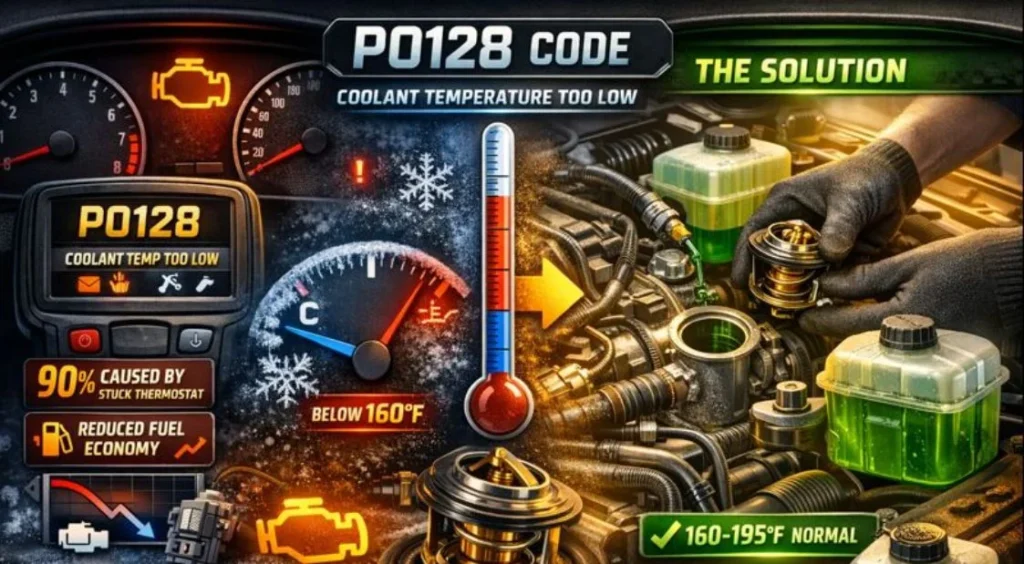
The P0128 code of diagnostic trouble shows that your engine coolant temperature is lower than the regulating temperature of the thermostat. To put it more simply, your engine is not starting as fast as it needs to, or is operating at a lower temperature than the optimum operating temperature. The engine control module (ECM) or the Powertrain Control Module (PCM) of your vehicle pays close attention to the coolant temperature. It runs the P0128 code and lights up your check engine light when it notices that the engine is not heating up to the required temperature after a set time of time, after starting your car.
Why This Code Matters for Your Engine?
A low temperature engine may not appear to be a problem, but it may cause a number of issues. When your engine does not attain its optimum operating temperature, the efficiency of combustion of fuel will decrease and result in a reduced fuel economy. The engine management system has depended on the appropriate temperature to switch to the close loop mode where it utilizes the oxygen sensor data to provide accurate control of fuel.
An engine that is started too cool may be equally as harmful as one that is overheated, and may lead to permanent damage of many of its parts. Also, condensation can’t burn out efficiently, that can mix with engine oil and lubrication will be compromised with time.
Common Symptoms of Code P0128
Common vehicles like the Ford F-150 often experience P0128 codes due to thermostat issues, especially in colder climates. An early detection of the problem can be achieved by identifying the symptoms related to the P0128 code:
- Check Engine Light: You see your malfunction indicator light turn on in your dashboard, it is the most obvious.
- Delayed Warm-Up Time: Your engine also requires much more time to put on normal operating temperature.
- Temperature Gauge Low: The temperature gauge is low even after long periods of driving.
- Low Fuel Economy: You can find the reduction of the number of miles per gallon because of inefficient burning.
- Problems in heater performance: Your cabin heater might blow cool or least hot air instead of hot air.
- Increased Idle Speed: There is a possibility that vehicles idle beyond normal in case of this problem.
Interestingly, there are drivers who state that the P0128 code does not show any symptom except the check engine light, but it does not mean that the issue should be overlooked.
What Causes the P0128 Code?
Although there are some triggers to this, one offender is guilty 90 percent of the time, particularly in popular models like the Honda Accord and Toyota Camry.
Thermostat Stuck Open (Most Common): Thermostat is a valve which retains coolant within the engine until it becomes hot. In case it sticks open, the coolant is always flowing to the radiator so that the engine will never get warm.
- Low Coolant Level: In case of insufficient coolant to touch the sensor, the sensor may give a false cold reading.
- Bad Coolant Temperature Sensor (ECT): It can be that the engine is hot, yet the sensor is deceiving the computer. Learn more about coolant temperature sensor diagnosis and replacement to properly troubleshoot this issue.
- Fan Stuck On: A fan that is turned on 100% of the time may be excessively cooling the engine.
How to Diagnose the P0128 Code?
One has to be properly diagnosed before trying to do any kind of repairs. Here’s a systematic approach of how you can do it:
Step 1: Scan for Codes Retrieval of all the codes stored can be done using an OBD-II scanner. Record any other codes that will be associated with P0128 as they might reflect similar problems with sensors or the cooling system.
Step 2: Check Coolant Levels When the engine is completely cool check your coolant reservoir. The coolant level must be in accordance with the manufacturers. The small readings may mean that there is a leakage or even the tank needs to be filled up.
Step 3: Observe Temperature Levels. Live data on the scanner to track coolant temperature and intake air temperature indicators. Both are supposed to be equal to ambient temperature at a startup. When the engine is warmed the coolant temperature will reach the operating range of 160-170 degrees Fahrenheit in approximately 15 minutes.
Step 4: Inspect the Thermostat Once the engine has warmed up you should feel the upper radiator hose carefully. When the thermostat opens, it should become hot. In case it slows down in warming up or remains cool, then it means that the thermostat is probably stuck on.
How to Fix Code P0128?
Solution 1: Rechange the Thermostat. In the majority of the cases, the P0128 code is resolved by substituting a defective thermostat. Make sure that you install a thermostat with a proper temperature rating in your car. The code will reoccur in case an aftermarket thermostat is used with a too low opening temperature.
Solution 2: Solution Low Coolant. When coolant is depleted, then replace it to the normal level with the particular type of coolant required by your manufacturer. Should the levels drop rapidly, examine hose leaks, radiator, water pump or other cooling system components.
Solution 3: Change ECT Sensor. ECT sensor can be faulty when the thermostat and coolant levels clear, and the P0128 code still remains. Substitute it with an OEM or good quality aftermarket sensor. Solution 4: Repairing Electrical Connections. Check all the wires and connectors connected with the cooling system sensors. Clean rusty terminals and repair or change damaged wiring.
Solution 5: Clear the Code and Test. Once you have made repairs, then perform the clearance of the code with your OBD-II scanner. Completing the drive cycle requires at least 20 miles of driving with diverse conditions. In case repair has been done successfully, the P0128 code should not reoccur.
Can You Drive with the P0128 Code?
Although this code does not represent the urgency but the P0128 code must be addressed as soon as possible, whether you’re driving a Chevrolet Silverado 1500 or a compact car. The driving in the short term is mostly harmless, but the long-term use of this code may result in a decrease in fuel consumption, an increase in emissions, and even engine deterioration.
Preventing Future P0128 Codes
Frequent maintenance is important in avoiding the problem of the cooling system:
- Monitor coolant levels and ensure that they are kept at correct specifications.
- Check components of cooling systems at regular service periods.
- Change the coolant as often as recommended by your manufacturer.
- Fix any leaks in the cooling system as soon as possible.
- Install appropriate parts which are of OEM standards.
For more in-depth insights on engine reliability, common engine problems, and replacement decisions, explore our complete collection of engine guides.
Conclusion
The P0128 code does not mean immediate emergency, but it indicates that there is a problem that needs to be addressed. Stuck thermostat, low coolant, sensor malfunction, etc., can all be correctly diagnosed and repaired in time to get your car back on the road and avoid more serious complications in the future. When you are unable to perform these repairs alone at home the seek the help of a professional mechanic, whom you can trust to diagnose and fix the problem, who will normally take an hour or two to do so.
Frequently Asked Questions
Is it safe to drive with a P0128 code?
Yes, you can usually drive for a short time without damaging your car. However, you should not ignore it for long. Driving with a P0128 engine code means your engine isn’t reaching the right temperature, which can lead to increased emissions, carbon buildup, and reduced fuel economy over time.
How much does it cost to fix code P0128?
If you go to a mechanic, expect to pay between $150 and $400, depending on labor costs and how hard the thermostat is to reach. If you DIY, the parts (thermostat and coolant) usually cost just $20 to $60.
Will the P0128 code clear itself?
ometimes, but rarely. If the issue was just a “glitch” or extremely cold weather affecting the sensor, the light might turn off after a few drive cycles. However, if the thermostat is mechanically stuck open (which is usually the case), the code will stay until you replace the part and clear the computer.
Can low coolant cause a P0128 code?
Yes. If your coolant level is too low, it may not circulate properly or touch the temperature sensor, causing the computer to think the engine is colder than it actually is. Always check your reservoir level first!
Does P0128 affect my gas mileage?
Absolutely. When your engine runs cold, the computer keeps the fuel mixture “rich” (adding more gas) to try and generate heat. This stays in effect until the engine reaches operating temperature, meaning a P0128 code can significantly lower your MPG.