


Table of Contents
Speed has always captivated automotive enthusiasts, pushing manufacturers to break records and redefine what’s possible on four wheels. The question “what is the fastest car in the world?” sparks intense debate among car lovers, engineers, and speed fanatics worldwide. While multiple vehicles claim speed supremacy using different measurements, understanding which car truly holds the title requires looking at verified top speeds, theoretical capabilities, and real-world performance.
In this comprehensive guide, we’ll explore the fastest cars ever built, with special focus on the extraordinary Koenigsegg Jesko Absolut a hypercar designed specifically to achieve the highest possible top speed. We’ll break down the technology, compare top contenders, and explain what makes these mechanical marvels capable of reaching speeds most people can barely imagine. Whether you’re dreaming about owning a hypercar or simply fascinated by automotive engineering excellence, this guide reveals everything about the world’s fastest cars.
Understanding Top Speed: How We Measure the Fastest Cars
Before we crown the fastest car in the world, it’s important to understand how top speed is measured and verified. Not all speed claims are equal, and the automotive world uses several different standards.
Verified top speed means a car achieved its claimed speed in controlled conditions with independent witnesses and timing equipment. Organizations like Guinness World Records require specific protocols including GPS verification, multiple runs in opposite directions to account for wind, and official observers.
Theoretical top speed represents what manufacturers calculate their vehicles can achieve based on aerodynamics, power output, and gearing. The Koenigsegg Jesko Absolut falls into this category its theoretical maximum exceeds 330 mph, though it hasn’t been tested at this speed yet due to the lack of suitable test tracks and tire limitations.
Production car definitions also matter. Some record-setting vehicles are built in such limited numbers or require such extensive modifications that they barely qualify as production cars. For our purposes, we’re focusing on cars you can theoretically buy and drive, even if they cost millions of dollars.
The difference between these categories explains why multiple cars can claim to be “the fastest.” The Bugatti Chiron Super Sport 300+ achieved a verified 304.77 mph in one direction, while the SSC Tuatara initially claimed 316 mph (later disputed and re-verified at lower speeds). Meanwhile, the Koenigsegg Jesko Absolut hasn’t attempted its theoretical maximum yet but is engineered specifically for ultimate top speed.
What is the Fastest Car in the World? Current Record Holders
Determining what is the fastest car in the world depends on which category you’re examining. Let’s look at the verified record holders and the most promising contenders.
Verified Production Car Speed Record: Bugatti Chiron Super Sport 300+
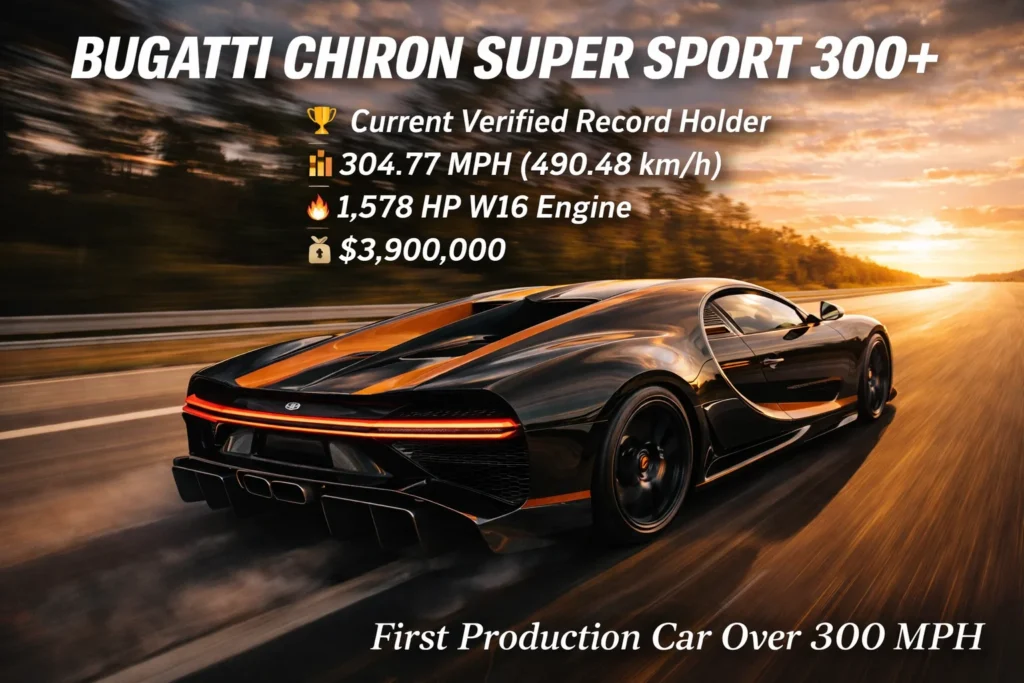
Currently, the Bugatti Chiron Super Sport 300+ holds the verified production car speed record at 304.77 mph (490.48 km/h), achieved in August 2019 at Volkswagen’s Ehra-Lessien test track in Germany. This modified version of the Chiron featured an extended body for better aerodynamics and ran on a special track long enough to reach such extreme velocities.
The Chiron Super Sport 300+ uses an 8.0-liter quad-turbocharged W16 engine producing 1,578 horsepower. The run was completed with professional race driver Andy Wallace behind the wheel. However, this record comes with an asterisk the run was completed in only one direction rather than the traditional two-way average, leading some purists to question its validity as an official record.
Koenigsegg Jesko Absolut: Designed for Ultimate Speed
The Koenigsegg Jesko Absolut represents the Swedish manufacturer’s single-minded pursuit of the highest possible top speed. Unlike the standard Jesko, which focuses on track performance with substantial downforce, the Jesko Absolut eliminates the large rear wing and features optimized aerodynamics specifically for low drag and maximum velocity.
Christian von Koenigsegg, the company’s founder, has stated that the Jesko Absolut’s theoretical top speed exceeds 330 mph (531 km/h), which would make it the fastest car ever built. This calculation is based on the car’s 1,600 horsepower (on E85 fuel), incredibly low drag coefficient of just 0.278 Cd, and optimized gearing.
The Koenigsegg Jesko Absolut features a revolutionary 9-speed Light Speed Transmission (LST) that can change gears in virtually zero time, a 5.0-liter twin-turbo V8 engine, and an aerodynamic design that reduces drag to absolute minimum levels. Every surface has been optimized for airflow, from the enclosed rear wheel fairings to the smooth underbody.
However, the Koenigsegg Jesko Absolut hasn’t attempted its theoretical top speed yet. The challenge isn’t the car’s capability it’s finding a suitable location. Test tracks long enough and safe enough for 330+ mph attempts are extremely rare, and current tire technology may not be rated for such extreme speeds over extended periods.
SSC Tuatara: The Controversial Contender
The SSC Tuatara briefly claimed the title of fastest production car with an announced speed of 316 mph in October 2020. However, this claim was met with significant skepticism from the automotive community after analysis of the video evidence suggested the speeds didn’t match the GPS data shown.
Following the controversy, SSC conducted a second attempt in January 2021, achieving a verified two-way average of 282.9 mph, with a peak speed of 286.1 mph in one direction. While impressive, this falls short of the Bugatti’s record and the company’s initial claims.
The SSC Tuatara uses a 5.9-liter twin-turbo V8 producing 1,750 horsepower on E85 fuel, making it one of the most powerful production cars ever built. Despite the controversy, the Tuatara remains an engineering marvel capable of extraordinary speeds.
Hennessey Venom F5: The American Challenger
Hennessey Performance Engineering’s Venom F5 aims squarely at the top speed crown with a claimed theoretical maximum of 311 mph. The car features a 6.6-liter twin-turbo V8 “Fury” engine producing 1,817 horsepower and is built from the ground up with speed as the primary objective.
The Venom F5 achieves its speed potential through a combination of massive power, lightweight carbon fiber construction (weighing just 2,998 pounds), and exceptional aerodynamics with a drag coefficient of 0.33. Like the Koenigsegg Jesko Absolut, the Venom F5 hasn’t attempted its theoretical maximum speed yet, though Hennessey has stated they’re committed to making the attempt.
The Fastest Cars in the World: Complete Comparison Table
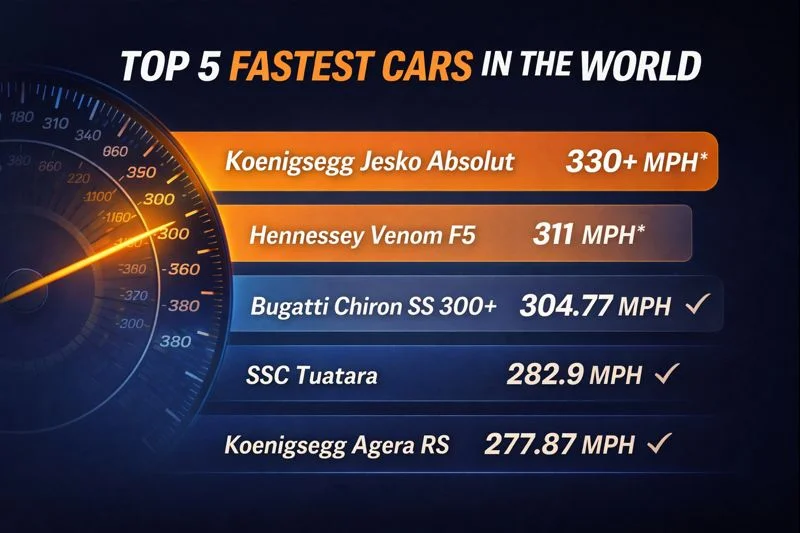
Here’s a comprehensive comparison of the fastest production cars and hypercars currently competing for the top speed title:
| Car Model | Top Speed (Verified) | Top Speed (Claimed/Theoretical) | Horsepower | Engine | Price (USD) | Production Units |
| Koenigsegg Jesko Absolut | Not yet tested | 330+ mph (531+ km/h) | 1,600 hp | 5.0L Twin-Turbo V8 | $3,000,000+ | 125 (combined with Jesko) |
| Bugatti Chiron Super Sport 300+ | 304.77 mph (490.48 km/h)* | 304+ mph | 1,578 hp | 8.0L Quad-Turbo W16 | $3,900,000 | 30 units |
| Hennessey Venom F5 | Not yet tested | 311 mph (500 km/h) | 1,817 hp | 6.6L Twin-Turbo V8 | $2,100,000 | 24 units |
| SSC Tuatara | 282.9 mph (455 km/h)** | 316 mph (disputed) | 1,750 hp | 5.9L Twin-Turbo V8 | $1,900,000 | 100 units |
| Koenigsegg Agera RS | 277.87 mph (447 km/h) | 280 mph | 1,360 hp | 5.0L Twin-Turbo V8 | $2,500,000 | 25 units (sold out) |
| Bugatti Chiron | 261 mph (420 km/h) | 261 mph (limited) | 1,479 hp | 8.0L Quad-Turbo W16 | $3,000,000 | 500 units |
| Rimac Nevera | 258 mph (412 km/h) | 258 mph | 1,914 hp | Electric (4 motors) | $2,400,000 | 150 units |
| Aston Martin Valkyrie | Not yet tested | 250+ mph | 1,160 hp | 6.5L V12 + Hybrid | $3,200,000 | 150 units |
*One-way run only, not two-way average
**Two-way verified average after controversial initial claim
Key Insights from the Comparison
Looking at this table, several important patterns emerge:
Power isn’t everything. While the Hennessey Venom F5 produces the most horsepower at 1,817, the Koenigsegg Jesko Absolut’s superior aerodynamics allow it to theoretically reach higher speeds with less power. This demonstrates that drag coefficient and weight matter as much as raw horsepower at extreme velocities.
Verification matters. The Bugatti Chiron Super Sport 300+ currently holds the only verified speed above 300 mph, though questions remain about the single-direction run. Until the Koenigsegg Jesko Absolut or Hennessey Venom F5 attempt their maximum speeds, Bugatti technically holds the crown.
Price reflects exclusivity. These hypercars cost between $1.9 million and $3.9 million, with prices reflecting not just performance but also brand prestige and production numbers. The Koenigsegg Jesko Absolut’s $3+ million price tag positions it as one of the most expensive cars ever offered for sale.
Testing challenges. Several cars on this list haven’t attempted their theoretical maximums due to practical limitations. Finding safe locations, suitable tires, and ideal conditions for 300+ mph runs presents enormous logistical and safety challenges.
Koenigsegg Jesko Absolut: Engineering Masterpiece for Ultimate Speed
The Koenigsegg Jesko Absolut deserves special attention as the car specifically engineered to achieve the highest possible top speed. Every design decision serves this single purpose, making it perhaps the purest expression of automotive velocity ever created.
Revolutionary Aerodynamics
The Koenigsegg Jesko Absolut achieves its extraordinary potential through ruthless aerodynamic optimization. With a drag coefficient of just 0.278 Cd, it’s one of the slipperiest cars ever designed. For comparison, most sports cars have drag coefficients between 0.30 and 0.35, while even efficient sedans rarely dip below 0.25.
To achieve this, Koenigsegg removed the massive rear wing found on the standard Jesko, replacing it with two small rear fins for stability. The rear wheel arches feature enclosed fairings that smooth airflow around the tires typically a major source of drag. The underbody is completely flat and optimized for minimal turbulence. Even the door mirrors have been replaced with tiny cameras to reduce frontal area.
The result is a car that slips through the air with minimal resistance, allowing its substantial power to translate directly into forward velocity rather than fighting drag.
Light Speed Transmission (LST)
One of the Koenigsegg Jesko Absolut’s most remarkable features is its revolutionary 9-speed Light Speed Transmission. This multi-clutch gearbox can change gears in essentially zero time by pre-selecting the next gear before disengaging the current one.
More importantly for top speed, the LST features what Koenigsegg calls “Ultimate Power on Demand” (UPOD). This system allows the transmission to skip gears entirely jumping from 6th to 3rd, for example enabling the engine to always operate at its power peak. For top speed runs, the closely-spaced gear ratios ensure the engine stays in its optimal power band even at 300+ mph.
Twin-Turbo V8 Power
The heart of the Koenigsegg Jesko Absolut is a 5.0-liter twin-turbocharged V8 engine producing 1,280 horsepower on regular gasoline or 1,600 horsepower on E85 biofuel. Despite its massive output, the engine weighs just 189 kilograms (417 pounds) thanks to extensive use of 3D-printed components and lightweight materials.
The engine features Koenigsegg’s patented Aircore carbon fiber intake manifold, tumble flap-deleted heads for improved flow, and a flat-plane crankshaft that allows the engine to rev to 8,500 RPM. The turbochargers themselves use a unique “tumble” design that spools incredibly quickly while producing minimal back pressure.
This combination of light weight, high power, and exceptional responsiveness gives the Koenigsegg Jesko Absolut the thrust needed to overcome aerodynamic drag at speeds where air resistance increases exponentially.
Why the Koenigsegg Jesko Absolut Hasn’t Been Tested Yet
If the Koenigsegg Jesko Absolut is theoretically capable of 330+ mph, why hasn’t it attempted this speed? Several significant challenges explain the delay:
Track availability: Very few locations in the world have straight sections long enough for 330 mph attempts. The car would need several miles just to accelerate and several more to safely decelerate. Volkswagen’s Ehra-Lessien track (where Bugatti set its record) is one of few possibilities, but it’s owned by VW Group and unlikely to be made available to competitors.
Tire technology: Current tires aren’t officially rated for sustained speeds above 300 mph. While they might survive brief runs, manufacturers won’t certify them for such extreme velocities, creating liability concerns.
Safety considerations: At 330 mph, even minor irregularities in the road surface or unexpected gusts of wind could cause catastrophic accidents. The margin for error is essentially zero.
Cost and logistics: Organizing such an attempt requires extensive planning, safety equipment, medical staff, timing officials, and ideal weather conditions. The financial and logistical investment is substantial.
Koenigsegg has stated they’re committed to attempting the record when conditions permit, but the company prioritizes safety over setting records prematurely.
Technology That Makes Extreme Speed Possible
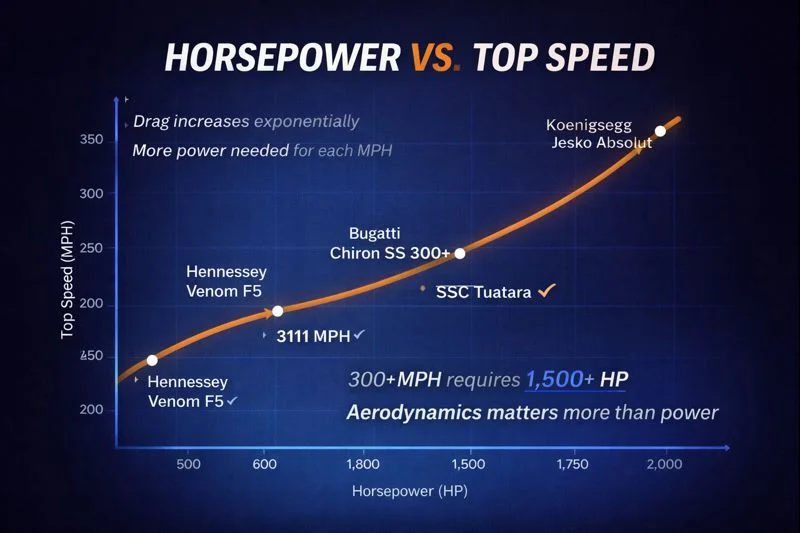
The fastest cars in the world share several key technologies that enable their extraordinary performance. Understanding these innovations helps explain what makes 300+ mph possible.
Advanced Aerodynamics
At speeds above 200 mph, aerodynamic drag becomes the dominant force resisting forward motion. Drag increases with the square of velocity, meaning doubling your speed requires four times the power to overcome air resistance. At 300 mph, virtually all engine power goes toward fighting drag rather than acceleration.
The fastest cars minimize drag through:
- Low drag coefficients (Cd values below 0.30)
- Minimal frontal area (narrow, low profile designs)
- Smooth underbodies (flat surfaces with no turbulence-creating components)
- Active aerodynamics (adjustable elements that optimize for different speeds)
- Careful detail work (every mirror, vent, and surface optimized for airflow)
Modern computational fluid dynamics (CFD) software allows manufacturers to test thousands of aerodynamic variations digitally before building physical prototypes, enabling optimization that would have been impossible even a decade ago.
Lightweight Materials
Weight matters less at top speed than during acceleration, but lighter cars still require less power to reach their maximum velocity. The fastest hypercars extensively use carbon fiber for chassis construction, body panels, and even suspension components.
The Koenigsegg Jesko Absolut’s monocoque chassis is made entirely from carbon fiber with integrated honeycomb aluminum reinforcement. This provides exceptional strength while keeping weight to just 1,280 kilograms (2,822 pounds) dry. For comparison, a standard family sedan weighs 3,000-4,000 pounds.
Advanced materials like titanium exhaust systems, carbon ceramic brakes, and even 3D-printed metal components help reduce weight further. Every kilogram saved improves the power-to-weight ratio and reduces the energy needed to overcome inertia.
Tire Technology
Perhaps the most underappreciated technology limiting top speed is tire capability. At 300 mph, tires experience incredible centrifugal forces that try to tear them apart, while friction generates extreme heat that can cause catastrophic failure.
Michelin developed special Pilot Sport Cup 2 tires for the Bugatti Chiron Super Sport 300+ record attempt. These tires feature reinforced sidewalls, special rubber compounds that resist heat, and construction techniques that maintain integrity even under extreme stress. However, these tires are essentially prototypes that cost tens of thousands of dollars and last only a few hundred miles.
The Koenigsegg Jesko Absolut will require even more advanced tires for its 330+ mph attempt. Michelin has acknowledged they’re developing new tire technology specifically for this challenge, but hasn’t announced when such tires will be available.
Advanced Stability and Control Systems
Driving at 300+ mph requires more than just powerful engines and good aerodynamics it demands sophisticated electronic systems to maintain stability and control. The Koenigsegg Jesko Absolut features:
Active suspension: Continuously adjusts damping to maintain optimal ride height and stability based on speed and road conditions.
Torque vectoring: Distributes power between rear wheels to enhance stability during acceleration and high-speed cornering.
Advanced traction control: Prevents wheelspin while allowing maximum acceleration, with special calibrations for different surfaces and speeds.
Stability management: Monitors vehicle dynamics hundreds of times per second, making micro-corrections to steering and brake balance to prevent instability.
These systems work together seamlessly, making 300+ mph runs theoretically achievable even for relatively inexperienced drivers (though manufacturers always use professionals for record attempts).
Just as these hypercars require advanced technology, proper maintenance is essential for any high-performance vehicle, similar to maintaining components like those found in powerful engines such as the Dodge Challenger engine or the sophisticated BMW M5 engine.
The Future of Top Speed: What’s Next?
The quest to build the fastest car in the world continues to push boundaries, with several manufacturers developing new contenders and technologies that could redefine extreme performance.
Electric Hypercars Enter the Arena
Electric vehicles are beginning to challenge traditional internal combustion engines in the hypercar segment. The Rimac Nevera currently tops out at 258 mph, making it the fastest electric production car. While this doesn’t compete with the top gasoline-powered hypercars yet, electric technology offers some intriguing advantages.
Electric motors provide instant maximum torque, enabling brutal acceleration. The Rimac Nevera reaches 60 mph in just 1.85 seconds faster than any gasoline car. While top speed remains limited by current battery and motor technology, future developments in power density and thermal management could enable electric hypercars to compete at 300+ mph.
However, electric vehicles face significant challenges for extreme top speeds. Battery weight reduces power-to-weight ratios, and the energy consumption at 300+ mph would drain even the largest battery packs in minutes. The cooling requirements for motors and batteries at sustained high speeds also present engineering challenges.
Hybrid Technology Advancement
Hybrid powertrains combining internal combustion engines with electric motors offer the best of both worlds the sustained power of gasoline engines with the instant torque of electric motors. The Aston Martin Valkyrie uses a 6.5-liter V12 combined with an electric motor for combined output exceeding 1,160 horsepower.
Future hypercars will likely embrace hybrid technology more extensively, using electric motors to fill in torque gaps at low RPMs while gasoline engines provide sustained power at high speeds. This combination could enable new levels of performance while also improving efficiency and reducing emissions during normal driving.
Active Aerodynamics Evolution
The next generation of hypercars will feature even more sophisticated active aerodynamics that continuously adjust for optimal performance. Instead of simple adjustable wings, future cars might feature:
- Morphing body panels that change shape based on speed and driving conditions
- Active underbody diffusers that maximize downforce or minimize drag as needed
- Adaptive cooling systems that close off airflow when not needed to reduce drag
- Intelligent brake cooling that only opens cooling ducts when brakes need airflow
These technologies will allow cars to optimize for both track performance (maximum downforce) and top speed (minimum drag) without compromise, potentially enabling a single vehicle to excel in both domains.
Will We See 350 MPH?
The question remains: will any production car eventually reach 350 mph or beyond? The physics become increasingly challenging as speeds increase. At 350 mph, air resistance is over 35% higher than at 300 mph, requiring substantially more power to overcome.
Achieving 350 mph would likely require:
- Power outputs exceeding 2,000 horsepower
- Drag coefficients below 0.25 Cd
- Weight reduction to under 2,500 pounds
- Revolutionary tire technology
- Advanced fuel systems to supply engines at extreme speeds
- Specialized testing locations with perfect surfaces
While theoretically possible, the practical challenges suggest 330-340 mph may represent the realistic upper limit for road-legal production cars with current technology. Beyond this, the costs, complexity, and safety risks may simply be too great to justify.
Owning the Fastest: What It’s Really Like
For the handful of people who can afford hypercars like the Koenigsegg Jesko Absolut, ownership involves far more than just writing a massive check. These cars represent ultimate automotive engineering but come with unique challenges and responsibilities.
The Purchase Process
Buying a Koenigsegg Jesko Absolut or similar hypercar isn’t like buying even an expensive luxury car. The process typically involves:
Application and approval: Manufacturers carefully select buyers, considering their car collections, reputation in the automotive community, and likelihood of actually driving the car rather than just storing it as an investment.
Customization: Buyers work directly with the manufacturer to specify every detail, from exterior colors to interior materials to performance options. This process can take months.
Deposit and payment: Initial deposits of $500,000 or more are common, with full payment due before delivery. Many buyers trade in previous hypercars as partial payment.
Delivery and training: Manufacturers often deliver cars personally and provide extensive training on proper operation, as these vehicles have unique characteristics that require familiarization.
Operating Costs and Maintenance
The purchase price is just the beginning. Operating costs for the fastest cars in the world are substantial:
Insurance: Annual premiums of $30,000-$50,000 are typical, with some owners paying even more depending on location and coverage levels.
Maintenance: Regular service from factory-trained technicians can cost $10,000-$20,000 annually even if nothing breaks. Major services at specific mileage intervals can exceed $50,000.
Tire replacement: Specialized tires cost $2,500-$5,000 per tire and may only last 2,500-5,000 miles depending on driving style.
Storage: Many owners keep hypercars in climate-controlled storage facilities with security, costing $500-$2,000 monthly.
Depreciation: While some limited-edition hypercars appreciate in value, most depreciate substantially in early years despite low mileage.
Following proper maintenance schedules is crucial for these machines, much like maintaining any high-performance vehicle requires attention to detail outlined in resources like a comprehensive car maintenance checklist.
Actually Driving Them
Here’s the surprising reality: most owners of the fastest cars in the world rarely drive them at even a fraction of their capability. Public roads don’t allow 300 mph driving legally anywhere, and even dedicated track days rarely provide opportunities to exceed 200 mph safely.
Many hypercar owners enjoy their vehicles more for the engineering achievement and exclusivity than actual performance. The Koenigsegg Jesko Absolut might theoretically reach 330 mph, but most examples will probably never exceed 150 mph in their entire lives.
That said, even at street-legal speeds, these cars offer extraordinary experiences. The acceleration, handling, sound, and mechanical precision make every drive special. The knowledge that you’re sitting in one of humanity’s most advanced mechanical creations adds intangible value that transcends pure performance numbers.
Conclusion
The question “what is the fastest car in the world?” doesn’t have a simple answer, but understanding the contenders reveals the incredible state of modern automotive engineering. The Bugatti Chiron Super Sport 300+ currently holds the verified production car speed record at 304.77 mph, while the Koenigsegg Jesko Absolut is theoretically capable of exceeding 330 mph once it attempts its maximum speed.
These hypercars represent the absolute pinnacle of what’s possible when cost is no object and engineering excellence is the only goal. The Koenigsegg Jesko Absolut, with its revolutionary Light Speed Transmission, exceptional aerodynamics, and pure focus on ultimate velocity, stands as perhaps the most ambitious speed machine ever conceived for road use.
Beyond the numbers and records, these vehicles showcase human ingenuity and the relentless pursuit of perfection. They push the boundaries of materials science, aerodynamics, power generation, and control systems. Even if you’ll never own or even see one in person, knowing that engineers are building 330+ mph road cars in 2025 is genuinely inspiring.
The pursuit of speed continues, with manufacturers already planning next-generation hypercars that may push boundaries even further. Whether electric, hybrid, or traditional internal combustion, the fastest cars of tomorrow will undoubtedly continue surprising us with new levels of performance. For now, the Koenigsegg Jesko Absolut stands ready to claim the crown as the fastest car in the world it just needs the right time and place to prove it.
Whether you’re fascinated by extreme performance or simply appreciate automotive excellence, the world’s fastest cars represent humanity’s endless drive to go faster, push harder, and achieve what seems impossible.
Frequently Asked Questions
-
What is the fastest car in the world right now?
The answer depends on how you define “fastest.” The Bugatti Chiron Super Sport 300+ holds the verified production car speed record at 304.77 mph (490.48 km/h), achieved in August 2019.
-
How fast is the Koenigsegg Jesko Absolut?
The Koenigsegg Jesko Absolut has a theoretical top speed exceeding 330 mph (531 km/h) according to calculations by Christian von Koenigsegg and his engineering team.
-
Why haven’t the fastest cars been tested at their maximum speeds?
Several significant challenges prevent top speed testing for the fastest cars. First, suitable test locations are extremely rare achieving 330+ mph requires several miles of perfectly smooth, straight road or track with adequate run-off areas for safety.
-
Can you legally drive 300 mph anywhere?
No, there are no public roads anywhere in the world where driving 300 mph is legal. Speed limits on the fastest highways rarely exceed 85 mph in the United States, with most countries having even lower limits.
-
How much does the Koenigsegg Jesko Absolut cost?
The Koenigsegg Jesko Absolut has a base price starting around $3,000,000 USD, though with customization options and market demand, actual transaction prices often exceed $3.5 million.