


Table of Contents
Have you ever noticed a yellow gas cap on a vehicle or seen “E85” at your local fuel station and wondered what it means? E85 gas is becoming increasingly popular among drivers looking for affordable, environmentally friendly fuel alternatives. This comprehensive guide will help you understand everything about E85 fuel, from what it is to whether your vehicle can use it.
What is E85 Fuel?
E85 fuel is a blend of gasoline and ethanol, containing approximately 51% to 83% ethanol and 15% to 49% gasoline. The “E85” name comes from the typical ethanol content of 85%, though this percentage can vary based on seasonal and regional factors. During winter months, E85 may contain less ethanol (as low as 51%) to ensure easier cold-weather starting.
Ethanol fuel is a renewable alcohol-based fuel made primarily from corn in the United States, though it can also be produced from sugarcane, wheat, and other plant materials. Unlike regular gasoline, which is entirely petroleum-based, E85 offers a more sustainable option that reduces dependence on fossil fuels.
The History of Ethanol Fuel
Ethanol has been used as a fuel source for over a century. Henry Ford originally designed the Model T to run on ethanol, gasoline, or a combination of both. However, as petroleum became more readily available and affordable, gasoline became the dominant fuel choice. The energy crisis of the 1970s renewed interest in alternative fuels, leading to the modern development of E85 and flex-fuel vehicles.
Understanding Flex Fuel and Flex Fuel Vehicles
What is Flex Fuel?
Flex fuel meaning refers to the ability of certain vehicles to run on multiple fuel types, specifically regular gasoline, E85, or any mixture of the two. A flex-fuel vehicle (FFV) has specially designed engines and fuel systems that can accommodate the different chemical properties of ethanol-blended fuels.
How to Identify a Flex Fuel Vehicle
Not sure if your car can use E85? Here are several ways to identify a flex-fuel vehicle:
- Yellow gas cap – Most flex-fuel vehicles feature a distinctive yellow fuel cap
- Owner’s manual – Check your vehicle documentation for flex-fuel capability
- Fuel door label – Look for a sticker inside the fuel door stating “E85” or “Flex Fuel”
- VIN check – Contact your dealer or check online databases using your Vehicle Identification Number
- Badging – Some vehicles have “FFV” or “Flex Fuel” badges on the exterior
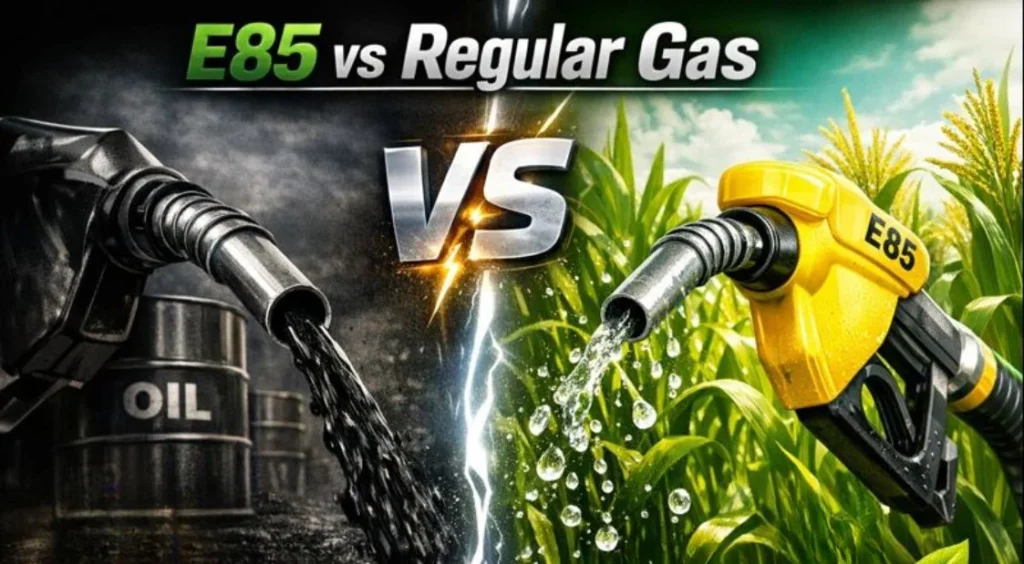
E85 vs Regular Gasoline: Key Differences
| Feature | E85 Fuel | Regular Gasoline (87 Octane) |
| Ethanol Content | 51-83% ethanol | 10-15% ethanol (E10) |
| E85 Octane Rating | 100-105 octane | 87-93 octane |
| Price per Gallon | Typically 20-30% cheaper | Higher cost per gallon |
| Energy Content | 27% less energy than gasoline | Higher energy density |
| Fuel Economy | 15-30% reduction in MPG | Standard MPG ratings |
| Environmental Impact | Lower carbon emissions | Higher carbon footprint |
| Availability | Limited stations (approx. 5,000+) | Widely available |
| Compatible Vehicles | Flex-fuel vehicles only | All gasoline vehicles |
Benefits of Using E85 Gas
Environmental Advantages
E85 petrol offers significant environmental benefits compared to traditional gasoline:
- Reduced greenhouse gas emissions – E85 can reduce carbon dioxide emissions by 30-40% compared to regular gasoline
- Renewable resource – Ethanol is made from crops that can be replanted annually
- Lower particulate emissions – Cleaner burning fuel reduces air pollution
- Decreased petroleum dependence – Supports energy independence and reduces foreign oil imports
Performance Benefits
The high E85 octane rating provides several performance advantages:
- Higher octane – With an octane rating of 100-105, E85 offers better knock resistance than premium gasoline
- Cooler combustion temperatures – Ethanol burns cooler, which can extend engine life
- Performance tuning potential – Modified vehicles can achieve significant power gains with E85
Performance vehicles equipped with LS engines or Coyote engines can benefit significantly from E85’s higher octane when properly tuned.
Economic Benefits
- Lower fuel costs – E85 is typically 20-30% cheaper per gallon than regular gasoline
- Supports domestic agriculture – Purchasing E85 supports American farmers and the agricultural economy
- Tax incentives – Some states offer tax credits or incentives for flex-fuel vehicle purchases
Drawbacks and Considerations
While E85 has many benefits, there are important considerations:
Reduced Fuel Economy
E85 contains approximately 27% less energy per gallon than gasoline, resulting in 15-30% lower fuel economy. This means you’ll need to fill up more frequently, which can offset the per-gallon savings. Understanding your vehicle’s fuel pressure regulator operation is important when running E85, as it affects fuel delivery efficiency.
Limited Availability
E85 is primarily available in the Midwest United States, where corn production is highest. Coastal regions and rural areas may have limited access to E85 stations, making it less practical for some drivers.
Cold Weather Starting Issues
Ethanol has a higher evaporation temperature than gasoline, making cold-weather starts more difficult. This is why E85 blends contain less ethanol during winter months. If you experience starting issues, checking your ignition coil can help ensure proper spark delivery.
Potential Corrosion
Ethanol is more corrosive than gasoline and can damage fuel system components in non-flex-fuel vehicles. Never use E85 in a standard gasoline vehicle, as it can cause:
- Fuel system damage
- Engine performance issues
- Voided warranties
- Costly repairs
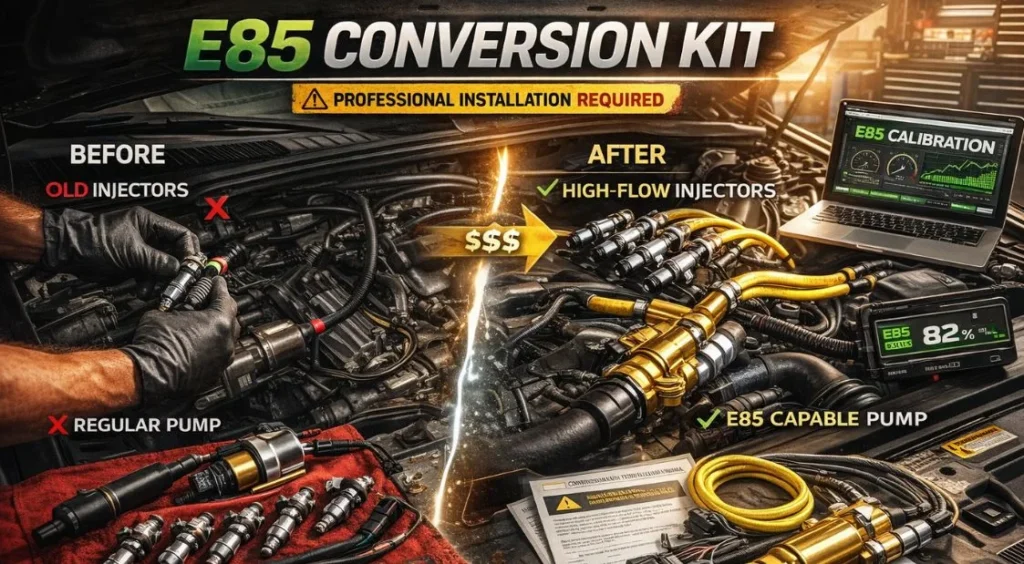
Can You Convert a Regular Vehicle to Run on E85?
E85 Conversion Kit Options
If you have a non-flex-fuel vehicle and want to use E85, an E85 conversion kit may be an option. These kits modify your fuel system to handle ethanol safely. However, before considering conversion, understand the following:
What an E85 Conversion Kit Includes:
- Modified fuel injectors with increased flow capacity
- Upgraded fuel pump to handle ethanol
- Specialized fuel lines resistant to ethanol corrosion
- Electronic control unit (ECU) tuning or piggyback system
- Ethanol content sensor
Important Considerations:
- Cost – Professional E85 conversion kits range from $500 to $3,000+
- Warranty concerns – Converting your vehicle may void manufacturer warranties
- Professional installation required – Improper installation can cause serious engine damage
- Not all vehicles are suitable – Some engines cannot be safely converted
Before investing in an E85 conversion kit, calculate whether the fuel savings justify the upfront costs and potential risks. Many enthusiasts who upgrade to performance engines like the LT1 engine or LS7 engine choose E85 conversion for the performance benefits rather than just cost savings.
How to Use E85 Fuel Properly
If you own a flex-fuel vehicle, follow these best practices:
Fueling with E85
- Verify compatibility – Confirm your vehicle is flex-fuel capable
- Find E85 stations – Use apps or websites like E85Prices.com or Alternative Fuels Data Center
- Mix at will – You can mix E85 with regular gasoline in any proportion
- Monitor performance – Track your fuel economy to understand the cost-benefit ratio
Maintenance Tips for Flex Fuel Vehicles
- Regular oil changes – Ethanol can dilute engine oil, making frequent changes important. Learn the proper oil change procedure to maintain your engine
- Inspect fuel system – Check for leaks or corrosion periodically
- Use quality fuel – Purchase E85 from reputable stations with high turnover
- Monitor fuel economy – Keep track of your MPG with different fuel blends
Understanding conventional oil change intervals becomes even more critical when running E85, as the fuel can affect oil viscosity over time.
E85 Fuel Economy Calculator
To determine if E85 makes financial sense for your situation, use this simple calculation:
Step 1: Calculate cost per mile with regular gasoline
- (Price per gallon of regular gas) ÷ (Your vehicle’s MPG with regular gas) = Cost per mile
Step 2: Calculate cost per mile with E85
- (Price per gallon of E85) ÷ (Your vehicle’s MPG with E85) = Cost per mile
Example:
- Regular gas: $3.50/gallon ÷ 25 MPG = $0.14 per mile
- E85: $2.50/gallon ÷ 20 MPG = $0.125 per mile
In this example, E85 saves approximately $0.015 per mile, or $15 for every 1,000 miles driven.
Common E85 Problems and Solutions
Engine Performance Issues
If you experience poor performance after switching to E85, several factors could be responsible. Issues like rough idling, hesitation, or reduced power often relate to improper fuel mixture or sensor problems. These symptoms are similar to those described in our guide about car shaking and check engine light issues.
Fuel System Maintenance
Regular maintenance is essential for vehicles running E85. The higher ethanol content can accelerate wear on fuel system components. Keeping up with your car maintenance checklist helps prevent costly repairs down the road.
The Future of E85 and Alternative Fuels
The future of E85 fuel depends on several factors:
- Infrastructure expansion – More E85 stations would make the fuel more practical for everyday drivers
- Agricultural advancements – New ethanol production methods using cellulosic materials could improve sustainability
- Government policies – Renewable fuel standards and incentives affect E85 adoption rates
- Vehicle technology – Continued development of flex-fuel and alternative fuel vehicles
While electric vehicles are gaining popularity, E85 remains a viable bridge technology that reduces emissions while using existing infrastructure.
Conclusion
E85 gas offers an interesting alternative to traditional gasoline, providing environmental benefits, cost savings potential, and high-octane performance for compatible vehicles. Understanding what is flex fuel and whether your vehicle can use E85 petrol is essential before making the switch.
While E85 isn’t the perfect solution for everyone—due to reduced fuel economy, limited availability, and vehicle compatibility requirements—it remains a valuable option for flex-fuel vehicle owners looking to reduce their carbon footprint and potentially save money at the pump.
Frequently Asked Questions
Can I use E85 in my regular car?
No, never use E85 in a non-flex-fuel vehicle. E85 requires specially designed fuel system components that standard vehicles lack, and using it will cause immediate damage.
Is E85 cheaper than regular gas?
E85 costs 20-30% less per gallon, but provides 15-30% worse fuel economy. The actual savings per mile are typically 5-15% depending on local prices.
What octane rating does E85 have?
E85 has an octane rating of 100-105, significantly higher than regular (87) or premium (91-93) gasoline, making it ideal for high-performance engines.
Where can I find E85 gas stations?
Use the Alternative Fuels Data Center website or apps like E85Prices.com. E85 is most common in Midwest states with high corn production.
Does E85 damage engines?
E85 does not damage flex-fuel vehicle engines. However, it will severely damage non-flex-fuel vehicle fuel systems due to ethanol’s corrosive properties.

