
Table of Contents
Does your check engine light suddenly illuminate or are you experiencing sudden downfall of power? If yes! then it is likely that you are dealing with a P0301 code. This common diagnostic trouble code affects thousands of drivers every year, but with proper knowledge and approach this can be fixed. In this guide we’ll walk you through everything you need to know about this engine code, what does it do and how to diagnose it.
What Does the P0301 Code Mean?
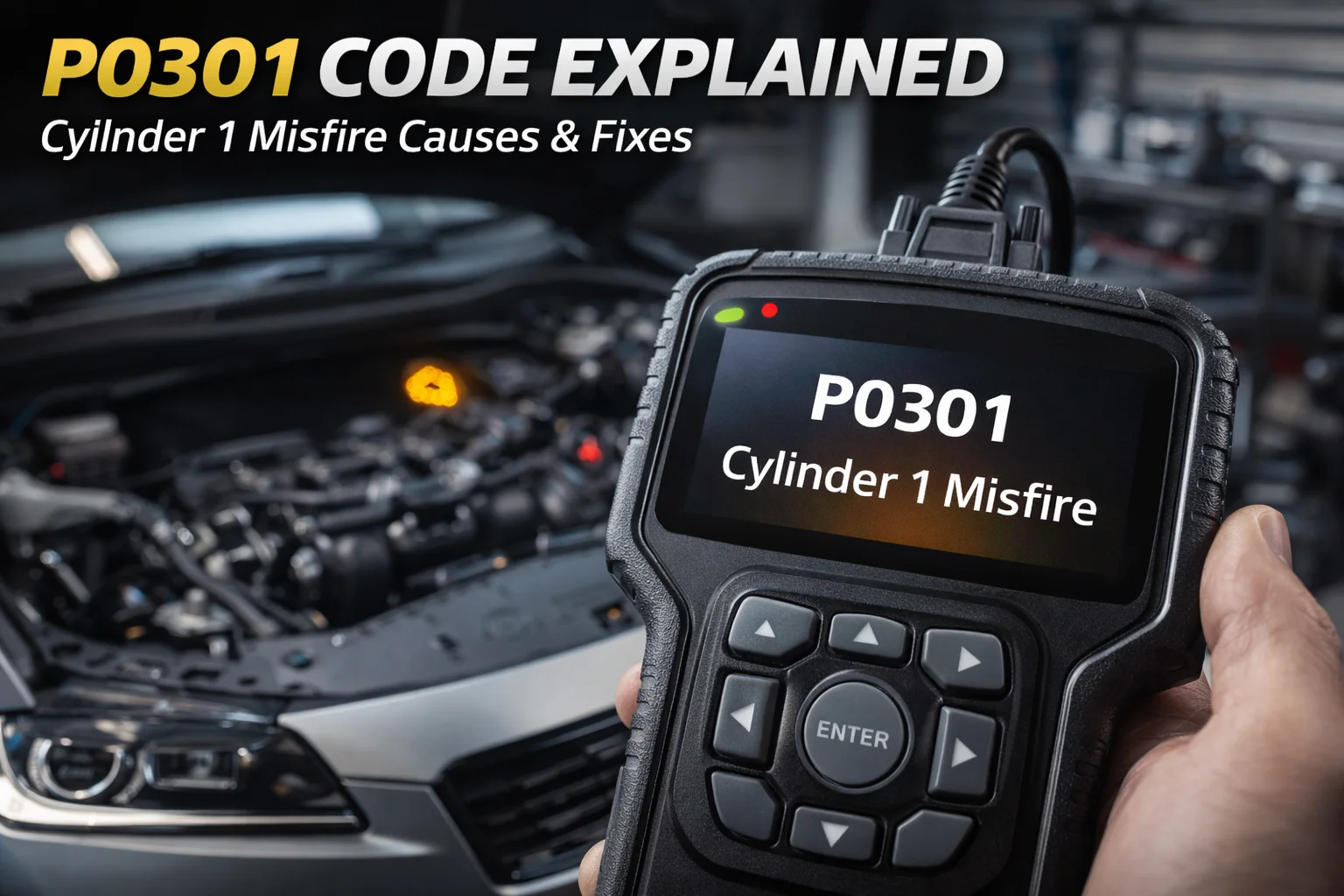
The P0301 trouble code shows that your engine’s computer system has detected a misfire in cylinder 1. This sudden misfire occurs when the combustion process fails or happens inconsistently in a specific cylinder. The P0301 engine code can illuminate the check engine light when the powertrain control module detects a misfire in cylinder 1. When ignored this warning can lead to catalytic converter damage, increased emissions and significantly higher repair cost.
| Code Component | Meaning |
| P | Powertrain-related issue |
| 0 | Generic SAE code (universal across all vehicle makes) |
| 3 | Ignition system or misfire category |
| 01 | Specific cylinder affected (cylinder 1) |
Table: Breaking down the cylinder 1 misfire code
Recognizing the Symptoms of Misfire Cylinder 1
Before your check engine light comes on, or even after, you might notice several telltale signs that point to a p0301 engine code:
- Rough or unstable idling that makes your vehicle shake while stopped
- Noticeable loss of power during acceleration
- Decreased fuel efficiency as your engine compensates for the misfire
- Difficulty starting your vehicle, especially on cold mornings
- Strong fuel smell from the exhaust due to unburned gasoline
- Engine hesitation or stuttering during normal driving
What Causes a P0301 Code?
Misfires do not occur randomly – it is normally caused by one or more underlying problems. These signs are what require understanding in order to effect a proper repair.
Ignition System Failures: The ignition system is the most important part of the code P0301. Old spark plugs, which have accumulated carbon or wrong gaps may lead to weak spark that is required to trigger combustion.
Fuel Delivery Issues: The engine should get an adequate fuel supply at the exact time. This balance is upset by a blocked or defective fuel injector in cylinder 1 which either cuts off fuel to the cylinder or causes it to overfuel. Misfires in more than one cylinder may also occur due to low fuel pressure caused by a weak fuel pump or dirty fuel filter and may include cylinder 1.
Mechanical and Compression Problems: Sometimes it is more than ignition or fuel. Low compression in cylinder 1 may be the result of loose piston rings, burnt valves, broken head gasket – improper spark and fuel delivery will never result in proper combustion. The valve timing can also be disturbed by a worn camshaft lobe in cylinder 1 to the point of producing consistent misfires.
Air Leaks and Sensor Problems: Vacuum leakage around cylinder 1 contributes to excess air which disturbs the well-measured air-fuel mixture. In the meantime, defective sensors such as mass airflow (MAF) sensor or oxygen sensors may relay wrong information to your engine computer, which in turn will result in improper fuel delivery and consequently misfires. If you’re experiencing lean condition codes alongside P0301, check our guide on P0171 code.
How to Diagnose the P0301 Code?
You can follow these steps to detect the P0301 Code:
- Start the diagnosis with a good OBD2 scanner to verify the P0301 engine code and also verify if other cylinders are also misfiring.
- When a misfire occurs only in one cylinder, then the issue is probably limited to components of that specific cylinder.
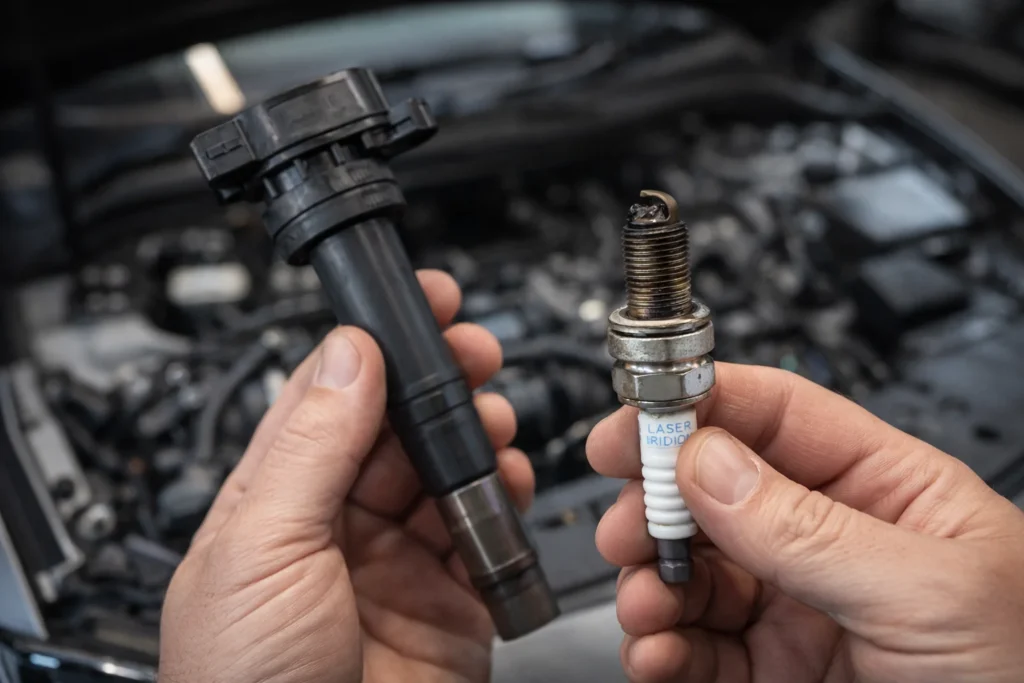
- Inspect the spark plug, ignition coil, and all the wiring which is attached to cylinder 1 visually.
- Identify the clear indications of damage such as broken insulation, oil spill, or rust.
- Take out the spark plug and look closely at it; the electrode must be tan or light gray, not black with carbon deposits or white and overrun with too lean mixture.
- When the visual inspection does not help to identify the problem, a compression test should be conducted.
- A normal cylinder will generally have 120–180 PSI with each engine and the cylinders must be within 10 percent.
- Low compression of cylinder 1 is indicative of internal mechanical damage.
Fixing the P0301 Code: Common Solutions
The right fix depends entirely on what’s causing your misfire cylinder 1. Here are the most common repairs:
For ignition problems, replace the spark plug in cylinder 1 first – it’s the most affordable fix and solves the issue in many cases. If the plug looks fine but the misfire persists, swap the ignition coil with another cylinder. If the misfire moves to the new cylinder, you’ve confirmed a bad coil. For quality replacement parts, consider our ignition coil options.
For fuel system issues, try using a quality fuel system cleaner if you suspect a dirty injector. For more serious clogs or failed injectors, professional cleaning or replacement may be necessary. Always address low fuel pressure by replacing clogged fuel filters and testing the fuel pump.
For mechanical problems, repairs can be more extensive and costly. Burned valves might require cylinder head work, while low compression from worn rings could mean an engine rebuild. These issues often develop gradually, so catching them early through regular maintenance is crucial.
Preventing Future Misfires
It is always more expensive to fix than to prevent. During the maintenance period as suggested by your manufacturer, replace spark plugs usually after every 30,000-100,000 miles, depending on the type of plugs you have. Premium fuel supplied by well-established stations is recommended to avoid injection contamination, and any signs of check engine lights should be checked early enough before small problems turn into bigger problems.
Regular oil changes are also a lightly considered way of preventing misfires. However, clean oil prevents accumulation of carbon deposits on the spark plugs and provides proper lubrication to the valve train parts which influence the performance of the cylinder.
Conclusion
It is easy to resolve a P0301 Code issue. Though the cylinder 1 misfire code is telling the user that something should be attended to, most of the causes can be easily diagnosed and corrected, especially when they are early. It can be as simple as a spark plug replacement or something greater but once you know what the P0301 code means then you have the authority to make good decisions about the work you have done on your car.
First of all, the fundamentals: Get a reliable OBD2 scanner to verify the code, then examine most common points of failure, and then proceed step by step through the possible causes. Using the right approach, your engine will be operating efficiently once again as well as you will help prevent the expensive repercussions of misfires which have been overlooked.
Frequently Asked Questions
Can bad gas cause a P0301 code?
Yes, contaminated fuel with water, debris, or incorrect octane can disrupt combustion and trigger P0301. If you recently filled up at an unfamiliar station, add quality fuel system cleaner and use premium fuel. Learn more about fuel quality and E85 gas. If the issue persists after one or two tanks, the problem likely stems from a mechanical component. Check our fuel pressure regulator guide for related issues.
What’s the difference between P0301 and P0300?
P0301 indicates a misfire in cylinder 1 specifically, making diagnosis straightforward. P0300 signals random or multiple cylinder misfires, suggesting system-wide issues like low fuel pressure or vacuum leaks requiring more comprehensive troubleshooting.
Can a P0301 code cause other codes?
Yes, persistent cylinder 1 misfires often trigger secondary codes including P0171 (system too lean), P0420 (catalytic converter efficiency), or P0351 (ignition coil circuit fault). These additional codes help pinpoint the root cause – always diagnose all stored codes together.
Should I replace all spark plugs if only cylinder 1 is misfiring?
If your spark plugs are near their service interval (30,000-100,000 miles), replacing all prevents future misfire codes and ensures consistent performance. For recently replaced plugs, you can replace just cylinder 1 to save money.
How do I know if it’s the spark plug, coil, or injector causing P0301?
Use the swap test method: swap the spark plug from cylinder 1 with another cylinder, clear codes, and run the engine. If the code changes to P0303, you’ve confirmed a bad spark plug. The same method works for ignition coils and fuel injectors. If the code stays P0301 after swapping, the problem lies with the cylinder itself.