

Table of Contents
Japanese Domestic Market (JDM) engines have built a strong reputation among car enthusiasts and performance builders in the United States. But what exactly is a JDM engine? And are JDM reliable enough for daily driving — or are they just hype from the tuner world?
In this in-depth guide, we’ll break down what a JDM actually is, how it differs from U.S.-spec engines, why they are imported, and whether buying a used JDM makes sense for your vehicle. All information is based on established automotive industry knowledge, manufacturer documentation, and regulatory guidance from trusted institutions.
What Is a JDM Engine?
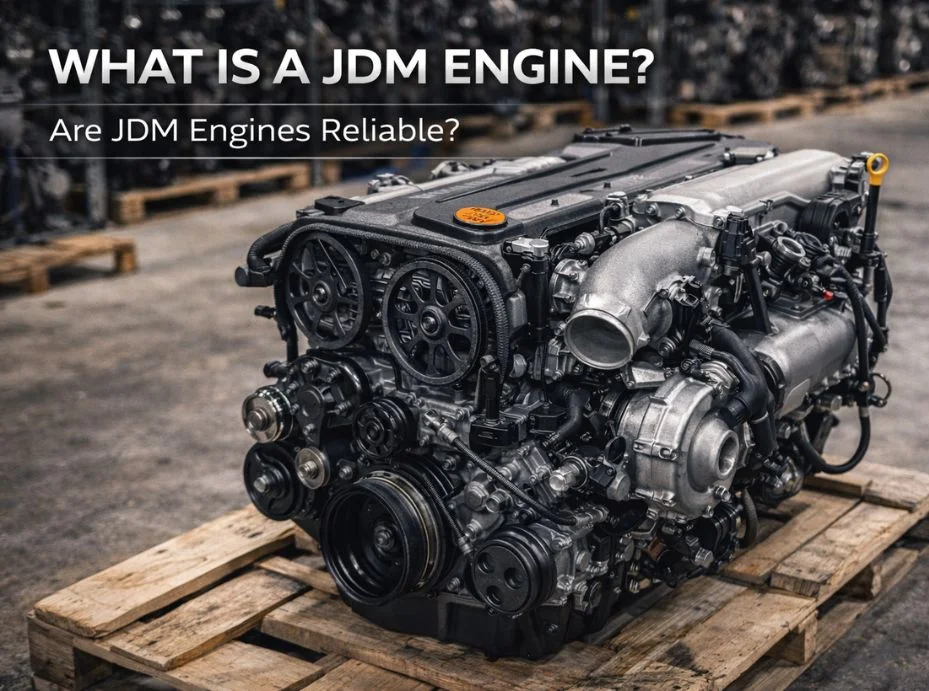
A JDM engine is one originally manufactured for vehicles sold in Japan under Japanese Domestic Market specifications. These engines were never intended for export markets such as the United States.
Japanese vehicles are subject to strict roadworthiness inspection laws known as Shaken. According to the Japan Automobile Inspection & Registration Information Association, vehicles in Japan must pass periodic inspections that become increasingly expensive as the vehicle ages. Because of these costs, many Japanese owners replace vehicles relatively early compared to U.S. ownership cycles.
As a result, engines from low-mileage vehicles are often removed and exported to countries like the United States, Canada, and Australia.
Why Are JDM Engines Imported to the U.S.?
There are three primary reasons:
1. Lower Average Mileage
Japanese drivers typically use public transportation extensively. Annual mileage tends to be lower compared to U.S. averages. That means many exported engines have fewer miles than domestic salvage yard alternatives.
2. Cost Efficiency
Replacing an engine with a JDM import can be significantly cheaper than rebuilding a severely damaged U.S. engine, depending on the application.
3. Unique Engine Variants
Some engines or trims were never officially sold in the U.S., such as certain turbocharged or high-performance variants from brands like Toyota, Nissan, and Honda.
Enthusiasts often seek JDM for performance upgrades or rare builds.
Are JDM Engines Reliable?
The short answer: Yes — when sourced properly and installed correctly.
Reliability depends on five critical factors:
- Engine condition prior to export
- Proper inspection before purchase
- Compatibility for your vehicle
- Correct installation
- Ongoing maintenance
Japanese manufacturers are globally recognized for engineering durability. Brands like Toyota and Honda consistently rank highly in long-term reliability studies conducted by organizations such as Consumer Reports.
However, an engine’s origin does not guarantee condition. Storage practices, handling, and prior maintenance history matter significantly.
Common Myths About JDM Engines
Myth 1: All JDM Engines Have 30,000–50,000 Miles
There is no universal mileage standard. While many imported engines have relatively low mileage, claims should always be verified with the supplier’s documentation.
Myth 2: JDM Engines Are Always More Powerful
Some Japanese-spec engines had higher compression ratios or different tuning due to Japan’s fuel standards. However, not all JDM versions produce more power than U.S.-spec engines.
Myth 3: Installation Is Plug-and-Play
Not always. Sensors, wiring harnesses, emissions equipment, and ECU tuning may differ between markets.
JDM vs. U.S.-Spec Engines: Key Differences
| Emissions Equipment | May differ | Designed for EPA compliance |
| OBD Systems | May vary | Fully compatible with U.S. OBD standards |
| Fuel Mapping | Tuned for Japanese fuel | Tuned for U.S. fuel |
| Mileage | Often lower | Varies widely |
The United States Environmental Protection Agency regulates emissions standards in the U.S. Swapping engines must comply with federal and state regulations.
Before installation, verify that the engine configuration meets local emissions laws.
How to Check a JDM Engine Before Buying
A responsible supplier should:
- Perform compression tests
- Provide photos or inspection reports.
- Check for sludge buildup.
- Inspect seals and gaskets.
- Verify engine code compatibility.
Look for visible rust on intake ports, damaged sensors, or cracked wiring connectors.
If you’re considering purchasing one, always buy from a reputable supplier that specializes in imported motors. You can explore a professionally inspected inventory of a used JDM engine here:
Popular JDM Engines in the U.S.
Certain engines dominate the import market:
- Toyota 2JZ-GTE
- Nissan RB26DETT
- Honda K20A
- Subaru EJ20
These engines gained popularity due to durability, aftermarket support, and performance potential.
For example, the Toyota 2JZ engine platform became widely recognized for its performance in motorsports.
Legal Considerations When Installing a JDM Engine

Engine swaps must comply with federal and state laws. In the U.S., emissions standards are governed by the United States Environmental Protection Agency.
General guidelines include:
- The engine must be the same year or newer than the vehicle.
- Must retain required emissions equipment
- Must pass state inspection
California and CARB-regulated states have stricter requirements.
Always consult local regulations before completing a swap.
Pros and Cons of JDM Engines
Advantages
- Often lower mileage
- Cost-effective replacement option
- Access to rare variants
- Strong reliability reputation
Disadvantages
- Compatibility adjustments may be needed.
- Emissions compliance challenges
- No manufacturer warranty
- Quality varies by supplier.
How Long Do JDM Engines Last?
Engine longevity depends more on maintenance than origin.
Japanese manufacturers design engines to exceed 150,000–200,000 miles with proper care. Maintenance factors include:
- Regular oil changes
- Cooling system upkeep
- Proper timing belt service
- Correct fuel grade
A well-maintained JDM can provide years of dependable service.
Should You Buy a JDM Engine?
You should consider a JDM if:
- Your current engine has catastrophic damage.
- Rebuilding costs exceed replacement costs.
- You want a performance upgrade.
- You find a verified low-mileage option.
Avoid buying if:
- The supplier cannot verify the condition.
- Engine compatibility is unclear.
- Local emissions compliance cannot be met.
Conclusion
JDM engines are not magic — but they are often a smart, cost-effective replacement solution once sourced carefully.
Japanese automotive engineering has a global reputation for durability. When you purchase from a reputable supplier, verify compatibility and follow proper installation procedures. A JDM can provide excellent long-term durability.
The key is research, inspection, and buying from trusted professionals.
Frequently Asked Questions
-
What does JDM stand for?
JDM stands for Japanese Domestic Market, referring to vehicles and parts originally manufactured for sale in Japan.
-
Are JDM legal in the U.S.?
They are legal if installed in compliance with federal and state emissions laws regulated by the EPA and local authorities.
-
Do JDM come with warranties?
Most importers provide limited startup warranties, but manufacturer warranties typically do not transfer internationally.
-
Are JDM better than rebuilt engines?
It depends. JDM may offer lower mileage, while rebuilt engines offer refreshed components. Evaluate cost, condition, and warranty.
-
Can I daily drive a JDM engine?
Yes. Many drivers use JDM for daily transportation without issues, provided installation and maintenance are done correctly.