


It can be quite stressful to drive up a hill, particularly if you are a novice driver, or if you don’t have experience with manual transmissions. One of the most useful and driver-friendly safety features to have come out of modern car design is Hill-start assist. The technology has been developed for removing the tension of reverse motion on a slope and is now offered on most manual and automatic cars, and in most vehicle segments from compact city cars to heavy duty SUVs.
A driver’s understanding of the meaning of hill start assist, its purpose, and how it works can be helpful when buying a vehicle or driving behind one. This article delves deeper into the technology, looks at some of the similar technologies and responds to the most frequently asked questions drivers have about the technology.
What Is a Hill Start Assist?
Hill start assist or hill assist control/hill hold control, are active safety systems intended to keep the vehicle from going backwards when starting from a stop at an uphill incline. Its main function is to hold the brakes to a lesser degree for a short time span when the driver lifts off the brake pedal, allowing the person to move the foot to the accelerator before the vehicle rotates backward.
So, have you ever wondered what a hill start assist does? Well, this refers to the fact that when the brake is released, the braking system is engaged for a period of about 1-3 seconds when the slope is usually greater than 3-5 degrees. In this brief instant, all that a driver has to do is press the accelerator or in a manual vehicle locate the point at which the clutch is biting and then press it again before relinquishing control to the driver.
Hill start assist works closely alongside other active safety systems already present in your vehicle. To understand how your vehicle’s braking and traction systems interact with hill start assist, our what is traction control guide provides a helpful overview of how these systems complement each other.
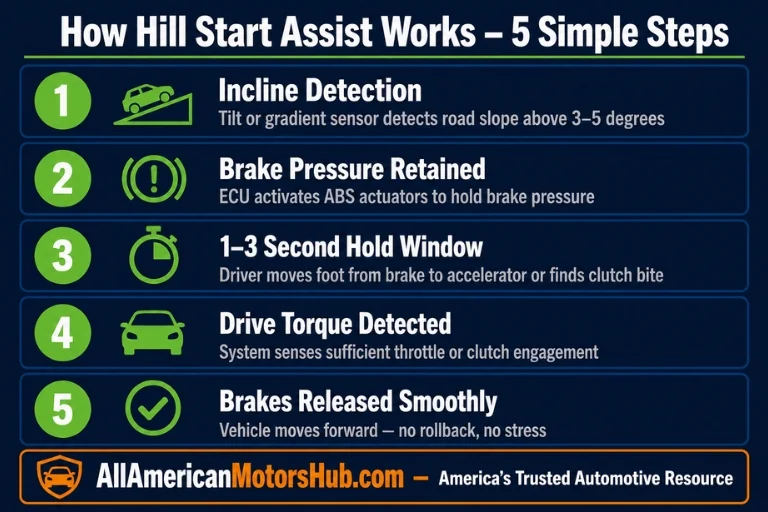
How Does the Hill Assist System Work?
The hill assist system uses a combination of sensors, the vehicle’s Electronic Control Unit (ECU) and the Anti-Lock Braking System (ABS). This is a simplified explanation of the process:
- Incline Detection: Sensors — typically a tilt or gradient sensor — senses the incline of the road surface
- Brake Pressure Retention: When the driver releases the brake on a slope, the ECU activates the ABS actuators for a short period of time to keep the brake pressure
- Throttle or clutch engagement: Holds for 1-3 seconds until the driver is able to step on the throttle (automatic) or find the clutch biting point (manual)
- System Release: When appropriate drive torque is sensed, or the hold time is up, the brakes are unlocked and the vehicle operates normally
- Slope Monitoring: In advanced hill assist systems, some of them monitor the slope continually and change the setting as needed
Hill Start Assist vs. Related Safety Systems
Understanding how hill start assist differs from other driver assistance technologies helps clarify its unique value:
| Feature | Hill Start Assist | Hill Descent Control | Electronic Stability Control |
| Primary Function | Prevents rollback on inclines | Controls speed on descents | Prevents skidding/loss of control |
| Activation | Automatic on slopes | Driver-activated | Automatic at all times |
| Terrain | Any incline | Steep off-road descents | All road surfaces |
| Braking | Temporary brake hold | Modulated braking per wheel | Individual wheel braking |
| Driver Skill Required | Minimal | Low | None |
For drivers who frequently tackle off-road terrain or steep descents alongside inclines, understanding how your drivetrain configuration affects these systems is important. Our full AWD vs FWD vs 4WD guide explains how different drivetrain setups interact with hill control technologies.
Key Benefits of Hill Start Assist
There are several advantages of Hill Start Assist. There are clear benefits for many drivers using the hill assist:
- Improved safety: No risk of inadvertent rollback on slopes, less risk of vehicles or objects behind
- Lowered driver Stress: Great for learner drivers, or steep urban roads or multi-storey car parks
- Manual Transmission Confidence: Hill start assist is useful for novice motorists learning to use the clutch in hilly areas to successfully make hill starts
- Cargo/Passenger Protection: Protecting against the unanticipated jerking or rolling that could harm the passengers or unsecured cargo
- Fuel Economy: Giving a smooth start on hills starts minimizing unnecessary engine revving, helping to achieve better fuel economy in the long run
Which Vehicles Have Hill Start Assist?
Hill start assist is now one of the most common active safety features in the automotive market. Found in common:
- Compact and midsize sedans and hatchbacks
- SUVs and crossovers, especially those that are meant to be used in light off-road conditions
- All manual transmission vehicles in all segments
- Commercial vans and light trucks
- Electric and hybrid vehicles (when regenerative braking makes things more complicated with hill management)
Hill assist control is a standard or optional feature with most of major manufacturers’ vehicles, including Toyota, Honda, Volkswagen, Ford, BMW, Mercedes-Benz, Hyundai and Kia. For many markets, it is now required as an integrated element of other active safety laws.
Whether you drive a compact sedan or a heavy-duty truck, the transmission type in your vehicle directly affects how hill start assist engages. Our AMT vs manual transmission guide explains how automated and manual gearboxes respond differently to hill control systems.
Hill Start Assist in Electric and Hybrid Vehicles
New driver-assistance technology is being introduced into electric and hybrid vehicles, such as Hill Start Assist. The hill assist function becomes more significant in electric vehicles (EVs) and hybrid cars. The transition between stationary and motion on inclines is due to the torque control and regenerative braking system used in EVs as opposed to the friction braking system used in conventional vehicles. Most modern EVs have a motor that provides instant torque to the wheels, making hill starts relatively easier, but in some instances, hill start assist is also integrated to ensure the motor never fails to provide adequate power during challenging starts, and to offer a consistent experience for the driver on all terrain gradients.
The hill assist control software is especially complex in hybrid cars, as it is required to manage the internal combustion engine and electric motor. Toyota’s Hill-start Assist Control (HAC) is a system that is specifically optimized for Toyota’s hybrid power trains to ensure smooth functioning.
Limitations and Considerations
Although hill start assist is a great safety device, there are a couple of things to keep in mind:
- Time Limit: The brakes on the system are engaged for only 1-3 seconds. This window might seem too small for drivers who are new to driving on very steep hills
- Not a Parking Aid: Hill start assist should not replace the parking brake when parking on a slope
- Sensor Dependability: The system relies on the sensors to operate. The hill assist control may be affected by problems with the tilt or ABS sensors
- Driver awareness: Drivers must not become dependent on the feature and still learn to use good hill start technique
Keeping your vehicle’s braking and sensor systems in top condition ensures hill start assist functions reliably every time. Our full car maintenance checklist covers every essential service interval to keep all of your vehicle’s active safety systems performing as intended.
Conclusion
Hill start assist is a helpful safety technology, and it has made a difference in how drivers take on inclines. The hill assist system supports you and your fellow motorists without making a lot of noise, whether you are driving up a busy urban hill or a steep car park ramp or a difficult off-road hill. Knowing about hill start assist and how it works and what hill assist does is control gives drivers confidence in how well they can use their vehicles. This is a feature you’re unlikely to want to miss out on if you’re thinking of a new car, especially if you live in a hilly area, or you’re still new to the driving game.
For drivers looking to keep any vehicle — new or high mileage — performing at its best across all terrain conditions, explore our full selection of quality used engines for sale for reliable, cost-effective replacements across all makes and models.
Frequently Asked Questions
What is hill start assist?
The hill start assist is a safety feature that allows your vehicle to stop your vehicle when it is inclined by maintaining the brake pressure. This brief pause prevents the car from rolling backward while moving your foot from the brake to the accelerator, allowing for a smooth and controlled start.
Does Hill start assist work on both manual and automatic vehicles?
Yes, Hill started to do work on both manual and automatic vehicles. It ensures your car doesn’t roll back by maintaining brake pressure for a few seconds while you move your foot from the brake to the accelerator.
Can hill hold start assist be deactivated?
Yes, hill hold start assist can be deactivated but the method might vary depending on the make, model and transmission type.
What does hill start assist mean for new drivers?
A Hill Start Assist is a safety feature in your car that allows you to temporarily hold brake pressure when you stop on an incline pathway.
Does hill start assist affect fuel consumption?
Yes, hill start assist can help you improve fuel efficiency in stop-and-go traffic on incline.

