
You bought your dream car, but it just doesn’t deliver the power and excitement you expected behind the wheel. This is one of the most common frustrations among car enthusiasts, and it almost always comes down to one fact — factory engine settings are deliberately conservative, prioritizing fuel economy, emissions compliance, and long-term reliability over raw performance. The solution that thousands of enthusiasts turn to every year is car tuning. This complete guide covers everything you need to know about tuning — what car tuning actually is, what a car tuner does, how to tune a car step by step, how much it costs, and even how to tune a car amplifier for your audio system.
What Is Car Tuning?
Car tuning is the process of adjusting and optimizing a vehicle’s engine management software — and in some cases its physical hardware — to improve performance characteristics such as horsepower, torque, throttle response, and fuel efficiency. Modern vehicles are controlled by an Engine Control Unit, commonly abbreviated as ECU, which is essentially a small onboard computer that manages every critical aspect of how your engine operates.
The ECU continuously processes data from dozens of sensors throughout the engine bay and uses that information to control fuel injection timing, ignition timing, turbocharger boost pressure, throttle response curves, and rev limiters. From the factory, manufacturers calibrate these parameters conservatively to account for varying fuel quality across different regions, extreme climate conditions, and long service intervals without warranty claims. Car tuning — also called ECU tuning, remapping, or reflashing — modifies these factory-conservative parameters to extract significantly more performance from the same engine hardware.
What Is a Car Tuner?
A car tuner refers to two related things in the automotive world, and understanding both meanings clarifies the entire tuning process. First, a car tuner can refer to the hardware device — a small interface module that physically connects to your vehicle’s OBD-II diagnostic port and allows new performance software to be uploaded directly to the ECU. Second, a car tuner can refer to the professional technician or specialist who creates and applies these performance calibrations, whether working in person at a dyno tuning shop or remotely reviewing data logs sent by the customer.
Professional car tuners use specialized software platforms to interface with a vehicle’s ECU, read its existing calibration, and write new performance parameters that unlock power the factory tune deliberately left on the table. The most experienced tuners combine deep technical knowledge of engine dynamics with real-world testing to deliver gains that are both powerful and reliable.
How Does Car Tuning Actually Work?
Understanding the mechanics behind car tuning explains why it delivers such significant performance improvements without requiring any physical engine modifications in many cases.
Reading the ECU
The tuning process begins with reading the vehicle’s existing ECU calibration — essentially downloading a complete copy of the factory software and its current parameter maps for fuel, ignition, and boost control.
Modifying the Parameters
The tuner then adjusts specific parameters within that map. On turbocharged engines, this typically means increasing boost pressure targets, advancing ignition timing within safe limits, and adjusting fuel delivery to match the increased airflow. On naturally aspirated engines, gains come primarily from optimised ignition timing curves and improved throttle mapping.
Writing the New Tune
Once the new calibration is finalised, it is written back to the ECU through the OBD-II port using a tuning interface device. This process — called flashing — typically takes only a few minutes to complete.
Data Logging and Refinement
Many tuning services, particularly remote tuning providers, require the customer to perform data logging after the initial tune is applied. This involves driving the vehicle through specific scenarios — typically wide-open-throttle pulls through multiple gears — while the ECU records detailed performance data. The tuner reviews these logs and refines the calibration to ensure the engine runs safely and optimally under real-world conditions, often requiring several rounds of adjustment before the final tune is locked in.
How to Tune a Car — Step-by-Step Methods
There are several distinct approaches to tuning a car, each suited to different goals, budgets, and technical comfort levels.
Off-the-Shelf (OTS) Tunes
OTS tunes use preset performance maps developed by the tuning company for a specific engine and a specific set of common modifications. These are the most affordable and fastest tuning options since no custom calibration work is required — the tuner has already developed and validated the map for vehicles matching your exact specification.
Custom Remote Tuning
Custom remote tuning involves a tuner building a calibration specifically tailored to your vehicle using the data logging process described above. The customer flashes an initial baseline tune, performs the requested data logs from their own driveway or a private road, and sends the data back to the tuner for review and refinement. This approach delivers more precise results than an OTS tune because it accounts for your specific vehicle’s modifications, fuel quality, and driving conditions.
Dyno Tuning
Dyno tuning takes place at a professional shop using a dynamometer — a machine that allows the vehicle’s wheels to spin freely while measuring real-time horsepower and torque output. The tuner makes live adjustments to the ECU calibration while watching the engine’s actual performance on screen, allowing extremely precise, real-time optimization. Dyno tuning is considered the gold standard for accuracy because the tuner can observe exactly how each adjustment affects performance in real time, rather than relying on data logs reviewed after the fact.
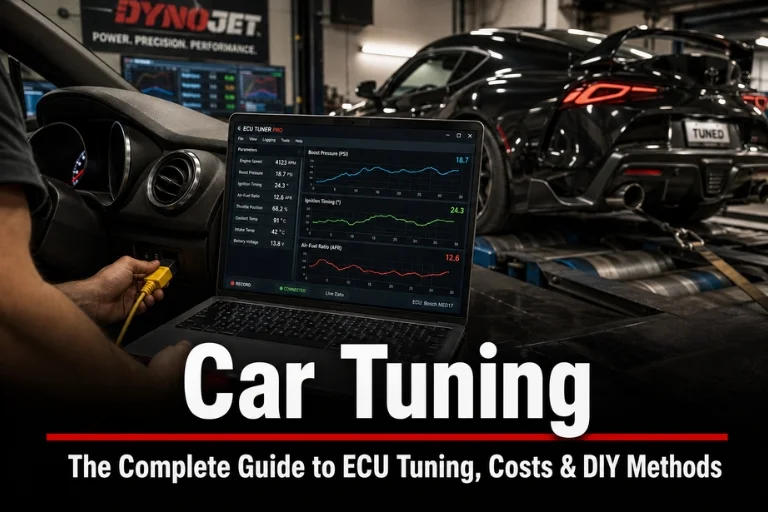
How to Tune a Car With a Laptop
For enthusiasts wanting a hands-on, do-it-yourself approach, learning how to tune a car with a laptop is entirely possible using consumer-accessible tuning software and an OBD-II interface module.
Step 1 — Acquire the Necessary Hardware
You will need a compatible OBD-II tuning interface module specific to your vehicle’s make and ECU type. These modules typically cost between $80 and $250, though some manufacturer-specific software platforms require their own proprietary interface device.
Step 2 — Choose Tuning Software
Select a tuning software platform compatible with your specific vehicle and ECU. Popular platforms include manufacturer-specific tools as well as broader aftermarket tuning suites. Licensing costs for tuning software access typically run around $600, though this varies significantly by platform and vehicle.
Step 3 — Connect the Laptop to the Vehicle
Plug the OBD-II interface module into your vehicle’s diagnostic port, typically located beneath the dashboard near the steering column, and connect it to your laptop via USB or Bluetooth depending on the module type.
Step 4 — Read the Stock Tune
Use the software to read and save a complete backup of your vehicle’s factory ECU calibration before making any changes. This backup is critical — it allows you to restore the original factory tune if anything goes wrong during the tuning process.
Step 5 — Apply an OTS Tune or Begin Custom Calibration
Beginners typically start with a validated off-the-shelf tune appropriate for their exact engine and modification level. More advanced users with engine tuning knowledge can begin adjusting individual parameters directly within the software’s tuning tables.
Step 6 — Data Log and Refine
After flashing the new tune, perform the requested data logging drives and review the results carefully. Watch closely for any signs of knock, excessive exhaust gas temperatures, or air-fuel ratios outside the safe range. Adjust accordingly or send the logs to a professional tuner for refinement if you are working with a remote tuning service.
DIY laptop tuning requires genuine technical knowledge of engine dynamics and carries real risk of engine damage if performed incorrectly. For enthusiasts without extensive tuning experience, working with a reputable professional tuner — even remotely — significantly reduces the risk of costly mistakes.
For drivers exploring how tuning interacts with their vehicle’s broader drivetrain, our internal combustion engine guide explains the fundamental engine processes that every tuning parameter ultimately affects.
How Much Does It Cost to Tune a Car?
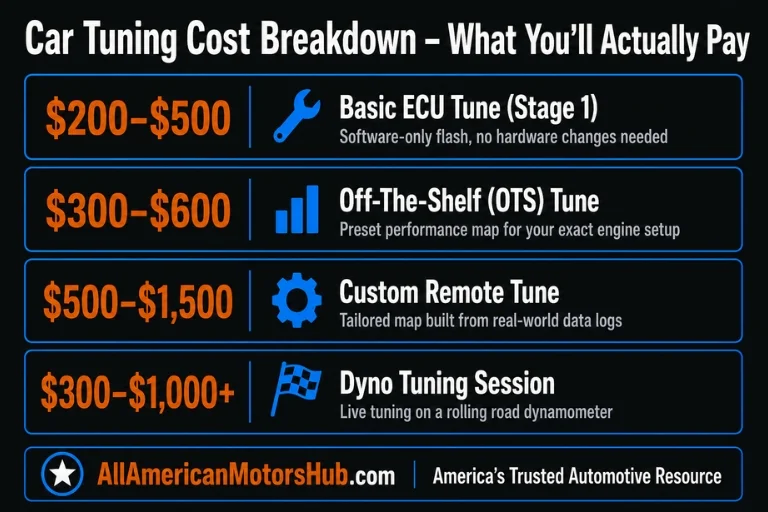
How much to tune a car varies considerably depending on the tuning method, vehicle type, and modification level. Here is a complete cost breakdown:
Basic ECU Tune (Stage 1)
A basic Stage 1 tune — requiring no supporting hardware modifications — typically costs between $200 and $500. On turbocharged platforms, this baseline tune alone can deliver 20 to 40 percent more power simply by optimizing boost targets, fueling, and ignition timing within the engine’s existing hardware limits.
Off-the-Shelf Tunes
OTS tunes for common platforms with simple bolt-on modifications typically range from $300 to $600, representing the most budget-friendly entry point into performance tuning.
Custom Remote Tuning
Custom remote tunes built specifically for your vehicle’s exact modification level typically cost between $500 and $700 for straightforward bolt-on setups. Vehicles with more significant modifications — larger turbochargers or flex-fuel conversions — can push custom tuning costs to $1,500 or $2,000.
Dyno Tuning
A dedicated dyno tuning session typically adds $300 to $600 on top of the base tuning cost, charged either as a flat rate or hourly depending on the shop. Full dyno tuning packages, including the calibration work itself, commonly range from $200 to $1,000 or more.
Hardware and Licensing Costs for DIY Tuning
For drivers tuning their own vehicle, the OBD-II tuning module hardware typically costs $80 to $250, with software licensing adding approximately $600 depending on the platform used.
Understanding these costs alongside your vehicle’s overall maintenance budget helps you plan responsibly. Our used engine price guide by car type provides helpful context for understanding component costs when planning a broader performance build.
Stage 1, Stage 2, and Beyond — Understanding Tuning Levels
Performance tuning is commonly organized into staged tiers that correspond to increasing levels of hardware modification supporting the software calibration:
Stage 1
The baseline tuning level — a pure ECU flash requiring no supporting hardware changes. On turbocharged engines, Stage 1 tunes commonly deliver 20 to 40 percent more power purely through software optimization of existing hardware capability.
Stage 2
Stage 2 tuning typically requires installing a downpipe or catback exhaust system, and sometimes an upgraded intake, to support higher power output. The ECU calibration is adjusted specifically to take advantage of the reduced exhaust restriction and improved airflow these hardware changes provide.
Stage 3 and Beyond
Higher stages introduce more significant hardware upgrades — larger turbochargers, upgraded fuel injectors, intercoolers, and supporting fuel system components — each requiring a completely custom tune to safely manage the dramatically increased airflow and fuel demands.
HigherNaturally aspirated engines without forced induction see more modest gains throughout these stages, typically in the range of 5 to 15 percent improvement, since there is no boost pressure parameter to adjust for additional power.
How to Tune a Car Amplifier
While engine tuning dominates most discussions about car tuning, audio enthusiasts often search specifically for how to tune a car amplifier — an entirely different but equally important process for anyone upgrading their vehicle’s sound system.
Step 1 — Set All Controls to Neutral
Before tuning, set the amplifier’s gain to its lowest setting, and set all crossover, bass boost, and equalizer controls to their neutral or flat positions.
Step 2 — Set Head Unit Volume Correctly
Turn your head unit’s volume to approximately 75 to 80 percent of maximum. This level represents typical listening volume without pushing the source unit into distortion territory.
Step 3 — Set the Gain Using a Test Tone
Play a test tone — typically a 0 dB reference track designed specifically for amplifier gain setting — and slowly increase the amplifier’s gain control until you hear the first signs of distortion or clipping in the speakers, then back off slightly. This ensures the amplifier receives a clean signal at maximum usable level without overdriving the speakers.
Step 4 — Set the Crossover Frequency
Adjust the high-pass or low-pass crossover settings according to your speaker and subwoofer specifications. This prevents frequencies outside each speaker’s optimal range from reaching it, protecting the components and improving overall sound clarity.
Step 5 — Fine-Tune the Bass Boost
If your amplifier includes a bass boost control, apply it sparingly. Excessive bass boost can introduce distortion and place unnecessary strain on subwoofers, particularly at higher volumes.
Step 6 — Listen and Adjust
Play a variety of music genres at normal listening volume and listen carefully for any distortion, rattling, or imbalance between frequency ranges. Make small incremental adjustments to the gain and crossover settings until the sound is clean, balanced, and free of distortion across your typical listening volume range.
Properly tuning a car amplifier protects your speakers and subwoofers from damage while ensuring you get the cleanest, most powerful sound your system is capable of producing.
Risks and Considerations of Engine Tuning
While car tuning delivers genuine performance benefits, it is important to understand the associated risks before committing to the process. Aggressive tuning that pushes ignition timing or boost pressure beyond what an engine’s hardware can safely handle risks engine knock, excessive heat buildup, and in severe cases, catastrophic engine damage. The difference between a skilled, reputable tuner and an inexperienced one can genuinely be the difference between a reliable daily driver and a damaged engine requiring expensive repair.
Tuning can also affect manufacturer warranty coverage, since most automakers consider ECU modification a voluntary alteration that may void powertrain warranty protection. Always research your specific vehicle’s warranty terms and your local emissions regulations before committing to any tuning modification, as some jurisdictions restrict or prohibit certain ECU modifications on vehicles used on public roads.
If tuning modifications have led to engine wear or damage, understanding when repair remains viable versus when replacement is the smarter choice is essential. Our when engine repair is no longer worth it guide helps you evaluate that decision with confidence.
Choosing a Reputable Car Tuner
Selecting the right car tuner is the single most important decision in the entire tuning process. Look for tuners with documented experience on your specific vehicle platform, verifiable customer reviews and dyno sheets demonstrating real results, transparent communication about the risks and limitations of your chosen modification level, and a clear data logging and refinement process rather than a one-and-done flash with no follow-up support.
Avoid tuners who promise unrealistic power gains without supporting hardware, who cannot explain what specific parameters they are adjusting and why, or who pressure you into more aggressive modifications than your vehicle’s hardware can safely support.
For drivers whose tuning journey eventually leads to a full engine swap or upgrade, our complete engine swap guide walks through everything you need to know about taking your performance build to the next level.
Conclusion
Car tuning represents one of the most cost-effective ways to unlock genuine performance gains from an engine that already sits in your driveway. Whether you choose a budget-friendly Stage 1 ECU flash, a custom remote tune built specifically for your modifications, professional dyno tuning for maximum precision, or the DIY route and learn how to tune a car with a laptop yourself, understanding what is actually happening inside your vehicle’s ECU empowers you to make informed, confident decisions about your performance build.
Choose your car tuner carefully, respect your engine’s hardware limits, and always prioritize a tuner who emphasizes safe, reliable gains over maximum numbers at any cost. For drivers building or maintaining a performance vehicle, explore our full selection of quality used engines for sale to find the reliable foundation your next build deserves.
Frequently Asked Questions
What is car tuning?
Car tuning is the process of modifying a vehicle’s engine control unit software — and sometimes its hardware — to optimize performance characteristics like horsepower, torque, throttle response, and fuel efficiency. Factory ECU settings are deliberately conservative for emissions and reliability reasons, and tuning unlocks performance the factory calibration intentionally leaves untapped.
What is a car tuner?
A ‘car tuner’ refers to either the hardware interface device that connects to your vehicle’s OBD-II port to upload new performance software or the professional technician who creates and applies these performance calibrations. Both meanings are commonly used interchangeably in automotive enthusiast communities.
How do you tune a car?
Tuning a car involves reading the vehicle’s existing ECU calibration, modifying parameters like fuel delivery, ignition timing, and boost pressure, writing the new tune back to the ECU through an OBD-II interface, and then data logging real-world driving performance to refine the calibration for safety and reliability.
How much does it cost to tune a car?
Basic Stage 1 ECU tuning typically costs $200 to $500. Off-the-shelf tunes range from $300 to $600. Custom remote tuning for bolt-on modifications runs $500 to $700, rising to $1,500 to $2,000 for more significant modifications. Dyno tuning sessions typically add $300 to $600 on top of the base tuning cost.
How do you tune a car with a laptop?
Tuning a car with a laptop requires a compatible OBD-II tuning interface module, tuning software licensed for your specific vehicle, and the technical knowledge to read the stock ECU calibration, apply a new tune, and data log the results for refinement. Always back up the factory tune before making any changes in case you need to restore it.
How much horsepower can you gain from tuning a car?
On turbocharged engines, a basic Stage 1 ECU tune commonly delivers 20 to 40 percent more horsepower purely through software optimization. Naturally aspirated engines see more modest gains, typically in the 5 to 15 percent range, since there is no boost pressure parameter available to adjust for additional power.
How do you tune a car amplifier?
Tuning a car amplifier involves setting the gain to its lowest level, setting the head unit volume to roughly 75 to 80 percent, playing a reference test tone while slowly increasing the gain until distortion appears and then backing off slightly, setting the crossover frequencies to match your speaker specifications, and fine-tuning bass boost sparingly to avoid distortion and speaker strain.
Does tuning a car void the warranty?
In most cases, yes. Manufacturers typically consider ECU modification a voluntary alteration that can void powertrain warranty coverage, particularly for any engine damage that can be traced back to the tune. Always review your vehicle’s specific warranty terms before tuning, and be aware that some jurisdictions also restrict ECU modifications on emissions-controlled, street-legal vehicles.