
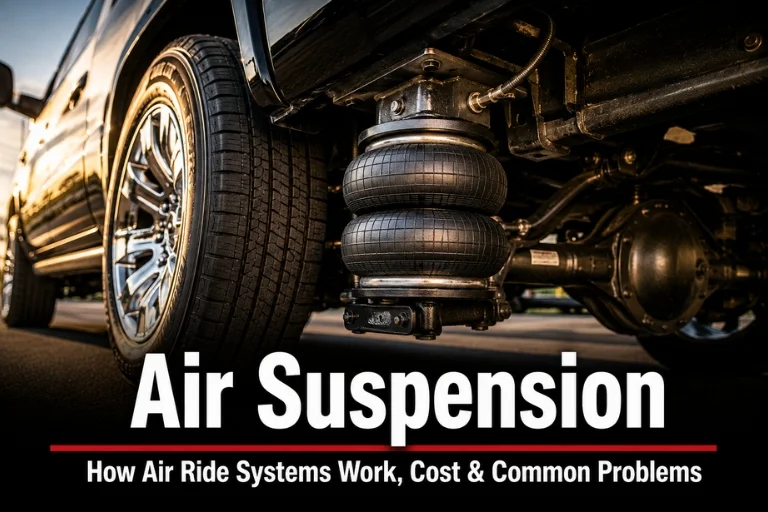

For decades, traditional coil and leaf spring suspensions were the only option available to drivers, offering a fixed, unchanging ride character regardless of road conditions, cargo load, or driver preference. Air suspension changed that completely. By replacing rigid metal springs with pressurized air-filled chambers, this technology gives drivers the ability to adjust ride height, stiffness, and comfort on demand — transforming everything from luxury sedans to heavy-duty pickup trucks. This complete guide covers everything you need to know about air suspension — what it is, how the air ride system actually works, its components, common problems, repair costs, and which vehicles offer it from the factory.
What Is Air Suspension?
Air suspension is a type of vehicle suspension system that uses air-filled chambers — commonly called air suspension air bags” or “air springs — to replace the traditional coil or leaf springs found in conventional suspension setups. Rather than relying on fixed metal springs that compress and rebound at a predetermined rate, air suspension uses pressurized air to support the vehicle’s weight, allowing the ride height and firmness to be adjusted dynamically while the vehicle is in motion or parked.
The air bags suspension components are typically constructed from reinforced rubber material similar to what is used in tire manufacturing, giving them the durability and flexibility needed to withstand constant inflation and deflation cycles across the vehicle’s lifetime. This technology is also widely known by several alternative names — pneumatic suspension, air ride suspension, or simply air ride — all referring to the same fundamental approach to vehicle support.
How Does Air Ride Suspension Work?
Modern air suspension systems are fully electronic, integrating a network of sensors, a central control module, an air compressor, and the air springs themselves into a coordinated, self-adjusting system. Understanding the step-by-step process reveals why this technology delivers such a dramatically different ride experience compared to traditional springs.
Height Sensors
Height sensors are positioned at each wheel and continuously monitor the vehicle’s ride height in real time. These sensors detect even minor changes caused by additional passenger weight, cargo loading, road surface changes, or cornering forces, and they transmit this data continuously to the system’s central control module.
Computer Processing
The Electronic Control Air Suspension module — commonly abbreviated as ECAS — receives the incoming sensor data and calculates the precise adjustments needed to maintain the target ride height and stiffness setting selected by the driver or determined automatically by the system’s programming.
Air Compressor
The air compressor pressurizes air and stores it in an onboard air tank or reservoir, ready to be distributed to wherever the system determines it is needed. The compressor activates automatically whenever the reservoir pressure drops below the system’s minimum operating threshold, keeping the tank topped up at all times.
Manifold and Valve Control
A central manifold containing solenoid valves directs the flow of pressurized air to specific corners of the vehicle based on commands from the control module. Adding air to a specific air spring raises that corner of the vehicle, while releasing air through the valve lowers it — allowing each corner to be adjusted independently for precise leveling.
Air Springs
The air springs themselves — the rubber bellows mounted at each wheel — inflate or deflate based on the air delivered through the manifold, physically raising or lowering the vehicle and absorbing road impacts through the compressed air inside them, much like a cushion of air rather than a rigid metal coil.
This entire process happens continuously and automatically, allowing the vehicle to maintain consistent ride height and handling characteristics regardless of changing loads or road conditions — something a traditional spring system simply cannot replicate.
Key Components of an Air Suspension System
A complete air suspension system relies on several interconnected parts working together. Understanding each component helps you recognize symptoms when something goes wrong and communicate more effectively with a repair technician.
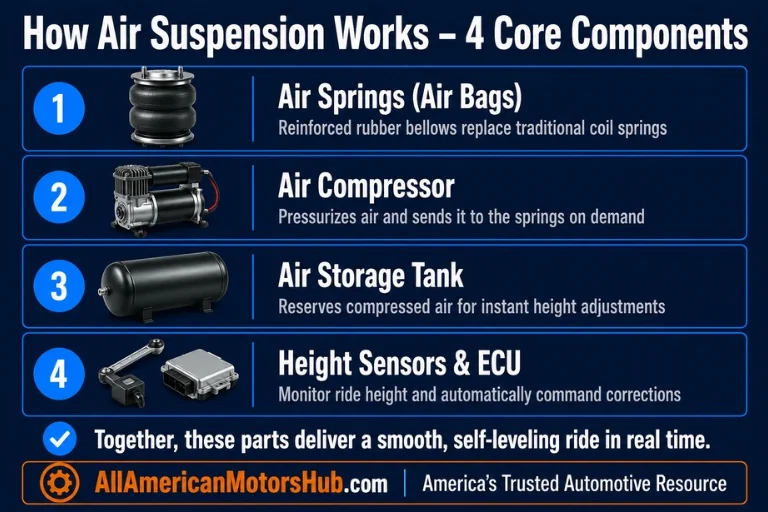
Air Springs (Air Bags)
These flexible rubber bellows replace the traditional coil or leaf springs entirely, inflating or deflating to support the vehicle’s weight and absorb road vibrations. The more air pressure inside the spring, the firmer and higher the ride.
Air Compressor
Often described as the heart of the entire system, the compressor is a small electric pump — typically mounted near the frame, trunk, or engine bay — that generates pressurized air on demand to keep the air springs properly inflated.
Air Storage Tank
The reservoir tank stores excess compressed air for immediate use, allowing the system to make quick height adjustments without waiting for the compressor to generate fresh pressure on the spot. A larger tank provides more reserve air for repeated lifting and lowering cycles.
Air Delivery Lines
Flexible hoses carry pressurized air between the compressor, the storage tank, the manifold, and each individual air spring throughout the vehicle.
Solenoid Valves and Manifold
These components regulate exactly how much air flows to each corner of the vehicle, allowing independent height and firmness adjustment at each wheel rather than uniform adjustment across the entire vehicle.
Control Module (ECU)
The electronic control unit monitors the entire system continuously, processes height sensor data, and commands the compressor and valves to make the precise adjustments needed to maintain the target ride characteristics at all times.
For drivers exploring how their vehicle’s suspension interacts with overall handling and stability, our what is traction control guide explains how suspension performance and traction management systems work together to deliver a controlled, predictable ride.
Benefits of Air Suspension
Air suspension delivers a meaningfully different driving experience compared to traditional springs, and the benefits extend well beyond simple ride height adjustment.
Adjustable Ride Height
The single most distinctive benefit of air suspension is the ability to raise or lower the vehicle at the push of a button — useful for clearing rough terrain, improving aerodynamics at highway speed by lowering automatically, or achieving a specific stance for show vehicles.
Superior Ride Comfort
Air springs absorb road imperfections more effectively than rigid metal coils, delivering a noticeably smoother ride over bumps, potholes, and uneven pavement — a key reason luxury automakers favor this technology in their flagship models.
Improved Load-Carrying Capacity
Air suspension automatically compensates for additional weight from passengers or cargo, maintaining consistent ride height and handling characteristics even when a vehicle is heavily loaded — a significant advantage for trucks and vehicles used for towing.
Better Handling and Stability
A properly maintained air suspension system provides better stability and control, particularly at higher speeds, by allowing the system to actively adjust firmness based on driving conditions in real time.
Customizable Ride Feel
Many systems allow drivers to select between comfort-oriented and performance-oriented ride settings, adjusting both height and firmness to match the driving scenario — something a fixed coil spring simply cannot offer.
Cars With Air Suspension — Which Vehicles Offer It
Air suspension has become increasingly common across the automotive industry over the past two decades, moving from an exclusively luxury feature to a more widely available option across multiple vehicle segments.
Luxury Sedans and SUVs
Air suspension is most commonly associated with luxury vehicles, where it is frequently offered as standard equipment or a premium option. Brands including Mercedes-Benz, BMW, Audi, Land Rover, Cadillac, and Lincoln have offered factory air suspension systems across multiple model lines for years, valuing the comfort and adjustability it provides to premium buyers.
Pickup Trucks and Heavy-Duty Vehicles
Air suspension is increasingly popular among pickup truck owners and commercial vehicle operators because of its load-leveling capability. Trucks equipped with air suspension can automatically compensate for heavy towing loads, maintaining proper ride height and headlight aim regardless of trailer weight.
Aftermarket Air Ride Installations
Beyond factory-equipped vehicles, automatic air suspension has become a popular aftermarket modification among car enthusiasts who want adjustable ride height for both show purposes and daily driving comfort. Established aftermarket brands offer complete air ride kits that can be installed on a wide range of vehicles not originally equipped with the technology from the factory.
If you are researching engine and drivetrain components alongside a suspension upgrade, our internal combustion engine guide provides helpful context on how your vehicle’s broader mechanical systems work together to deliver overall performance.
Common Air Suspension Problems and Warning Signs
Like any complex mechanical and electronic system, air suspension components wear over time and can develop issues. Recognizing the warning signs early helps prevent minor problems from escalating into expensive repairs.
Vehicle Sagging on One Side
If one corner or side of the vehicle consistently sits lower than the others, this typically indicates an air leak in that specific spring or a failing height sensor providing inaccurate data to the control module.
Bouncy or Rough Ride
A noticeably bouncier ride than usual often signals that an air spring has lost pressure or that the compressor is struggling to maintain adequate system pressure.
Slow to Rise or Failure to Adjust
If the vehicle takes noticeably longer than normal to reach its target ride height, or fails to raise at all, the compressor may be failing, an air line may be leaking, or a valve in the manifold may be stuck.
Unusual Noises
Hissing sounds typically indicate an air leak somewhere in the system — at a spring, a line connection, or a valve. Clunking or knocking noises often point toward worn mounting components or a failing strut assembly within the air spring housing.
Uneven Tire Wear
When air suspension fails to maintain consistent ride height and alignment geometry, the resulting changes in suspension geometry can cause accelerated and uneven tire wear over time.
Warning Light or Error Message
Most modern air suspension systems include dashboard warning indicators that illuminate when the control module detects a system fault, low pressure condition, or sensor malfunction.
Air Suspension Repair Cost — What to Expect
Air suspension repair costs vary considerably depending on which component has failed, your vehicle’s make and model, and whether you choose OEM or aftermarket replacement parts. Understanding the typical cost ranges helps you budget appropriately and recognize a fair quote when you receive one.
Ride Height Sensor Replacement
Replacing a single ride height sensor typically costs around $450, making it one of the more affordable air suspension repairs when caught early.
Air Spring Replacement
A single air spring replacement typically ranges from $800 to $2,500 including parts and labor. Since springs on opposite corners often wear at a similar rate, replacing both sides simultaneously is common and can bring the total cost to between $1,500 and $4,500.
Air Compressor Replacement
Compressor replacement is one of the more expensive and technically demanding air suspension repairs, often requiring specialized diagnostic equipment to confirm failure and careful electrical and pneumatic work to complete correctly. This repair is generally not recommended as a DIY project unless you have advanced mechanical skills and access to a factory service manual.
Full System Repair
Repairing an air suspension system across all four corners — addressing the air springs, compressor, control module, and sensors together — can reach $5,000 or more on luxury vehicles with fully independent four-corner systems. For drivers facing this level of cost, converting to a traditional coilover suspension setup is sometimes a more economical long-term alternative, offering proven durability at a fraction of the air suspension repair cost.
General Suspension Repair Range
Across all suspension types, repairs typically range from $150 for minor component replacement to over $1,200 per wheel for complex strut assemblies, with luxury air suspension repairs frequently exceeding $2,000 for combined component failures.
If your vehicle’s overall maintenance budget needs careful planning around major repairs like air suspension, our comprehensive car maintenance checklist helps you stay ahead of developing issues across every system in your vehicle.
Automatic Air Suspension — Self-Leveling Technology Explained
Automatic air suspension takes the core air ride concept a step further by removing manual driver input from the height adjustment process almost entirely. Rather than requiring the driver to select a height setting, automatic systems continuously monitor vehicle load, speed, and road conditions, making real-time adjustments without any driver intervention.
This is particularly valuable in two common scenarios. First, automatic load leveling allows a vehicle to maintain consistent ride height regardless of how many passengers or how much cargo weight is loaded — critical for maintaining proper headlight alignment, handling characteristics, and braking performance when a vehicle is heavily loaded. Second, automatic speed-sensitive height adjustment allows many luxury vehicles to lower themselves slightly at highway speeds to improve aerodynamic efficiency and high-speed stability, then return to normal height at lower speeds for improved ground clearance.
Many modern systems also include selectable terrain modes that adjust both ride height and suspension firmness based on the driving environment — raising the vehicle for off-road clearance, lowering it for sport-oriented handling, or maintaining a balanced comfort setting for everyday driving.
Air Suspension Maintenance Tips
Proper maintenance significantly extends the service life of any air suspension system and helps avoid the most expensive repair scenarios.
Inspect Air Lines Regularly
Periodically check air delivery lines for cracks, abrasion, or loose connections, particularly in areas exposed to road debris and temperature extremes.
Address Small Leaks Immediately
A minor hissing sound or slow sag should never be ignored. Small leaks force the compressor to run more frequently, accelerating wear on the compressor itself and increasing the risk of a much larger, more expensive failure down the line.
Keep the System Clean
Road salt, debris, and moisture accelerate corrosion on metal fittings and valve components. Regular underbody cleaning, particularly in regions that use road salt during winter months, helps protect air suspension components from premature failure.
Monitor Compressor Cycle Frequency
If you notice the compressor running more frequently than it used to, this is often an early indicator of a developing leak somewhere in the system, even before any visible sagging or warning lights appear.
Schedule Professional Inspections
Given the complexity and safety-critical nature of air suspension systems, periodic professional inspection — particularly as the vehicle ages past five to seven years — helps catch developing issues before they result in a complete system failure or unsafe handling characteristics.
Conclusion
Air suspension represents one of the most significant advances in vehicle ride technology over traditional coil and leaf spring systems, offering adjustable ride height, superior comfort, automatic load compensation, and a genuinely customizable driving experience. Whether you are driving a luxury sedan with factory air ride, a heavy-duty truck using automatic air suspension for towing stability, or considering an aftermarket air ride installation for your own vehicle, understanding how the system works — and recognizing the early warning signs of component failure — protects you from the kind of expensive, escalating repair costs that catch unprepared owners off guard.
For drivers managing the broader costs of vehicle ownership alongside suspension maintenance, explore our full selection of quality used engines for sale and used transmissions for reliable, cost-effective replacements across all makes and models.
Frequently Asked Questions
What is air suspension?
Air suspension is a type of vehicle suspension system that uses pressurized air-filled chambers, known as air springs or air bags, in place of traditional coil or leaf springs. The system allows ride height and firmness to be adjusted dynamically using an air compressor, storage tank, and electronic control module, providing a more comfortable and adaptable ride compared to fixed metal springs.
How does air ride suspension work?
Air ride suspension works through a coordinated system of height sensors, an electronic control module, an air compressor, and air springs at each wheel. Height sensors continuously monitor ride height and send data to the control module, which calculates the needed adjustments and commands the compressor and valves to add or release air from specific springs, raising or lowering each corner of the vehicle as needed.
What are air suspension airbags made of?
Air suspension airbags, also called air springs, are typically constructed from reinforced rubber material similar to tire rubber. This material is chosen for its durability and resilience, allowing the springs to withstand thousands of inflation and deflation cycles throughout the vehicle’s service life while maintaining an airtight seal.
How much does air suspension repair cost?
Air suspension repair costs vary by component. Ride height sensor replacement typically costs around $450. A single air spring replacement ranges from $800 to $2,500, while replacing springs on both sides can reach $1,500 to $4,500. Air compressor replacement is among the more expensive repairs, and a complete four-corner system repair on a luxury vehicle can reach $5,000 or more.
What cars have air suspension?
Air suspension is most commonly found in luxury vehicles from brands including Mercedes-Benz, BMW, Audi, Land Rover, Cadillac, and Lincoln, where it is often standard or available as a premium option. It is also increasingly common in heavy-duty pickup trucks for load-leveling purposes and is a popular aftermarket modification for enthusiasts seeking adjustable ride height on vehicles not originally equipped with the system.
What is automatic air suspension?
Automatic air suspension is a self-leveling system that continuously adjusts ride height and firmness without requiring manual driver input. It compensates automatically for changes in passenger or cargo weight and, in many vehicles, also lowers the body slightly at highway speeds to improve aerodynamics before returning to normal height at lower speeds.
What are the warning signs of failing air suspension?
Common warning signs include the vehicle sagging on one side, a noticeably bouncier ride, the vehicle taking longer than normal to reach its target height or failing to rise at all, hissing or clunking noises, uneven tire wear, and dashboard warning lights related to the suspension system. Any of these symptoms warrants prompt inspection to prevent more expensive damage.
Is air suspension worth the repair cost compared to converting to coilovers?
For many owners facing a full air suspension system failure costing $5,000 or more, converting to a traditional coilover suspension setup can be a more economical long-term option. Coilovers are mechanically simpler, generally more durable over time, and significantly less expensive to repair, though they sacrifice the adjustable ride height and automatic load-leveling capability that makes air suspension appealing in the first place.

