
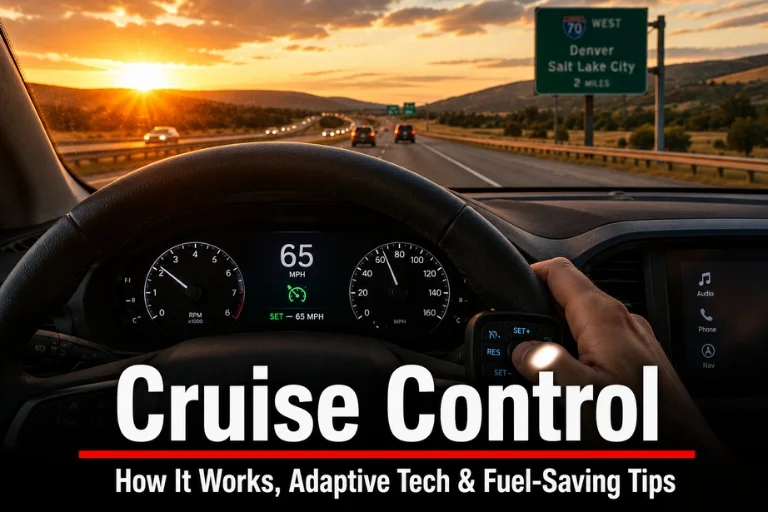

Long highway drives can wear down even the most attentive driver, and constantly modulating the gas pedal over hundreds of miles adds unnecessary fatigue to any road trip. Cruise control was invented to solve exactly that problem, and decades later it remains one of the most useful and underappreciated features in any modern vehicle. Whether you are a brand-new driver still learning the basics or a seasoned road-tripper wondering whether the newer adaptive systems are worth using, this complete guide explains what cruise control is, how it works, what adaptive cruise control adds to the equation, whether it actually saves gas, and exactly how to use it correctly every time you drive.
What Is Cruise Control?
What is cruise control, exactly? At its core, cruise control is a driver-assistance feature that automatically maintains a vehicle at a constant speed set by the driver, without requiring continuous pressure on the accelerator pedal. Once activated and set to a target speed, the system takes over throttle control entirely, holding the vehicle within a narrow speed band — typically within about one mile per hour of the chosen setting — until the driver brakes, accelerates manually, or switches the system off.
The purpose of cruise control is to make long drives smoother, more comfortable, and significantly less tiring. Instead of constantly adjusting foot pressure to maintain a consistent speed over hours of highway driving, the driver can rest their foot and focus more fully on steering and monitoring traffic. This single feature has become one of the most valued comfort technologies in the history of the automobile, found in some form on the vast majority of vehicles sold today.
What Does Cruise Control Do? — The Core Function Explained
So what does cruise control do at a mechanical level? The system connects to the vehicle’s throttle control — either through a mechanical cable on older vehicles or, far more commonly today, through an electronic throttle control module on modern vehicles. When the driver presses the “set” button at their desired speed, the cruise control module records that speed and continuously compares it against the vehicle’s actual speed using input from the speed sensor.
If the vehicle begins to drift below the set speed — for example, while climbing a hill — the system automatically increases throttle input to compensate. If the vehicle exceeds the set speed — for example, while descending a grade — the system reduces throttle accordingly. This continuous, automated correction is what allows cruise control to hold a steady speed far more precisely than most human drivers can manage manually over an extended period.
How Does Cruise Control Work? — Behind the Scenes
Understanding how cruise control works requires looking at the three core components working together inside every modern system.
The Control Switch
Typically mounted on the steering wheel, the control switch allows the driver to activate the system, set the desired speed, increase or decrease that speed in small increments, resume a previously set speed, and cancel the system entirely.
The Speed Sensor
The vehicle’s speed sensor — typically integrated with the transmission output shaft or wheel speed sensors — continuously reports actual vehicle speed to the cruise control module multiple times per second.
The Control Module and Throttle Actuator
The cruise control module compares the actual speed reported by the sensor against the target speed set by the driver. Based on any difference between the two, it sends commands to the throttle actuator, which physically adjusts the throttle position to speed up or slow down the vehicle as needed, all without any driver input on the accelerator pedal.
This closed-loop feedback system — sensor, module, actuator, repeat — operates continuously while cruise control is engaged, making micro-adjustments far more frequently than a human driver typically would while manually maintaining speed.
What Is Adaptive Cruise Control?
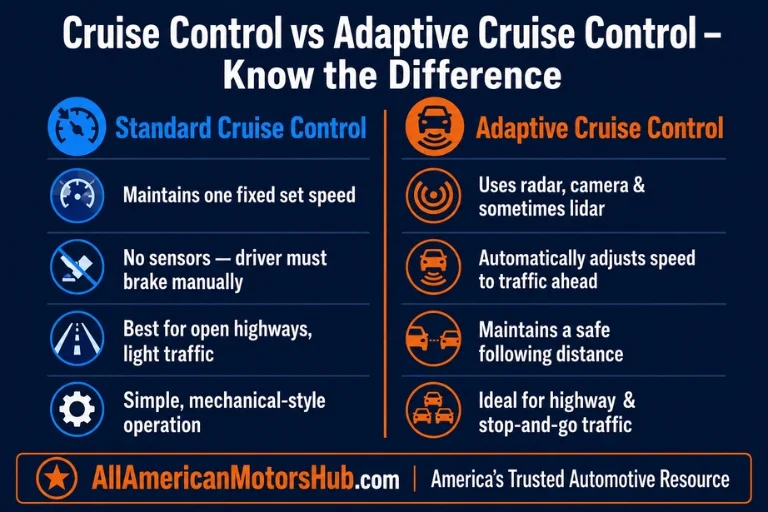
What is adaptive cruise control, and how is it different from the standard system described above? Adaptive cruise control — commonly abbreviated as ACC — takes the basic cruise control concept and adds an entirely new layer of intelligence: the ability to automatically adjust speed based on the vehicles around you, not just maintain a single fixed speed regardless of traffic conditions.
Adaptive cruise control relies on a combination of radar sensors positioned at the front of the vehicle, forward-facing cameras, and in some systems, lidar sensors to continuously detect the distance and speed of the vehicle traveling ahead. When the vehicle in front slows down, your adaptive cruise control system automatically reduces your speed to maintain a safe following distance. When that vehicle speeds up or moves out of your lane, the system automatically accelerates back toward your originally set cruising speed, all without any input from the driver.
This represents a genuine leap forward from traditional cruise control, which simply holds one fixed speed and requires the driver to brake manually the moment traffic ahead slows down. Adaptive cruise control significantly reduces the mental workload of highway driving, particularly in moderate traffic conditions where speeds fluctuate frequently.
Dynamic Cruise Control — Is It the Same as Adaptive?
Many drivers searching for information also come across the term dynamic cruise control and wonder how it differs from adaptive cruise control. In practice, dynamic cruise control is simply an alternative name used by certain automakers — most notably within the Toyota and Lexus lineup, where it is officially branded as Dynamic Radar Cruise Control — for the same fundamental radar-based adaptive technology described above.
Regardless of the specific brand name used by a given manufacturer, the underlying function remains consistent: sensors detect the vehicle ahead, the system calculates safe following distance, and throttle and braking are automatically adjusted to maintain that distance while still respecting the driver’s originally set maximum cruising speed.
How to Use Cruise Control — Step-by-Step Instructions
Learning how to use cruise control correctly takes only a few minutes, though the exact button layout varies slightly between manufacturers. Here is the general process that applies to the vast majority of modern vehicles:
Step 1 — Reach Your Desired Speed
Accelerate manually to the speed you want to maintain, typically on a highway or open road with light to moderate traffic.
Step 2 — Activate the System
Press the main cruise control “on” button, usually located on the steering wheel, to enable the system and prepare it to accept a set speed.
Step 3 — Set Your Speed
Press the “set” button while traveling at your desired speed. The system will lock in that exact speed and take over throttle control immediately.
Step 4 — Adjust as Needed
Most systems allow you to increase or decrease your set speed in small increments — typically one or five miles per hour per press — using dedicated buttons without needing to disengage the system entirely.
Step 5 — Resume After Braking
If you tap the brake pedal to slow down temporarily, cruise control automatically disengages. Pressing the “resume” button afterwards returns the vehicle to your previously set speed without needing to set it again from scratch.
Step 6 — Cancel When Finished
Press the “cancel” or “off” button, or simply press the brake pedal, whenever you want to fully exit cruise control and resume normal manual driving.
How to Set Cruise Control on Adaptive Systems
For vehicles equipped with adaptive cruise control, learning how to set cruise control also involves choosing your preferred following distance, in addition to your target speed. Most adaptive systems offer multiple following distance settings — typically ranging from close to far — that the driver can adjust using a dedicated button on the steering wheel. A shorter following distance setting keeps you closer to the vehicle ahead, which can be useful in moderate traffic, while a longer setting provides additional reaction time and is generally recommended for highway driving at higher speeds or in adverse weather conditions.
Once your speed and following distance preferences are set, the system handles the rest automatically — accelerating, decelerating, and in some advanced systems, even applying moderate braking force entirely on its own to maintain the chosen gap from traffic ahead.
For drivers who want to understand how cruise control interacts with their vehicle’s broader safety technology, our what is traction control guide explains how stability and traction systems work alongside cruise control to keep your vehicle composed during automatic speed adjustments.
Does Cruise Control Save Gas?
This is one of the most frequently asked and genuinely complicated questions about the technology. Does cruise control save gas? The honest answer is it depends significantly on driving style, road conditions, and which type of cruise control you are using.
For drivers who tend to accelerate aggressively or constantly fluctuate their speed manually, standard cruise control generally helps fuel economy by holding a smooth, consistent speed rather than the stop-start acceleration pattern many drivers naturally fall into on long highway stretches. Maintaining a steady speed keeps the engine and transmission operating in a more efficient range rather than repeatedly demanding bursts of extra throttle.
Adaptive cruise control’s relationship with fuel economy is more nuanced. Research analyzing real-world driving data found that engaging adaptive cruise control resulted in a modest overall increase in fuel consumption compared to driving without it, largely because the system’s automated following-distance corrections sometimes require more frequent throttle adjustments than a skilled human driver maintaining the same following distance manually. However, separate research into more advanced “ecological” adaptive cruise control systems — which factor in road grade and upcoming traffic conditions rather than reacting only to the vehicle directly ahead — found these enhanced systems could improve fuel efficiency by a meaningful margin compared to standard adaptive cruise control, particularly in low-traffic highway conditions and on rolling terrain.
The practical takeaway: using cruise control is unlikely to dramatically hurt your fuel economy, and for drivers prone to aggressive acceleration habits, it will likely provide a modest improvement. It is not, however, a guaranteed fuel-saving solution, particularly with current-generation adaptive systems in stop-and-go traffic conditions.
Cruise control’s fuel-saving potential also closely ties to your engine’s overall efficiency. Understanding your specific engine type helps explain why some vehicles benefit more than others — our internal combustion engine guide breaks down how different engine configurations respond to sustained, steady-speed driving conditions like those created by cruise control.
When Should You Use Cruise Control?
Cruise control is most effective and most beneficial in specific driving scenarios:
Long Highway Drives
Extended stretches of consistent-speed highway driving represent the ideal use case, reducing driver fatigue significantly over multi-hour trips.
Light-to-Moderate Traffic
Standard cruise control works best when traffic is light enough that you are not constantly required to brake and accelerate. Adaptive cruise control extends this usefulness into moderate traffic conditions as well.
Open Rural Roads
Roads with consistent speed limits and minimal intersections or turns are well suited to cruise control use, minimizing the need for frequent manual disengagement.
When You Should Avoid It
Cruise control is not recommended in heavy stop-and-go traffic, on winding roads requiring frequent speed adjustments, in severe weather conditions like heavy rain, snow, or ice where reduced traction makes automated throttle control less predictable, or on steep, winding mountain roads where manual engine braking control is preferable.
For a complete understanding of how your vehicle’s full suite of driving systems work together to keep you safe at speed, our car maintenance checklist helps ensure every component — from brakes to tires — is ready to support safe cruise control use on any road.
Cruise Control Safety Tips
Even with cruise control engaged, the driver remains fully responsible for safe vehicle operation at all times. Follow these safety practices whenever using the system:
Stay Alert and Keep Your Hands on the Wheel
Cruise control manages speed only — it does not steer the vehicle. Full attention to the road and steering remains entirely the driver’s responsibility at all times.
Disengage Immediately in Poor Conditions
If road conditions deteriorate suddenly — rain begins, traffic thickens, or visibility drops — disengage cruise control immediately and resume full manual control.
Know Your Following Distance Setting
If using adaptive cruise control, be aware of your selected following distance setting and adjust it appropriately for current traffic density and weather conditions.
Never Rely on Adaptive Systems as a Substitute for Attention
Adaptive cruise control assists with speed and following distance, but it is not a fully autonomous driving system. Drivers must remain prepared to brake or steer manually at any moment.
Conclusion
Cruise control, in both its standard and adaptive forms, remains one of the most genuinely useful comfort and convenience features available in modern vehicles. Understanding what cruise control is, how it works mechanically, what adaptive cruise control and dynamic cruise control add to the experience, and how to use and set the system correctly empowers you to take full advantage of it on every long drive. While the fuel-saving benefits are modest and depend heavily on driving style and road conditions, the reduction in driver fatigue and the smoother, more consistent highway experience cruise control delivers make it a feature well worth using correctly every time the right conditions present themselves.
For drivers looking to keep every system in their vehicle — from the throttle body to the drivetrain — performing reliably for years of comfortable highway driving, explore our full selection of quality used engines for sale and used transmissions for dependable, cost-effective replacements across all makes and models.
Frequently Asked Questions
What is cruise control?
Cruise control is a driver-assistance feature that automatically maintains a vehicle at a constant speed set by the driver, without requiring continuous pressure on the accelerator pedal. Once set, the system controls the throttle directly to hold the chosen speed until the driver brakes, accelerates manually, or cancels the system.
What does cruise control do exactly?
Cruise control continuously compares the vehicle’s actual speed against the speed the driver set, then automatically adjusts the throttle to maintain that target speed—increasing throttle on uphill grades and reducing it on downhill grades—all without the driver needing to keep a foot on the accelerator pedal.
What is adaptive cruise control?
Adaptive cruise control is an advanced version of standard cruise control that uses radar, cameras, and sometimes lidar sensors to detect the vehicle ahead and automatically adjust your speed to maintain a safe following distance, rather than simply holding one fixed speed regardless of surrounding traffic.
How does cruise control work?
Cruise control works through a closed-loop system involving a steering wheel control switch, a speed sensor that continuously reports actual vehicle speed, and a control module connected to the throttle actuator. The module compares actual speed to the target speed and sends continuous correction signals to the throttle to maintain the set speed automatically.
What is dynamic cruise control?
‘Dynamic cruise control’ is largely a brand-specific name — most notably used by Toyota and Lexus as ‘dynamic radar cruise control’ — for the same fundamental adaptive cruise control technology. It uses radar sensors to detect traffic ahead and automatically adjusts speed and following distance regardless of the specific name a manufacturer assigns to the feature.
Does cruise control save gas?
It depends on driving style and conditions. Standard cruise control generally helps fuel economy for drivers prone to aggressive or fluctuating acceleration by maintaining a smooth, consistent speed. Adaptive cruise control’s effect on fuel economy is more mixed, with some real-world studies showing a slight increase in fuel consumption due to more frequent automated speed corrections, though advanced eco-focused adaptive systems can improve efficiency, particularly on rolling terrain and in light traffic.

