
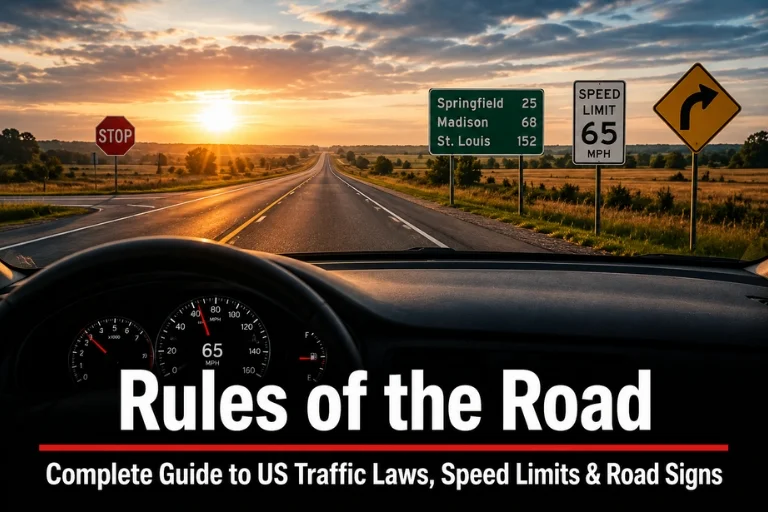

Whether you are preparing for your first driver’s license examination, refreshing your knowledge after years behind the wheel, or navigating American roads for the first time as a visitor or new resident, understanding the rules of the road is not optional — it is a legal requirement and a fundamental safety responsibility. The United States maintains more than 4 million miles of public roads governed by a layered system of federal guidelines and state-specific traffic laws that together create the framework every driver must follow.
More than 40,000 traffic fatalities occur on American roads every year, and the overwhelming majority of them involve some form of traffic law violation. This complete guide covers everything you need to know — American road speed limits, how US traffic signs and meanings work, what the core traffic laws require, how many laws govern American drivers, and how to apply all of it confidently every time you get behind the wheel.
How Many Laws Are There in America Governing Drivers?
One of the most common questions new drivers and visitors ask is how many laws are there in America that apply to driving. The answer is genuinely complex because traffic law in the United States operates on two simultaneous levels.
At the federal level, the United States government establishes broad transportation standards and guidelines — including the Manual on Uniform Traffic Control Devices (MUTCD), which standardizes the design, meaning, and placement of traffic signs across all 50 states. The Federal Highway Administration manages the MUTCD, and its most recent edition — the 11th — took effect in January 2024. The MUTCD governs more than 500 federally approved sign types covering every conceivable driving scenario on American roads.
At the state level, each of the 50 states maintains its own individual traffic code — a body of law that establishes state-specific speed limits, right-of-way rules, seatbelt requirements, cell phone restrictions, DUI thresholds, and dozens of other regulations. This means a driver crossing from Texas into New Mexico may encounter different posted speed limits, different regulations around hands-free device use, and different penalties for the same violation. When you add local municipal ordinances — city and county-level rules governing parking, school zones, and specific intersection controls — the total body of driving-related law in America runs into the tens of thousands of individual statutes and regulations.
The practical takeaway is this: while federal guidelines create a consistent visual and procedural foundation across state lines, every driver must be specifically familiar with the traffic laws of the state in which they are operating their vehicle.
American Road Speed Limits — The Complete Breakdown
American road speed limits are among the most visible and most commonly misunderstood elements of the rules of the road. Every posted speed limit on an American roadway represents the maximum legal speed under ideal conditions — dry pavement, clear visibility, normal traffic density. The basic speed law, present in the traffic code of virtually every state, further requires that drivers travel at a speed that is safe and reasonable for the actual prevailing conditions — meaning that driving at the posted limit during a heavy rainstorm, on ice, or in dense fog can itself constitute a violation even when the speed is technically within the posted maximum.
Here is a complete breakdown of standard American road speed limits by road type:
Residential Streets and Neighborhoods
Most American residential streets carry speed limits between 25 and 30 miles per hour. These lower limits reflect the presence of pedestrians, children, cyclists, and vehicles entering from driveways with limited sighting distance.
School Zones
Active school zone speed limits typically drop to 15 to 25 miles per hour during designated school hours — usually one hour before and after the school day. In most states, school zone speed limits are legally enforced only when beacons or flashing lights are active. When those beacons are illuminated, the lower speed limit applies and is legally binding regardless of the posted general speed limit in that corridor.
Urban Arterials and City Streets
Major urban streets and arterial roads commonly carry limits of 35 to 45 miles per hour. Many cities have been recalibrating these limits downward in recent years based on crash data and pedestrian safety research.
Rural Highways and Two-Lane State Roads
Rural roads outside of city limits commonly carry limits of 55 miles per hour, though this varies significantly by state and road classification.
Interstate Highways and Freeways
Interstate highway speed limits range from 65 to 80 miles per hour across most of the country, with Texas holding the distinction of operating the highest posted speed limit in the United States at 85 miles per hour on a specific toll road segment between Austin and San Antonio.
Driving Too Slowly
A widely overlooked element of American road speed limits is the minimum speed law. Traveling more than 15 miles per hour below the posted speed limit is considered a dangerous hazard in many states and can result in a traffic citation. On most American highways, the right lane is designated for slower-moving traffic while left lanes are reserved for passing and faster travel. Lingering in the left lane while traveling slowly is a significant source of congestion and is specifically prohibited in many states.
Work Zone Speed Limits
Temporary orange signs in active construction and work zones establish legally binding reduced speed limits for the duration of the work zone. In most states, fines for speeding in work zones are doubled when workers are present, and electronic message boards and temporary portable signs carry the same legal weight as permanent posted signs.
Signs Provide Information About Road Rules and Traffic Laws — The US Traffic Sign System
There are approximately 40 million road signs installed across the United States — a figure that reflects the sheer scale and complexity of the American road network. All of these signs are governed by the MUTCD’s standardized visual system, which uses distinct shapes and colors to communicate the category and urgency of each sign’s message before a driver even reads the text.
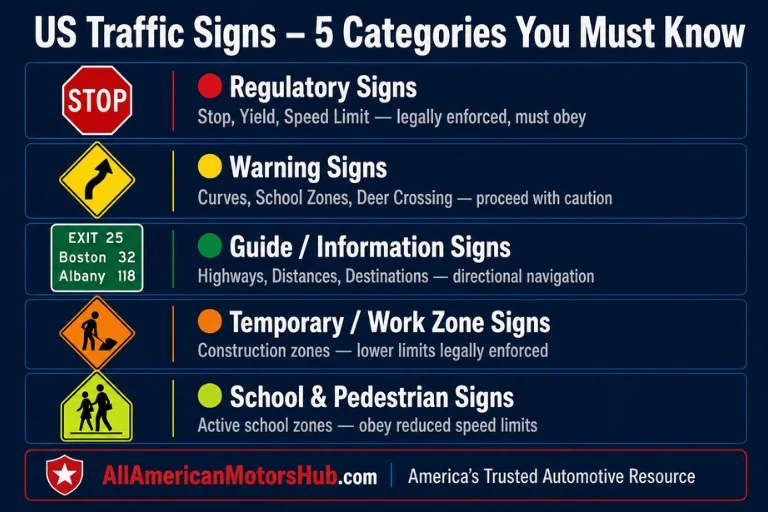
The MUTCD establishes five primary categories of traffic signs, and understanding each one is essential to operating legally and safely on American roads:
Category 1 — Regulatory Signs
Regulatory signs carry the full force of law. They inform drivers of specific legal requirements that must be obeyed, and violations of regulatory signs result in citations, fines, and in serious cases, criminal charges. Regulatory signs use predominantly white or red backgrounds with black or white text. The most universally recognized regulatory signs include the red octagonal Stop sign, the white triangular Yield sign, rectangular white Speed Limit signs, No Left Turn signs, Do Not Enter signs, and One Way signs.
A critical point that many drivers misunderstand: signs provide information about road rules and traffic laws, and that information is legally binding. A No Left Turn sign is not a suggestion — it is an enforceable legal prohibition identical in legal weight to a written statute.
Category 2 — Warning Signs
Warning signs alert drivers to changing road or environmental conditions ahead that require increased caution and often a reduction in speed. Warning signs use yellow or fluorescent yellow-green diamond shapes with black text or symbols. Common examples include Sharp Curve Ahead, Slippery When Wet, Deer Crossing, Merge, Lane Ends, and Railroad Crossing signs. These signs are placed far enough in advance of the hazard to allow drivers adequate distance for corrective action. While warning signs do not carry the same direct legal mandate as regulatory signs, ignoring them and subsequently causing an accident or injury can result in serious legal liability.
Category 3 — Guide and Information Signs
Guide signs function as the road’s navigation system, providing directional, distance, and destination information. Green rectangular highway guide signs, blue service signs indicating fuel stations, hospitals, and lodging, and brown recreational area signs all fall within this category. Interstate route shields, U.S. Highway markers, and state highway signs are all guide sign elements. These signs do not impose legal obligations — they provide navigational assistance.
Category 4 — Temporary Traffic Control Signs
Orange temporary signs govern construction zones, work areas, road closures, and detours. These signs carry full legal weight while they are posted. Electronic message boards and portable orange signs in work zones override the normal speed limit and traffic pattern signs for their designated segment. Many drivers treat orange work zone signs as advisory — in reality, the posted construction zone speed limit is the enforceable law for that entire segment regardless of what the permanent signs outside the work zone read.
Category 5 — School and Pedestrian Signs
Fluorescent yellow-green pentagon-shaped school crossing signs and crosswalk signs carry some of the most serious legal protections in the entire traffic sign system. Failure to yield to pedestrians in marked crosswalks or to reduce speed in an active school zone can result in significant fines, license points, and in cases involving injury, criminal charges.
Understanding traffic signs also prepares you to maintain your vehicle properly for road safety. Our car maintenance checklist covers all the vehicle systems — brakes, tires, lights, and signals — that must be in top condition for you to legally and safely respond to road signs and traffic law requirements.
US Traffic Signs and Meanings — The Color and Shape Code
The genius of the American traffic sign system is its use of a standardized visual code that communicates meaning through shape and color before the driver reads a single word. This color and shape coding is governed by the MUTCD and consistent across all 50 states.
Color Codes:
- Red — Stop, prohibition, or danger (Stop signs, Yield signs, Wrong Way signs, Do Not Enter signs)
- White — Regulatory information (Speed Limit signs, lane control signs, distance signs)
- Yellow — General warning of changing conditions ahead
- Orange — Temporary traffic control, construction zones, detours
- Green — Guide information, directional navigation, distance
- Blue — Motorist services (fuel, food, lodging, hospital)
- Brown — Recreational areas, parks, scenic routes
- Fluorescent Yellow-Green — School zones and pedestrian areas
Shape Codes:
- Octagon — Stop only (exclusive shape reserved globally for stop signs)
- Triangle (inverted) — Yield only
- Diamond — Warning signs
- Rectangle (vertical) — Regulatory signs
- Rectangle (horizontal) — Guide and information signs
- Pentagon — School warning signs
- Circle — Railroad crossing advance warning
This dual coding system means that a driver approaching a sign at highway speed on a dark night or in adverse weather can determine the general category and urgency of the sign from its shape and background color alone — before the text is legible. This redundancy saves lives by ensuring the most critical information is communicated in under half a second of visual processing time.
Core Traffic Laws Every American Driver Must Know
Beyond signs and speed limits, the rules of the road encompass a body of behavioral traffic laws that apply to every driver on every road at every moment of operation:
Right-of-Way Rules
Right-of-way rules govern which vehicle or road user has priority at intersections, merges, and crosswalks. At an uncontrolled intersection — one without signs or signals — the vehicle that arrives first has right of way. When two vehicles arrive simultaneously, the vehicle on the right has priority. Pedestrians in marked crosswalks always have right of way over vehicles at intersections and mid-block crossings.
Turn Signal Requirements
Using turn signals before turning or changing lanes is not optional — it is a legal requirement in every state. Failure to signal is a traffic infraction that can result in a citation in most jurisdictions. Signals should be activated a minimum of 100 feet before the turn in residential areas and 200 feet or more on higher-speed roads.
Following Distance
Maintaining safe following distance — commonly expressed as the three-second rule for normal conditions and the six-second rule in adverse weather — is a legal requirement under basic speed and safe operation laws. Tailgating constitutes a traffic violation in most states.
Seatbelt Laws
All 50 states except New Hampshire have primary or secondary seat belt laws requiring occupants to be buckled at all times. Primary seatbelt laws allow officers to stop a vehicle solely for seatbelt non-compliance. Secondary laws require another violation to be the primary stop reason.
DUI and Impaired Driving
Operating a motor vehicle with a blood alcohol concentration of 0.08% or higher is illegal in all 50 states. Commercial vehicle operators face a lower threshold of 0.04%. Enhanced DUI penalties apply in most states for BAC levels significantly above the legal limit, repeat offenders, and impaired driving involving minors in the vehicle.
Cell Phone and Distracted Driving Laws
Handheld cell phone use while driving is prohibited in 24 states and the District of Columbia. Texting while driving is prohibited in 48 states. Many municipalities impose additional local restrictions. Hands-free operation through Bluetooth or mounted devices is generally permitted but subject to state-specific rules.
For drivers who want to understand how their vehicle’s safety systems work alongside traffic laws to protect them on the road, our what is stabilitrak guide explains how modern electronic stability systems interact with driver inputs in emergency traffic situations.
Right-of-Way at Intersections — A Deeper Look
Intersection management is one of the most complex elements of the rules of the road because it involves multiple road users making simultaneous, often competing decisions. Understanding right-of-way principles at every type of intersection eliminates one of the most common sources of traffic collisions:
Signalized Intersections
Green means proceed when safe — not proceed without looking. Red means stop completely before the stop line. Yellow means prepare to stop, not accelerate to beat the light. A flashing red light functions as a stop sign — come to a complete stop, then proceed when clear. A flashing yellow light means proceed with caution.
Four-Way Stops
At a four-way stop, the first vehicle to arrive and stop has right of way. When two vehicles arrive simultaneously, the vehicle on the right proceeds first. When vehicles directly across from each other arrive simultaneously and both intend to go straight, both may proceed simultaneously. When one is turning and one is going straight, the turning vehicle yields.
Roundabouts
At a roundabout, traffic already circulating inside the roundabout has right of way. Entering vehicles must yield to all circulating traffic before entering the flow. Roundabouts eliminate the most dangerous crossing conflict points present at traditional intersections, which is why traffic engineers increasingly favor them for high-volume intersections.
Special Driving Situations — School Buses, Emergency Vehicles, and Railroad Crossings
Several specific traffic law scenarios carry elevated legal consequences and require specific driver responses:
School Bus Laws
When a school bus activates its red flashing lights and extends its stop arm, all traffic in both directions on an undivided road must stop and remain stopped until the lights are deactivated and the stop arm is retracted. On divided highways with a physical median, only traffic traveling in the same direction as the bus is required to stop. Violations of school bus stop laws carry among the highest non-criminal traffic fines in most states and are among the most aggressively enforced traffic laws.
Emergency Vehicle Laws
When an emergency vehicle — police, fire, ambulance — approaches with active lights and sirens, drivers must immediately pull as far right as safely possible, come to a complete stop if necessary, and remain stopped until the emergency vehicle has completely passed. Move Over laws — now in effect in all 50 states — additionally require drivers to move to a non-adjacent lane or slow significantly when passing stopped emergency vehicles, law enforcement, and roadside assistance vehicles with active warning lights.
Railroad Crossings
At a railroad crossing with active flashing red lights and lowered gates, stopping before the gate is legally mandatory. Never drive around a lowered gate or attempt to beat a train — a fully loaded freight train traveling at 55 miles per hour requires more than a mile to stop completely.
Understanding how your vehicle’s braking and drivetrain systems respond in these emergency situations is critical. Our how to jump start a car guide and car maintenance checklist together ensure your vehicle is mechanically prepared to respond correctly when traffic situations demand immediate action.
Conclusion
The rules of the road represent the shared contract that makes it possible for millions of drivers to share the same road network safely and efficiently every single day. Understanding American road speed limits — from 25 mph in a school zone to 80 mph on a western interstate — knowing what US traffic signs mean and how the color and shape coding system works, obeying core traffic laws from right-of-way to seat belts to turn signals, and recognizing that signs provide information about road rules and traffic laws with the full force of legal enforcement behind them are not optional areas of knowledge. They are the foundation of every safe, legal, and responsible journey you take behind the wheel.
Whether you are a new driver preparing for your license exam or an experienced driver refreshing your knowledge, this guide gives you the complete framework to drive confidently on any American road in any condition. For drivers who also want to ensure their vehicle is mechanically ready to meet every demand the road places on it, explore our full selection of used engines for sale and used transmissions to keep your vehicle performing at its safest and most reliable best.
Frequently Asked Questions
What are the rules of the road in America?
The rules of the road in America are a combination of federal guidelines and state-specific traffic laws that govern every aspect of vehicle operation — including speed limits, right-of-way, traffic signs, seatbelt requirements, signal use, following distance, DUI thresholds, and special scenarios like school bus stops and emergency vehicle encounters. While federal standards create consistency in traffic signs and road markings across all states, each state maintains its own traffic code with specific requirements that may differ from neighboring states.
What are the American road speed limits?
American road speed limits vary by road type and location. Residential streets typically carry limits of 25 to 30 mph. Urban arterials range from 35 to 45 mph. Rural highways commonly post 55 mph. Interstate freeways range from 65 to 80 mph across most states, with Texas holding the highest posted limit in the country at 85 mph on one specific toll road segment. All posted limits represent the legal maximum under ideal conditions — the basic speed law requires driving at a safe speed for actual conditions regardless of the posted maximum.
What do US traffic signs mean?
US traffic signs are categorized into five types: regulatory signs carry the force of law and must be obeyed; warning signs alert drivers to changing conditions requiring caution; guide signs provide directional and navigation information; temporary orange signs govern construction zones; and school and pedestrian signs protect vulnerable road users. Each category uses standardized colors and shapes so drivers can identify the sign’s category before reading the text.
Do signs provide information about road rules and traffic laws?
Yes, and that information is legally binding. Regulatory signs such as Stop signs, Speed Limit signs, No Turn signs, and Do Not Enter signs carry the same legal weight as written statutes. Violating a regulatory sign is a traffic offense subject to fines, license points, and in serious cases criminal charges. The common misconception that posted signs are merely advisory is incorrect — regulatory signs are enforceable law.
How many traffic laws are there in America?
There is no single count because American traffic law operates at three levels simultaneously — federal, state, and local. The federal MUTCD standardizes over 500 approved sign types and governs traffic control device design nationally. Each of the 50 states maintains its own traffic code with dozens to hundreds of individual statutes. Municipal ordinances add thousands more local rules. The total body of traffic-related law across all levels of American government runs into the tens of thousands of individual statutes, regulations, and ordinances.
What are the most important rules of the road for new drivers?
The most critical rules for new drivers include always obeying posted speed limits and adjusting speed for conditions, coming to a complete stop at all stop signs and red lights, using turn signals before every turn and lane change, maintaining at least a three-second following distance, wearing a seatbelt at all times, never operating a vehicle while impaired, and yielding to pedestrians in crosswalks. Consistent application of these fundamentals prevents the vast majority of traffic collisions involving new drivers.
What is the highest speed limit in the United States?
The highest posted speed limit in the United States is 85 miles per hour, on a specific segment of Texas State Highway 130 — a toll road between Austin and San Antonio. Several other western states including Utah, Wyoming, Nevada, and Montana post interstate limits of 80 miles per hour on qualifying rural freeway segments.
What happens if you drive too slowly on an American highway?
Driving significantly below the posted speed limit — particularly more than 15 mph below the limit on a highway — is considered a hazardous road condition in most states and can result in a traffic citation for impeding the normal flow of traffic. On most American highways and interstates, the right lane is designated for slower traffic and the left lane is reserved for passing. Traveling slowly in the left lane is specifically prohibited in many states and contributes significantly to traffic congestion and rear-end collision risk.

