
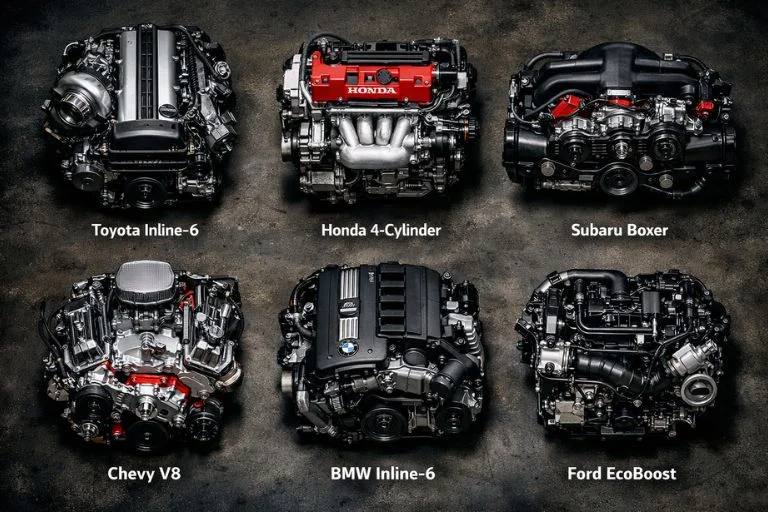

Key Takeaways:
- Toyota’s 2JZ-GE, 1GR-FE, and 2GR-FE engines are among the longest-lasting ever made, with documented cases exceeding 400,000 miles.
- Honda’s K24, Honda’s B-series, and Subaru’s EJ25 (with proper maintenance) routinely surpass 250,000 miles.
- The single biggest factor in engine longevity is consistent oil changes every 5,000–7,500 miles.
- Diesel engines — especially Toyota’s 1HZ and Cummins 5.9 — frequently exceed 500,000 miles in commercial use.
- Buying a used vehicle with one of these engines at 150,000 miles is far less risky than buying a lesser engine at 80,000 miles.
Table of Contents
What Makes an Engine Last Over 200K Miles?
This guide is for car buyers, owners, and enthusiasts who want to know which engines are genuinely built to last — backed by real-world data, not just marketing claims. Whether you’re buying a high-mileage used car, planning a vehicle purchase for the long haul, or simply curious about engine longevity, you’ll find clear, actionable answers here.
Not all car engines are created equal. The difference between an engine that dies at 120,000 miles and one that powers on past 300,000 comes down to a handful of engineering and ownership factors:
Engineering factors that determine engine longevity:
- Oversquare vs. undersquare design — Engines with shorter strokes (oversquare) generate less friction and wear over time
- Cast iron vs. aluminum block — Cast iron blocks are more dimensionally stable under heat; modern aluminum alloys with proper engineering are equally durable
- Timing chain vs. timing belt — Timing chains (self-lubricating, metal) outlast rubber belts by 100,000+ miles in most cases
- DOHC vs. SOHC — SOHC engines have fewer moving parts, reducing failure points; DOHC offers performance but requires more maintenance
- Forged vs. cast internals — Forged crankshafts and connecting rods handle stress significantly better at high mileage
Ownership factors (arguably more important):
- Consistent oil changes (every 5,000–7,500 miles with quality oil)
- Coolant flushes every 30,000–50,000 miles
- Timing belt/chain replacement on schedule
- Avoiding extended idling and hard cold-starts
- Using the manufacturer-recommended fuel grade
Toyota and Honda vehicles are 3x more likely to reach 200,000 miles than the industry average — largely because of well-engineered powerplants combined with straightforward maintenance requirements.
Top 10 Most Reliable Car Engines Over 200K Miles
1. Toyota 2JZ-GE / 2JZ-GTE — The Legendary Inline-6
Found in: Toyota Supra, Lexus GS300, IS300 (1991–2005) Displacement: 3.0L Inline-6
The Toyota 2JZ is widely considered the single most reliable performance engine ever mass-produced. In naturally aspirated (2JZ-GE) form, 300,000+ mile examples are not unusual — and with proper maintenance, 400,000-mile 2JZ engines have been documented. Even the turbocharged 2JZ-GTE, pushing 280+ hp stock, routinely crosses 200,000 miles when maintained.
Why it lasts:
- Cast iron block with aluminum head — exceptional heat management
- Timing belt (replaceable on schedule) — no surprise chain failure
- Conservative factory tune leaves enormous reliability headroom
- Forged steel crankshaft and connecting rods from the factory
- Massive aftermarket support for worn component replacement
Real-world longevity: Multiple documented cases on forums and YouTube of 2JZ engines in Lexus IS300 taxis in Southeast Asia exceeding 500,000 km without internal rebuilds.
Maintenance priority: Replace timing belt every 90,000 miles; use Toyota-spec 5W-30 oil and change every 5,000 miles.
2. Honda K24A / K24Z — The People’s Champion
Found in: Honda Accord, CR-V, Element, Acura TSX (2002–2015) Displacement: 2.4L Inline-4
The Honda K24 series is the most common engine on “high-mileage survivor” lists. Consumer Reports has consistently ranked Honda Accord and CR-V — both K24-powered — among the top vehicles for long-term reliability. Owners regularly report 250,000–300,000 miles on original engines.
Why it lasts:
- Timing chain (not belt) — no scheduled replacement needed under 200K
- Honda’s proven i-VTEC system adds minimal complexity
- Simple, well-understood maintenance requirements
- Aluminum block with iron cylinder liners — light but durable
- Massive parts availability keeps repair costs low at any mileage
Related: Used Honda Engines for Sale — Buyer’s Guide
Maintenance priority: K24 is sensitive to oil changes. Use 5W-20 Honda-spec oil, change every 5,000 miles. Never let oil drop below the minimum mark — oil starvation is the #1 K24 killer.
3. Toyota 1GR-FE — The Truck Engine That Never Quits
Found in: Toyota 4Runner, Tacoma, Tundra, FJ Cruiser, Land Cruiser Prado (2002–present) Displacement: 4.0L V6
For truck and SUV buyers seeking a 200K+ powerplant, the 1GR-FE V6 is the gold standard. This engine powers some of Toyota’s most demanding platforms globally — from Australian outback Landcruisers to U.S. Forest Service fleet vehicles — and regularly exceeds 300,000 miles in real-world use.
Why it lasts:
- Dual timing chains (primary and secondary) — extremely durable
- Cast iron cylinder liners in aluminum block
- Toyota’s variable valve timing (VVT-i) system is simple and reliable
- Available in millions of global vehicles — parts supply is permanent
Real-world longevity: Fleet data from Toyota commercial vehicle programs in Australia shows average 1GR-FE service life of 450,000 km before first major overhaul.
4. Toyota 1HZ — The Diesel Immortal
Found in: Toyota Land Cruiser 70/80 Series (1990–2007) Displacement: 4.2L Inline-6 Diesel (naturally aspirated)
The 1HZ is perhaps the longest-lasting engine ever put in a mass-market vehicle. This non-turbo diesel is legendarily simple — no electronics, no intercooler, no turbo to fail — and Land Cruiser 1HZ engines with 700,000–1,000,000 km are documented in Africa, Australia, and the Middle East where these trucks serve as workhorses for decades.
Why it lasts: No turbo, no intercooler, minimal electronics, cast iron everything, and a conservative 129 hp tune that leaves vast mechanical headroom.
5. Subaru EJ25 SOHC (Non-Turbo) — The Flat-Four Workhorse
Found in: Subaru Outback, Forester, Legacy (1996–2011) Displacement: 2.5L Flat-4 (Boxer)
Important caveat: The Subaru EJ25 has a split reputation. The turbocharged EJ25 (WRX/STI) has well-documented head gasket issues. However, the naturally aspirated SOHC EJ25 found in Outbacks and Foresters — when serviced with head gasket preventive maintenance — is a 200,000+ mile engine. Consumer Reports rates 2010–2014 Subaru Outback reliability highly once the head gasket issue is addressed.
Maintenance priority: Have head gaskets inspected/replaced at 100,000 miles preventively. Use Subaru-recommended coolant with conditioner. Beyond that, these engines run forever.
6. Toyota 2GR-FE — The Modern Reliable V6
Found in: Toyota Camry, Avalon, Highlander, RAV4, Lexus RX350/ES350 (2005–present) Displacement: 3.5L V6
The 2GR-FE is Toyota’s modern workhorse V6 and has become one of the most reliability-proven engines of the 21st century. It powers millions of Camrys, Highlanders, and Lexus vehicles globally, and 250,000-mile examples are common on enthusiast forums.
Why it lasts: Dual VVT-i, timing chain, aluminum block, and Toyota’s famously conservative factory calibration.
7. Honda D16Z6 / D16Y8 — Budget Champion
Found in: Honda Civic (1992–2000) Displacement: 1.6L Inline-4 SOHC VTEC
The humble D-series Honda engine is the definition of “over-engineered for the application.” These small 1.6L SOHC VTEC units, often found in early Civics, regularly reach 250,000+ miles when maintained. Timing belt replacements every 90,000 miles are the critical maintenance item.
8. Lexus / Toyota 1UZ-FE — The Luxury V8 That Lasts Forever
Found in: Lexus LS400, SC400, GS400; Toyota Celsior (1989–2000) Displacement: 4.0L V8 DOHC
The 1UZ-FE was Toyota/Lexus’s flagship V8 for over a decade, and it was massively over-engineered for its power output (260 hp from 4.0L). These engines are documented well past 300,000 miles in LS400 taxis and police vehicles globally.
9. Mazda MZR 2.0 (LF) — The Underrated High-Mileage Engine
Found in: Mazda3, Mazda6, Mazda CX-7 (non-turbo), Ford Focus (2003–2013) Displacement: 2.0L Inline-4
Mazda’s naturally aspirated MZR 2.0L engine is one of the most underappreciated high-mileage engines on the market. Simple DOHC design, timing chain, and Mazda’s reputation for mechanical refinement make it a 200K+ engine in routine use.
10. BMW M57 3.0L Diesel — European High-Mileage King
Found in: BMW 3 Series, 5 Series, X5 (E46, E60, E53 — 1998–2007) Displacement: 3.0L Inline-6 Diesel
The BMW M57 is the diesel counterpart to the 2JZ in terms of cult longevity status. European taxi fleets running M57-powered BMW 5 Series regularly log 500,000–700,000 km with routine maintenance. The straight-six diesel architecture provides exceptional balance and low vibration, reducing long-term wear.
Maintenance priority: Injector and fuel filter maintenance is critical. EGR cleaning at 150,000 miles. Beyond that, M57 engines are extremely durable.
Most Reliable Diesel Engines Over 200K Miles
Diesel engines, by nature, are built to higher tolerances and run at lower RPM than gasoline engines — giving them a structural longevity advantage.
| Engine | Application | Average Service Life |
| Cummins 5.9L ISB (6BT) | Ram 2500/3500 (1989–2007) | 350,000 – 500,000+ miles |
| Toyota 1HZ 4.2L | Land Cruiser 70/80 Series | 500,000 – 1,000,000+ km |
| BMW M57 3.0L | BMW 3/5 Series, X5 | 400,000 – 700,000 km |
| Mercedes OM617 3.0L | W123, W126 (1976–1985) | 500,000+ miles documented |
| Duramax LBZ 6.6L | Chevy/GMC 2500/3500 (2006–07) | 300,000 – 500,000+ miles |
| VW/Audi TDI 1.9 (ALH) | Golf, Jetta, Beetle (1998–2006) | 300,000+ miles with maintenance |
The Cummins 5.9L (also called the 12-valve and 24-valve Cummins) is often cited as the most reliable diesel engine ever sold in the U.S. passenger truck market. Commercial fleets report average engine life of 350,000–500,000 miles before major overhaul.
Brands With the Best Engine Longevity Track Record
| Brand | Avg. % of Vehicles Reaching 200K Miles | Most Reliable Engine(s) |
| Toyota | 3.4x industry average | 2JZ, 1GR-FE, 2GR-FE, 1HZ |
| Honda | 3.2x industry average | K24, D16, B18, J35 |
| Lexus | 3.1x industry average | 1UZ, 2GR-FE, 1GD-FTV |
| Mazda | 2.8x industry average | MZR 2.0, Skyactiv-G |
| Subaru | 2.1x industry average (NA only) | EJ25 SOHC, FB25 |
| Ford | 1.6x industry average | 7.3L IDI Diesel, 5.0L Coyote |
| BMW | 1.4x industry average (diesel) | M57, B47 |
Longevity multipliers estimated from iSeeCars.com high-mileage vehicle analysis and Consumer Reports long-term reliability data.
High-Mileage Engine Maintenance Checklist
The majority of engine failures before 200,000 miles are preventable. Here’s the essential high-mileage engine maintenance guide in checklist form:
Every 5,000–7,500 Miles
- Engine oil and filter change (never exceed 7,500 miles on conventional oil)
- Check coolant level and condition
- Inspect for oil leaks around valve cover and oil pan
Every 30,000 Miles
- Air filter replacement
- Fuel filter replacement (especially diesel engines)
- Spark plug inspection (replace at 60K on standard; 100K on iridium)
- Throttle body cleaning
Every 50,000–60,000 Miles
- Coolant flush and refill with manufacturer-spec coolant
- Transmission fluid change (automatic and manual)
- Inspect timing belt (if applicable — replace per manufacturer schedule)
- PCV valve replacement
Every 90,000–100,000 Miles
- Timing belt replacement (critical for belt-driven engines)
- Water pump replacement (do this with timing belt — same job)
- Inspect valve clearances (especially Honda engines)
- Check and replace engine mounts if worn
At 150,000+ Miles
- Switch to high-mileage engine oil formulation
- Inspect head gaskets (especially Subaru EJ, Ford 5.4 Triton)
- Clean EGR system (diesel engines)
- Inspect injectors for wear or deposits
Related: Best Engine Oil for High Mileage Cars
Should You Buy a Used Car With 200K Miles?
This is one of the most common questions for used car buyers — and the answer isn’t a simple yes or no. It depends entirely on which engine is under the hood.
A 200,000-mile Toyota Camry with a 2GR-FE engine that has been maintained on schedule is a fundamentally different proposition than a 200,000-mile vehicle with a known problematic engine. Here’s how to evaluate:
Buy with confidence at 200K miles if:
- The engine is on this list (Toyota, Honda, Mazda, Lexus)
- Maintenance records show consistent oil changes
- Compression test reads within 10% across all cylinders
- No visible oil leaks or coolant contamination
- Timing belt/chain has been replaced on schedule (for belt engines)
Proceed with caution at 200K miles if:
- No maintenance records are available
- Engine is known for specific high-mileage issues (see Red Flags below)
- Seller cannot explain why the car has high mileage
Typical inspection cost: A pre-purchase inspection at an independent mechanic costs $100–$175 and can save you thousands. Always get one for any high-mileage vehicle purchase.
Related: Signs Your Engine Is Failing — What to Watch For
Red Flags: Engines That Don’t Last
For balance, here are engines known for not reaching 200,000 miles reliably:
| Engine | Problem | Common Failure Mileage |
| Ford 5.4L Triton 3-valve | Spark plug ejection, cam phaser failure | 100,000 – 150,000 miles |
| Chrysler 2.7L V6 | Sludge buildup, oil passage failure | 80,000 – 120,000 miles |
| Subaru EJ25 DOHC Turbo | Head gasket failure | 80,000 – 120,000 miles |
| BMW N54 / N55 (turbo) | HPFP failure, injector issues | Variable |
| Audi 1.8T (early) | Sludge without synthetic oil | 80,000 – 100,000 miles |
| Nissan VQ35HR (350Z) | Chain tensioner issues at high mileage | 130,000 – 180,000 miles |
Universal red flags in any used high-mileage engine:
- Milky or foamy oil on the dipstick (head gasket failure)
- Blue smoke from exhaust (burning oil — worn rings/valve seals)
- White smoke at startup that persists (coolant burning — head gasket)
- Ticking at idle that disappears when warm (collapsed lifter or low oil)
- Overheating history documented in service records
Conclusion
When it comes to the most reliable car engines over 200,000 miles, the data is remarkably consistent: Toyota and Honda dominate the gasoline engine category, Cummins and Toyota lead in diesel, and the common thread is always conservative engineering paired with disciplined maintenance.
The engines on this list weren’t built to be exciting — they were built to be dependable. A 250,000-mile Camry with a 2GR-FE or a 220,000-mile CR-V with a K24 is not a gamble; it’s a proven platform with decades of real-world validation behind it.
Frequently Asked Questions
What is the most reliable car engine for over 200,000 miles?
The Toyota 2JZ-GE (naturally aspirated) and Honda K24 are consistently cited as the most reliable car engines for exceeding 200,000 miles in gasoline-powered vehicles. For diesel, the Cummins 5.9L and Toyota 1HZ hold the record, with documented examples exceeding 500,000 miles in fleet use. The common thread across all long-lasting engines is simple design, timing chains (or well-maintained belts), and conservative factory power output relative to displacement.
What is the highest mileage engine ever recorded?
The highest reliably documented mileage for a production car engine belongs to a 1966 Volvo P1800 owned by Irv Gordon, which accumulated over 3.25 million miles on its original engine before his death in 2018. In modern production vehicles, Toyota Land Cruiser diesel engines are regularly documented past 1,000,000 km (620,000 miles) in commercial use in Australia, Africa, and the Middle East.
Does engine mileage matter more than engine age?
For most gasoline engines, mileage matters more than age if the vehicle has been well-maintained. A 200,000-mile Camry that had oil changes every 5,000 miles is more mechanically sound than a 60,000-mile car that went 15,000+ miles between oil changes. However, for vehicles that sit unused for years (dry-rotted seals, varnished fuel systems), age becomes a significant factor regardless of mileage.
How long do Toyota engines last compared to Honda?
Both Toyota and Honda engines are among the most reliable in the world, with statistically similar longevity. Toyota holds a slight edge in absolute maximum mileage (particularly with the 2JZ, 1GR, and 1HZ), while Honda engines — particularly the K-series — are more commonly maintained by DIY owners due to better parts availability and community documentation.
What oil should I use in a high-mileage engine?
For engines over 100,000 miles, switch to a high-mileage motor oil formulation (e.g., Mobil 1 High Mileage, Valvoline High Mileage, or Castrol GTX High Mileage). These oils contain seal conditioners that reduce minor oil leaks and additional detergents that clean varnish buildup. Continue using the manufacturer-recommended viscosity (e.g., 5W-20 for Honda K-series, 5W-30 for Toyota). Change every 5,000 miles even with synthetic blends.
Can I buy a car with 200,000 miles and expect it to last?
Yes — if the engine is one of the proven long-lasting designs listed in this guide. A Toyota Camry with a 2GR-FE at 200,000 miles, verified service history, and a clean compression test can realistically deliver another 50,000–100,000 miles. Always get a pre-purchase inspection, check compression on all cylinders, and review maintenance records. Budget for timing belt (if applicable), water pump, and fresh fluids regardless of when they were last done.