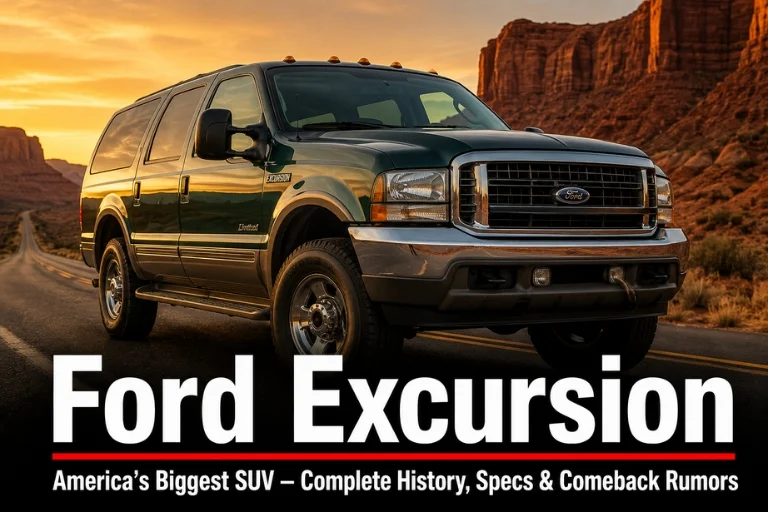

In the history of the American full-size SUV, no single vehicle has ever been larger, more commanding, or more polarizing than the Ford Excursion. Built on the same Super Duty F-250 platform that anchors Ford’s heaviest commercial trucks, the excursion ford was not just a vehicle — it was a statement. It said that some families needed more space than any minivan or crossover could ever offer, that some towing jobs demanded more than a standard SUV platform could deliver, and that sheer capability mattered more than fuel economy ratings or parking convenience.
Produced from 2000 through 2005, the Ford Excursion earned a devoted following that has not diminished in the two decades since the last one rolled off the assembly line, and comeback rumors continue to circulate every time the automotive internet needs something to argue about. This is the complete story.
What Is the Ford Excursion?
The Ford Excursion is a full-size body-on-frame SUV produced by Ford Motor Company from the 2000 through 2005 model years. Built on the Ford Super Duty F-250 truck chassis, it was the largest SUV ever mass-produced for the consumer market at the time of its production — stretching longer than a Chevrolet Suburban, standing taller than any competing SUV, and offering seating for up to nine passengers across three rows.
The Excursion was Ford’s answer to a specific and real market demand: families and commercial users who needed the passenger capacity of a full-size van combined with the towing capability of a heavy-duty pickup truck and the go-anywhere capability of a four-wheel-drive utility vehicle. No single product in Ford’s lineup — not the Expedition, not the F-250 alone — could simultaneously deliver all three of those capabilities at the level the Excursion’s target buyers required.
The vehicle was assembled at Ford’s Kentucky Truck Plant in Louisville, alongside the Super Duty pickup lineup, and shared its front fascia, chassis architecture, and engine options with the F-250 Super Duty, giving it a recognizably truck-derived appearance that appealed directly to buyers who already trusted that platform’s capability credentials.
Ford Excursion History — From Development to Discontinuation
Ford began development of the Excursion during the mid-1990s in response to growing demand for maximum-capacity vehicles from large families, commercial operators, church congregations, and transportation businesses. The original design brief called for a vehicle that could seat nine comfortably, tow at least 10,000 pounds, and operate in genuine off-road conditions when equipped with four-wheel drive.
The Excursion debuted for the 2000 model year and immediately established itself as the undisputed size champion of the SUV segment. At 226.7 inches long, 80 inches wide, and nearly 79 inches tall, it dwarfed every competitor. The Chevrolet Suburban — itself a massive vehicle — looked compact parked alongside it. Ford installed side steps on the Excursion as standard equipment because the vehicle sat high enough that many adults found unassisted entry genuinely difficult.
Early sales were strong, benefiting from the low fuel prices of the late 1990s and early 2000s that made operating costs relatively manageable despite the vehicle’s considerable thirst. The Excursion found its most devoted buyers among large families, RV towers who needed a tow vehicle that could keep pace with heavy fifth-wheel trailers, government and commercial fleet operators, and rural buyers who used the vehicle’s capability across demanding terrain and weather conditions.
Environmental backlash arrived quickly and loudly. The Sierra Club famously branded the Excursion the “Ford Valdez” — a reference to the Exxon Valdez oil spill — criticizing its fuel consumption and emissions profile in terms that generated substantial negative press coverage. Rising fuel prices through the early 2000s compounded the commercial pressure on the model. Ford discontinued the Excursion after the 2005 model year, replacing it with the extended-wheelbase Expedition EL — a vehicle that shared the Excursion’s market position but sat on a lighter, more fuel-efficient unibody-derived platform.
Ford Excursion Engine Options — Every Powertrain Explained
The engine lineup was one of the Excursion’s most compelling attributes, offering a range of powertrains that matched the vehicle’s diverse buyer base.
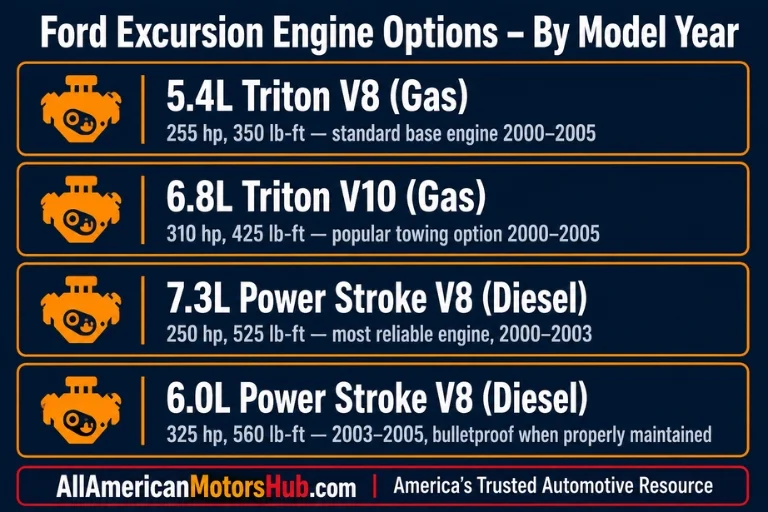
5.4L Triton V8 (Gas) — 2000 to 2005
The standard base engine was Ford’s 5.4-liter two-valve Triton V8, producing 255 horsepower and 350 lb-ft of torque. While adequate for basic driving, this engine was undersized for the vehicle’s weight and was rarely the choice of buyers who intended to use the Excursion’s towing capability seriously.
6.8L Triton V10 (Gas) — 2000 to 2005
The 6.8-liter V10 was the natural upgrade for buyers who wanted gasoline power without the diesel option. Producing 310 horsepower and 425 lb-ft of torque through a four-speed 4R100 automatic transmission, the V10 provided the pulling power the Excursion’s size demanded. Maximum towing with the V10 reached 10,000 pounds in properly configured examples.
7.3L Power Stroke Diesel V8 — 2000 to 2003
The 7.3-liter Power Stroke diesel is widely regarded as the greatest engine ever offered in the Ford Excursion, and one of the most reliable diesel engines Ford has ever produced. Generating 250 horsepower and a massive 525 lb-ft of torque through the 4R100 four-speed automatic, the 7.3L Power Stroke delivered the kind of low-end torque that made towing heavy trailers feel effortless. Owner stories of 7.3L Excursions exceeding 300,000 miles with basic maintenance are common and credible. The combination of relatively simple electronics, robust mechanical construction, and proven long-term reliability makes the 7.3-powered Excursion the most sought-after variant in today’s collector market.
6.0L Power Stroke Diesel V8 — 2003 to 2005
Ford transitioned to the 6.0-liter Power Stroke diesel beginning mid-model-year 2003. The 6.0L produced 325 horsepower and 560 lb-ft of torque through the five-speed 5R110W Torqshift automatic transmission, delivering improved performance numbers over the 7.3L on paper. In practice, the 6.0L developed a reputation for reliability issues related to its emissions equipment — particularly the EGR cooler, oil cooler, and head gaskets — that dampened enthusiasm considerably among the diesel community.
However, a 6.0L Power Stroke that has been properly maintained or professionally “bulletproofed” — a term referring to the process of addressing the engine’s known weak points with upgraded components — can be an extremely capable and long-lasting powertrain. Many enthusiasts specifically seek out bulletproofed 6.0L Excursions as capable tow vehicles available at a meaningful price discount compared to 7.3L examples.
If you are sourcing a replacement engine for a Ford Excursion restoration or repair project, our Ford F-250 Super Duty engine page covers compatible Super Duty platform powerplants, and our Ford F-350 Super Duty engine page provides additional options for heavy-duty engine sourcing.
2004 Ford Excursion — The Sweet Spot Year
Among all the model years in the Excursion’s production run, the 2004 Ford Excursion occupies a particularly notable position that enthusiasts and collectors frequently point to as the sweet spot of the entire lineup.
The 2004 Ford Excursion benefited from several years of production refinement that had smoothed out the early model year teething issues. By 2004, the interior quality had improved meaningfully from the first model years, with better fit and finish throughout the cabin, upgraded trim materials on the higher specification models, and enhanced convenience features that made living with the vehicle’s enormous dimensions more manageable day to day.
The 2004 model year also saw the 6.0L Power Stroke diesel enter its second full production year, during which Ford had addressed some — though not all — of the reliability concerns that had emerged in the transitional 2003 model year units. The 2004 diesel Excursion also came equipped with the five-speed 5R110W Torqshift automatic transmission that offered better highway fuel economy and improved shift quality compared to the 4R100 that had backed the 7.3L.
Trim levels available in the 2004 Ford Excursion included XLT, Eddie Bauer — the family-oriented mid-level trim featuring two-tone exterior paint, premium seating, and enhanced interior appointments — and Limited, the flagship model offering leather seating, premium audio, and the most complete feature content available in the lineup. The Eddie Bauer trim, introduced in 2003, quickly became one of the most popular configurations among large family buyers seeking a balance of capability and interior quality.
Maximum towing capacity for the 2004 Ford Excursion reached 11,000 pounds in properly equipped diesel configurations, placing it at the absolute top of the full-size SUV class for towing capability in that era. This figure remains competitive with many full-size SUVs available today, two decades later — a testament to how seriously Ford engineered the Excursion’s commercial-grade underpinnings.
For owners seeking transmission components compatible with the 2004 Excursion’s 5R110W drivetrain, our 5R110W transmission product page offers quality used units for this specific application.
Ford Excursion SUV Comeback Rumors — The Full Truth
Few topics generate as much passionate discussion in automotive enthusiast communities as the Ford Excursion SUV comeback rumors that have circulated persistently since approximately 2023 and accelerated dramatically through 2024 and into 2025.
The rumors were initially amplified by AI-generated concept renderings of what a modern Excursion might look like, based on styling cues from Ford’s current Super Duty F-250 and F-350 lineup. These images spread rapidly across social media platforms and were picked up by automotive news aggregators, some of which presented them as factual confirmation of an upcoming announcement — which they were not.
As of the time of this writing in mid-2026, Ford has made no official announcement confirming any plans to revive the Excursion nameplate for any upcoming model year. The vehicle did not appear at the Detroit Auto Show in September 2025, and no credible insider reporting from established automotive journalists at outlets including Car and Driver, Motor Trend, or Automotive News has confirmed that a production program exists. The 2026 Excursion does not exist as a real production vehicle.
There are, however, legitimate market and strategic arguments that make a hypothetical Excursion revival a reasonable topic for genuine discussion. Ford has demonstrated willingness to revive dormant nameplates — the Bronco returned successfully in 2021 after a 25-year absence, and the Maverick pickup created an entirely new market segment when it launched. The large SUV segment continues to grow, with buyers increasingly demanding third-row seating, serious towing capability, and body-on-frame durability. No vehicle in Ford’s current lineup fills the exact gap the original Excursion occupied — the Expedition MAX comes closest but sits on a unibody-derived platform and lacks the raw commercial-grade capability of the original Super Duty-based vehicle.
If Ford ever formally confirms an Excursion revival, the most credible powertrain speculation centers on a 6.7-liter Power Stroke diesel, a 7.3-liter Godzilla gasoline V8, and potentially a hybrid or electric variant leveraging platform technology from the F-150 Lightning or Super Duty hybrid programs. Whether that announcement ever comes remains to be seen — but the passion of the Excursion’s existing owner community makes it one of the most emotionally compelling revival candidates in Ford’s entire nameplate history.
Ford Excursion vs. Modern Competition
Understanding how the original Excursion compares against today’s large SUV market reveals exactly what made it special — and exactly what the market has been missing since 2005.
The closest modern competitor to the original Excursion concept is the Chevrolet Suburban and its GMC Yukon XL sibling, which offer nine-passenger seating and significant towing capability on a unibody platform. The Ford Expedition MAX — Ford’s own flagship SUV — provides eight-seat capacity and up to 9,300 pounds of towing on a platform that is lighter and more fuel efficient than the Excursion’s Super Duty foundation.
What none of these vehicles replicate is the Excursion’s truck-grade body-on-frame Super Duty foundation, which provided dramatically greater structural rigidity for heavy towing applications and enabled the vehicle to be equipped with the Power Stroke diesel engine family — a capability no current full-size SUV from any manufacturer offers from the factory.
This gap — a true commercial-grade, diesel-capable, nine-passenger SUV built on a heavy-duty truck platform — remains unfilled in the current market, which explains precisely why the Excursion’s fan base has never quieted down and why every piece of Excursion revival speculation finds an immediately receptive audience.
Buying a Used Ford Excursion Today — What to Look For
The used Ford Excursion market in 2025 remains active and enthusiastic, driven by buyers who want the vehicle’s unique combination of capability and passenger capacity that nothing currently in production can replicate.
Engine Selection
Choose carefully based on your intended use and mechanical comfort level. The 7.3L Power Stroke diesel is the most desirable and most reliable powertrain — expect to pay a meaningful premium over comparable V10 or 6.0L examples for a clean 7.3L unit with documented service history. The V10 gasoline engine is an excellent choice for buyers who prioritize reliability without the complexity of diesel maintenance. The 6.0L Power Stroke diesel offers strong performance but requires due diligence on its maintenance history and whether it has been bulletproofed.
Rust and Structural Inspection
The Excursion’s heavy body-on-frame construction is durable but not immune to corrosion, particularly in northern states where road salt exposure is significant. Inspect the frame rails, rocker panels, rear quarter panels, and tailgate thoroughly. Frame rust is the most serious finding and can make an otherwise functional vehicle non-viable for heavy towing applications.
Transmission Condition
The 4R100 automatic transmission backing the V10 and early 7.3L Power Stroke diesel has a good service reputation but benefits from documented transmission fluid service history. The 5R110W Torqshift in later diesel models is a stronger unit overall but has its own maintenance requirements that should be verified before purchase.
For buyers sourcing replacement transmissions for a Ford Excursion, our full selection of used transmissions and used engines provides quality, inspected components to support any Excursion restoration or mechanical rebuild project.
Conclusion
The Ford Excursion occupies a singular position in American automotive history as the largest, most capable body-on-frame SUV ever mass-produced for the consumer market. From its debut as the 2000 model year’s undisputed size champion through the collector-favorite 2004 Ford Excursion and the final 2005 production year, it delivered something that no vehicle before or since has fully replicated — nine-passenger capacity, genuine commercial-grade towing capability, and the structural foundation of a heavy-duty pickup truck, all in a single family vehicle.
The excursion ford remains a living legend in enthusiast communities two decades after its discontinuation, and the persistent Ford Excursion SUV comeback rumors reflect the genuine market gap it left behind. Whether Ford ultimately fills that gap remains the most compelling unanswered question in the full-size SUV segment.
For enthusiasts maintaining or restoring an Excursion, our Ford Powerstroke guide provides essential technical knowledge on the diesel engines that made this SUV a legend, and our used transmission price guide by car type helps you benchmark fair market values for replacement drivetrain components.
Frequently Asked Questions
What is the Ford Excursion?
The Ford Excursion is a full-size body-on-frame SUV produced by Ford Motor Company from the 2000 through 2005 model years. Built on the Super Duty F-250 truck platform, it was the largest SUV ever mass-produced for the consumer market, offering seating for up to nine passengers, a maximum towing capacity of 11,000 pounds in diesel configuration, and a choice of gasoline V8, gasoline V10, or Power Stroke diesel V8 engines.
Is the Ford Excursion SUV comeback happening?
As of mid-2026, Ford has made no official announcement confirming any plans to revive the Ford Excursion. The Ford Excursion SUV comeback rumors have been driven primarily by AI-generated concept art that spread across social media and was misrepresented by some outlets as fact. Ford has not confirmed a 2025, 2026, or any other model year revival, and the vehicle did not appear at the Detroit Auto Show in September 2025.
What made the 2004 Ford Excursion special?
The 2004 Ford Excursion is considered by many enthusiasts as the sweet spot year of the entire production run. It combined several years of production refinement, improved interior quality, the Eddie Bauer and Limited trim levels that brought premium appointments to the lineup, and the second full year of the 6.0L Power Stroke diesel with the five-speed 5R110W Torqshift automatic. Maximum towing capacity reached 11,000 pounds, making the 2004 Ford Excursion one of the most capable SUVs of its era.
What is the excursion ford’s most reliable engine?
The 7.3-liter Power Stroke diesel V8 — available in the excursion ford from 2000 through 2003 — is widely regarded as the most reliable engine ever offered in the vehicle. Known for its simple electronics, robust mechanical construction, and ability to exceed 300,000 miles with basic maintenance, the 7.3L Power Stroke commands a significant premium in the used market and is the most sought-after powertrain choice for Excursion buyers today.
What were the trim levels of the Ford Excursion?
The Ford Excursion was offered in three primary trim levels: XLT as the base working-vehicle-oriented configuration, Eddie Bauer as the mid-level family-focused trim with two-tone paint and premium interior appointments available from 2003 onward, and Limited as the flagship trim with leather seating, enhanced audio, and the most complete feature content available in the lineup.
How much can a Ford Excursion tow?
Towing capacity for the Ford Excursion varied by engine and drivetrain configuration. The 5.4L V8 offered modest towing suitable for lighter trailers. The 6.8L V10 configuration reached approximately 10,000 pounds of towing capacity. The diesel-powered examples — particularly the later 6.0L Power Stroke models mated to the 5R110W Torqshift — reached a maximum towing rating of 11,000 pounds in properly equipped configurations.
Why was the Ford Excursion discontinued?
The Ford Excursion was discontinued after the 2005 model year due to a combination of rising fuel prices that made operating the vehicle increasingly expensive, growing environmental criticism of its fuel consumption and emissions profile, and declining sales as buyers shifted toward smaller, more fuel-efficient alternatives. Ford replaced it with the extended-wheelbase Expedition EL, which offered comparable passenger capacity on a lighter, more fuel-efficient platform.
Is a used Ford Excursion worth buying today?
For buyers who specifically need what the Excursion offers — nine-passenger body-on-frame construction, genuine diesel towing capability, and Super Duty-grade durability — a well-maintained used Excursion remains an exceptional value that no current production vehicle can replicate. The key is selecting the right engine, verifying thorough maintenance history, and inspecting the frame and body carefully for corrosion before purchase.