
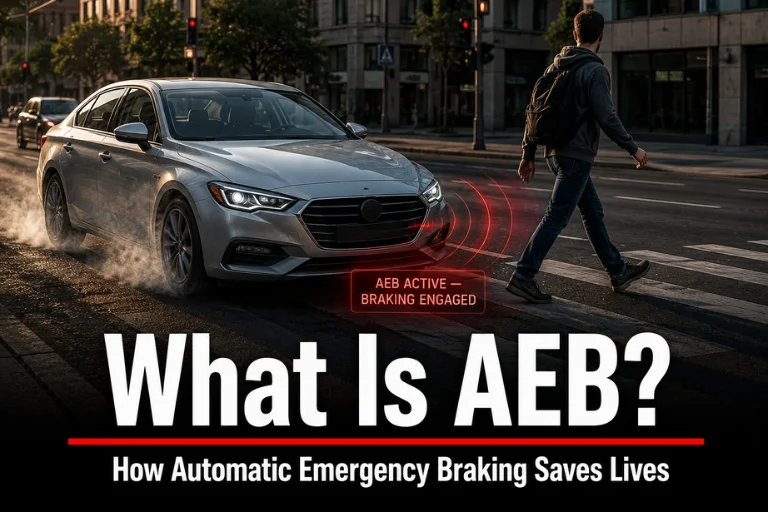

Picture this: you are driving home, momentarily distracted by something in your peripheral vision, when the car ahead of you suddenly slams on its brakes. In the split second before you can react, your vehicle senses the danger and brings itself to a stop — without you touching the brake pedal at all. This is not science fiction. It is AEB, one of the most important and rapidly expanding safety technologies in the modern automotive industry. This complete guide explains exactly what AEB is, how automatic emergency braking actually works, how it relates to brake assist, what its real-world limitations are, and why this technology is about to become mandatory on every new car sold in America.
What Is AEB?
AEB stands for Automatic Emergency Braking, also widely known as Autonomous Emergency Braking. This advanced driver assistance system uses a combination of sensor data to detect an imminent collision and, if the driver fails to react in time, automatically applies the vehicle’s brakes to either avoid the crash entirely or significantly reduce its severity. AEB falls under the broader umbrella of ADAS — Advanced Driver Assistance Systems — and represents one of the most consequential safety advancements in recent automotive history.
The fundamental promise of AEB is simple but powerful: it acts as a final safety net when a driver is distracted, fatigued, or simply unable to react quickly enough to an unfolding hazard. AEB first appeared on vehicles from Volvo, Honda, and Mercedes-Benz, and for much of the past decade it remained largely confined to high-end, luxury models. That has changed dramatically in recent years, with the technology now standard equipment on even entry-level vehicles.
How Does Automatic Emergency Braking Work?
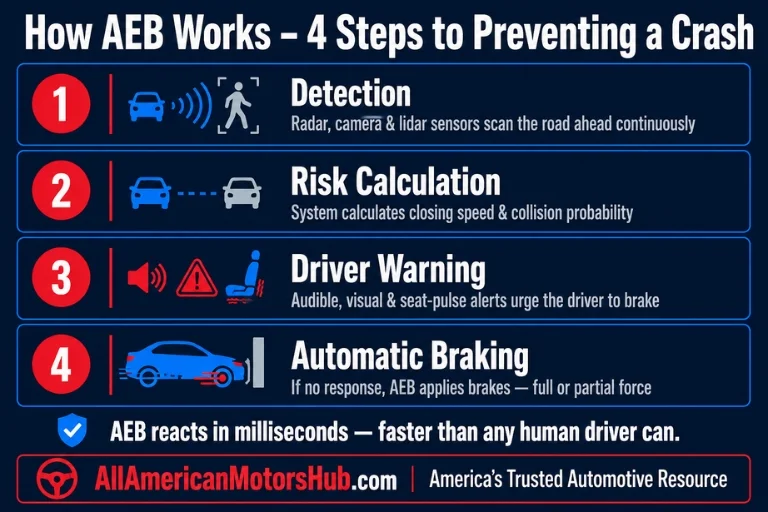
Understanding how automatic emergency braking actually functions reveals why it has become such a trusted and effective safety technology. While the specific implementation varies somewhat between manufacturers, the underlying process follows a consistent four-stage sequence.
Stage 1 — Detection
The system continuously scans the road ahead using one or more sensor types — typically radar, forward-facing cameras, ultrasonic sensors, or in more advanced systems, lidar. These sensors work together to identify vehicles, pedestrians, cyclists, and other obstacles in the vehicle’s path of travel.
Stage 2 — Risk Calculation
Once an object is detected, the system’s onboard computer continuously calculates the closing speed between your vehicle and the obstacle ahead, along with the distance remaining and the time available to react. Using a proprietary algorithm, the system determines whether a collision is becoming probable based on these factors.
Stage 3 — Driver Warning
If the system determines that you have not begun slowing down for the detected hazard, it issues an audible alert, a visual warning on the dashboard, and in many vehicles, a tactile warning such as a pulsation in the driver’s seat cushion or steering wheel. This warning stage gives the driver every opportunity to respond manually before the system intervenes.
Stage 4 — Automatic Intervention
If the driver has not reacted to the warning and the system determines that the object remains in the vehicle’s path, AEB takes over. The system applies the brakes automatically through the vehicle’s anti-lock braking system — and depending on the severity of the detected threat, this application can be sudden and forceful in order to stop the vehicle as quickly as physically possible.
This entire four-stage sequence — from initial detection through full braking intervention — happens within a fraction of a second, far faster than human reaction time allows.
Types of Automatic Emergency Braking Systems
Not all AEB systems are identical. Several distinct variations exist, each designed to address a different driving scenario:
Low Speed AEB
Also called city speed AEB, this version of automatic emergency braking is designed to operate at speeds typically below 55 miles per hour, making it most effective in urban and suburban driving conditions where sudden stops and slow-moving traffic are common.
Highway Speed AEB
This more advanced version of the technology is designed to function at speeds above 55 miles per hour, addressing the higher-speed collision scenarios that occur on highways and interstates.
Rear Automatic Emergency Braking
Rear AEB activates during reverse maneuvers, sensing obstructions behind the vehicle and automatically applying the brakes to prevent a backing collision. This feature is frequently combined with rear cross-traffic alert for comprehensive rear-end protection.
Pedestrian AEB
Systems equipped with pedestrian detection capability can specifically identify pedestrians in the vehicle’s path — not just other vehicles — and trigger braking intervention accordingly. Some advanced systems extend this same detection logic to cyclists and even animals.
The combination of AEB working alongside forward collision warning has demonstrated a significant safety impact. Vehicles equipped with both technologies together have been shown to reduce rear-end crashes by approximately 50 percent, while vehicles using forward collision warning alone — without automatic braking intervention — still achieve a meaningful 27 percent reduction.
AEB and Brake Assist — How They Work Together
A closely related and frequently confused technology is brake assist, which works in conjunction with — but is functionally distinct from — AEB. Brake assist is a system that detects when a driver is attempting an emergency stop based on the speed and force with which the brake pedal is pressed, and then increases brake pressure beyond what the driver’s foot alone is generating, ensuring the vehicle stops as quickly as physically possible.
The relationship between the two systems is complementary rather than redundant. When AEB determines that automatic braking intervention is necessary, brake assist applies the brakes to their maximum effective force, ensuring the most powerful possible stopping performance during the critical moment of intervention. In this sense, brake assist functions as the muscle behind AEB’s decision-making — AEB determines when and whether to brake automatically, while brake assist ensures that braking force is applied at its full potential the instant it is needed.
For drivers who want to understand how their vehicle’s braking hydraulics support technologies like AEB and brake assist, our how to bleed brakes guide explains how properly maintained brake fluid and hydraulic pressure are essential to these systems functioning at peak effectiveness.
Autonomous Emergency Braking — Why the Different Names?
Many drivers researching this technology notice that it is referred to by several different names — AEB, automatic emergency braking, and autonomous emergency braking — and wonder whether these represent different systems. They do not. These terms are used interchangeably across the automotive industry and among regulators, manufacturers, and safety organizations, all referring to the exact same underlying technology and function.
Regardless of which specific term a manufacturer or safety organization uses, the core principle remains identical: sensors detect a probable collision, the system alerts the driver, and if necessary, the vehicle’s brakes are applied automatically without driver input to avoid or reduce the severity of a crash.
Is AEB becoming mandatory in the United States?
Yes — and this is one of the most significant regulatory developments in automotive safety in recent memory. The United States government has established a rule requiring automatic emergency braking systems on all new passenger vehicles sold in America, with full compliance required by September 2029. This regulatory mandate sets a comprehensive performance standard that all new vehicles must meet, marking the formal transition of AEB from an optional luxury feature to a universal safety requirement.
The expected impact of this mandate is substantial. Government safety regulators estimate that making AEB standard equipment across the entire new vehicle fleet will save more than 360 lives annually and prevent approximately 24,000 injuries each year once full compliance is achieved. Separately, earlier industry voluntary commitments toward AEB adoption were projected to prevent an estimated 28,000 crashes and 12,000 injuries.
Under updated regulatory guidance, high-speed AEB systems are now expected to mitigate the impact of collisions at speeds up to 90 miles per hour — a substantial expansion beyond the lower-speed systems that defined the technology’s earliest implementations.
For drivers shopping for a new vehicle and wanting to understand the full landscape of safety technology now becoming standard, our what is traction control guide provides helpful context on how AEB works alongside other essential active safety systems in modern vehicles.
Important Limitations of AEB
While automatic emergency braking represents a genuine advancement in vehicle safety, it is important to understand that the technology is not infallible and carries specific limitations that every driver should be aware of.
AEB Is Not 100 Percent Foolproof
No automatic emergency braking system can guarantee the complete avoidance of every accident. The technology can reduce the severity and likelihood of collisions, but it cannot eliminate crash risk entirely. Drivers must continue to drive attentively and never rely on AEB as a substitute for active, engaged driving.
Reduced Effectiveness at Night
Automatic emergency braking systems are generally less effective in low-light and nighttime conditions, particularly those that rely heavily on camera-based detection rather than radar or lidar, since reduced visibility limits the system’s ability to accurately identify obstacles and pedestrians.
Weather-Dependent Performance
Some basic AEB systems are designed to function reliably only during daylight hours and in clear weather conditions. Heavy rain, snow, fog, and similarly degraded visibility conditions can reduce sensor accuracy and therefore reduce the system’s overall reliability.
Speed-Specific Operation
Not every AEB system functions identically across all speed ranges. Some systems are calibrated specifically for low-speed city driving below 55 miles per hour, while only more advanced systems extend reliable protection to highway speeds. Understanding which type of AEB your specific vehicle has is important for setting realistic expectations about its capabilities.
For drivers maintaining their vehicle’s full suite of active safety technology, our car maintenance checklist ensures that sensors, cameras, and braking components remain in optimal condition to support reliable AEB performance.
How AEB Differs From Forward Collision Warning
It is worth clarifying the distinction between AEB and the related technology known as forward collision warning, since the two are often discussed together but serve different functions. Forward collision warning uses the same general sensor technology — radar and cameras — to monitor the road ahead and alert the driver with audible and visual warnings when a collision risk is detected. However, forward collision warning alone does not take automatic braking action. It is purely a warning system that depends entirely on the driver’s manual response.
AEB represents the more advanced evolution of this same underlying detection technology, adding the critical capability of automatic braking intervention when the driver does not respond to the warning in time. This is why vehicles equipped with both forward collision warning and AEB together achieve significantly greater real-world crash reduction than vehicles with forward collision warning alone.
Conclusion
AEB — whether you call it automatic emergency braking, autonomous emergency braking, or simply AEB — represents one of the most meaningful safety advancements available in modern vehicles. By combining sophisticated sensor detection, real-time risk calculation, and automatic braking intervention working hand in hand with brake assist, this technology provides drivers with a genuine final layer of protection in the critical seconds before a potential collision.
While it is not a substitute for attentive, engaged driving and carries real limitations around weather, lighting, and speed range, the data is clear: vehicles equipped with AEB are dramatically less likely to be involved in rear-end collisions, and as this technology becomes mandatory across the entire new vehicle fleet by 2029, it promises to save thousands of lives and prevent tens of thousands of injuries every single year.
For drivers who want every system in their vehicle — from advanced safety technology to the engine and drivetrain underneath — performing reliably for years to come, explore our full selection of quality used engines for sale and used transmissions for dependable, cost-effective replacements across all makes and models.
Frequently Asked Questions
What is AEB?
AEB stands for Automatic Emergency Braking, also known as Autonomous Emergency Braking. It is an advanced driver assistance system that uses sensors like radar, cameras, and sometimes lidar to detect an imminent collision and automatically apply the brakes if the driver does not react in time, helping to avoid or reduce the severity of a crash.
How does automatic emergency braking work?
Automatic emergency braking works through a four-stage process: detecting an object in the vehicle’s path using sensors, calculating the collision risk based on closing speed and distance, issuing an audible and visual warning to the driver, and if the driver does not respond, automatically applying the brakes through the vehicle’s anti-lock braking system.
What is the difference between AEB and brake assist?
AEB and brake assist work together but serve different functions. AEB determines when automatic braking intervention is necessary based on sensor data and collision risk calculations. Brake assist detects emergency braking attempts by the driver and increases brake pressure beyond what the driver’s foot alone generates, ensuring maximum stopping force is applied during the critical moment of intervention.
Is autonomous emergency braking the same as AEB?
Yes. Autonomous emergency braking and automatic emergency braking are simply two different names for the exact same technology. Both terms are used interchangeably throughout the automotive industry, by regulators, and by safety organizations to describe the same sensor-based automatic braking system.
Will AEB be mandatory on all new cars?
Yes. The United States government has established a rule requiring automatic emergency braking systems on all new passenger vehicles sold in America, with full compliance required by September 2029. This mandate is expected to save more than 360 lives annually and prevent approximately 24,000 injuries per year once fully implemented.
Can AEB prevent every accident?
No. AEB significantly reduces the likelihood and severity of collisions, but it cannot guarantee the complete avoidance of every accident. The technology has real limitations, including reduced effectiveness at night, in poor weather conditions, and depending on the specific system, at certain speed ranges. Drivers should never rely on AEB as a substitute for attentive driving.
What types of automatic emergency braking systems exist?
There are several types of AEB, including Low Speed AEB for city driving under 55 mph, Highway Speed AEB for higher-speed scenarios, Rear AEB for reverse maneuvers, and Pedestrian AEB, which specifically detects pedestrians, cyclists, and sometimes animals in the vehicle’s path in addition to other vehicles.
How effective is AEB at reducing crashes?
Research has found that vehicles equipped with both AEB and forward collision warning together reduce rear-end crashes by approximately 50 percent, while vehicles with forward collision warning alone, without automatic braking intervention, still see a meaningful 27 percent reduction in crashes.

