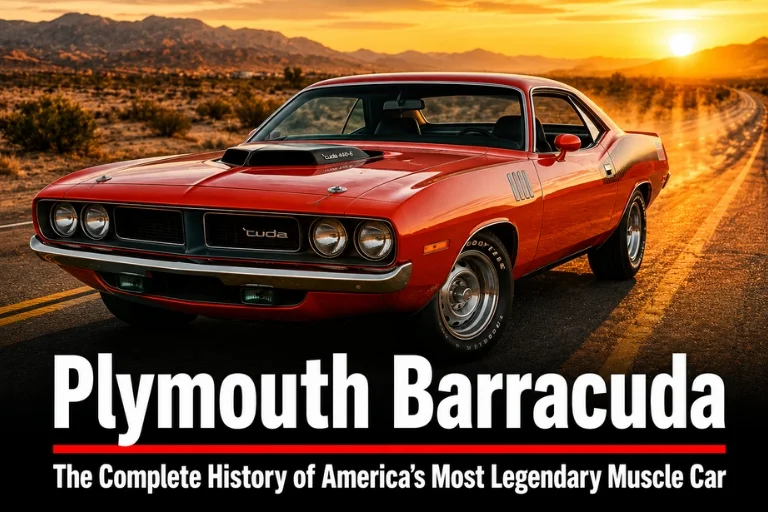

Few automobiles in American automotive history carry the cultural weight, mechanical legend, and raw emotional power of the Plymouth Barracuda. Born at the dawn of the pony car era and refined into one of the most ferocious muscle cars ever built by the close of the 1960s, the Barracuda car represents everything that defined American performance culture — thunderous V8 engines, aggressive styling, and an untamed spirit that no emissions regulation or fuel crisis could fully extinguish before its time. From its humble 1964 debut through the legendary 1970 Plymouth Barracuda Cuda and the distinctive 1971 Plymouth Barracuda Cuda, this is the complete story of one of Mopar’s greatest achievements.
Who Made the Barracuda Car?
The Plymouth Barracuda was designed, engineered, and manufactured by Plymouth — a division of Chrysler Corporation that operated from 1928 until 2001. Plymouth positioned itself as Chrysler’s mass-market volume brand, producing affordable, practical vehicles for everyday American buyers. However, by the early 1960s, the muscle car revolution was reshaping the entire automotive market and Plymouth needed a performance hero to compete.
The Barracuda was the answer. Plymouth engineers developed it as a direct response to growing consumer demand for sporty, performance-oriented coupes, and in a remarkable coincidence of automotive history, it actually beat the Ford Mustang to market by a matter of weeks in April 1964 — making the Plymouth Barracuda technically the first pony car of the American performance era, though it is the Mustang that history remembers as the segment’s commercial trailblazer.
Plymouth produced the Barracuda through three distinct generations spanning from 1964 to 1974 before discontinuing the model entirely as emissions regulations and the energy crisis strangled the muscle car market into submission.
First Generation Plymouth Barracuda — 1964 to 1966
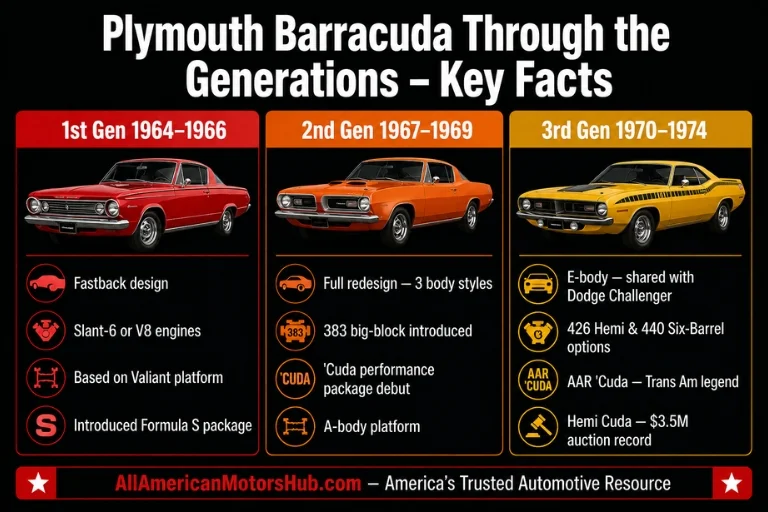
The original Plymouth Barracuda was introduced on April 1, 1964, and its design reflected its origins as a performance upgrade of the existing Plymouth Valiant economy car. Built on the Chrysler A-body platform, the first-generation Barracuda was most visually distinctive for its enormous wraparound rear fastback glass window — one of the largest rear glass panels ever fitted to a production automobile at that time.
Engine options in the first generation were modest by later standards. The base power plant was a 170 cubic-inch Slant-Six producing 101 horsepower, with a 225 cubic-inch Slant-Six and a 273 cubic-inch V8 available as upgrades. The performance-oriented Formula S package — introduced in 1965 — added a high-performance 273 V8 with a four-barrel carburetor, firmer suspension, wide-oval tires, and a tachometer, giving the first generation a genuine performance identity alongside its practical fastback body.
The first-generation Barracuda sold modestly — approximately 64,000 units in 1964 — but was overshadowed dramatically by the Ford Mustang’s blockbuster sales success. Plymouth recognized that a more fundamental transformation was needed to make the Barracuda a serious contender in the rapidly evolving pony car market.
Second Generation Plymouth Barracuda — 1967 to 1969
The 1967 Plymouth Barracuda marked a complete reinvention of the model. Plymouth severed the visible connection to the Valiant entirely and introduced all-new sheetmetal in three distinct body styles — fastback, hardtop coupe, and convertible — for the first time in the nameplate’s history. The new design was cleaner, more mature, and more overtly sporty than the original, with a longer hood and more pronounced body sculpting.
More importantly, the second generation opened the engine bay to genuine performance hardware. The 1968 Plymouth Barracuda brought the critically important new 340 cubic-inch V8 — a lightweight, high-revving small-block engine that produced 275 horsepower and earned an outstanding reputation for its combination of power, reliability, and handling balance. The 383 cubic-inch big-block V8 also joined the lineup during this generation, producing 300 horsepower and marking the Barracuda’s first serious step toward muscle car territory.
The 1968 Plymouth Barracuda also introduced the Formula S performance package to the new body, bundling the high-performance engine options with heavy-duty suspension, upgraded brakes, and wider tires. Auction records from 2025 show 1968 Plymouth Barracuda examples selling for approximately $29,700 to $30,900 for standard models in good condition — reflecting their growing collectibility among enthusiasts who appreciate the transitional significance of this model year.
By 1969, Plymouth introduced the ‘Cuda option package on the second-generation body — a high-performance variant that bundled the most powerful available engines with visual upgrades and performance hardware. The ‘Cuda name had been used informally as a nickname for performance Barracudas since the mid-1960s, but 1969 marked its first official use as a factory-designated package. The seed was planted for what would become the most celebrated version of the car.
Third Generation — The 1970 Plymouth Barracuda Cuda and the E-Body Era
The 1970 Plymouth Barracuda represents the single most significant year in the model’s entire production history — and arguably one of the most important model years in the entire history of American muscle cars.
For 1970, Plymouth moved the Barracuda to the all-new Chrysler E-body platform, which it shared with the newly introduced Dodge Challenger. The E-body brought a dramatically different design philosophy — an aggressive, low-slung, long-hood short-deck silhouette that bore absolutely no visual resemblance to anything Plymouth had produced before. The styling was executed by designer John E. Herlitz and his team, who created one of the most visually compelling muscle car bodies of the entire era.
Plymouth reorganized the 1970 Barracuda lineup into three distinct trim levels. The base Barracuda offered practical daily transportation. The Gran Coupe provided a luxury-oriented option with premium interior appointments. And the ‘Cuda — the performance flagship — offered an extraordinary lineup of V8 engine options that has never been replicated in a single model year by any American automaker before or since.
The 1970 Plymouth Barracuda Cuda engine menu included the 340 cubic-inch four-barrel V8 at 275 horsepower, the 383 cubic-inch Magnum V8 at 335 horsepower, the 440 cubic-inch Super Commando V8 at 375 horsepower, the 440 Six-Barrel with three two-barrel carburetors at 390 horsepower, and at the absolute pinnacle — the legendary 426 cubic-inch Hemi V8 producing 425 horsepower in street tune.
The 426 Hemi was so brutally powerful that it was banned from NASCAR competition. The Hemi Cuda came standard with the iconic Shaker hood scoop — a functional ram-air intake that protruded through a hole in the hood and visibly shook with engine vibration, one of the most dramatic visual statements in the muscle car era. Only 666 Hemi Cuda hardtops and 14 Hemi Cuda convertibles were produced in 1970, making them among the rarest and most valuable American muscle cars ever built.
Plymouth also introduced the one-year-only 1970 AAR ‘Cuda — named for Dan Gurney’s All American Racers team — built specifically to homologate Plymouth’s small-block racing program in the SCCA Trans Am Series. The AAR ‘Cuda used a 340 cubic-inch V8 with three two-barrel Holley carburetors producing 290 horsepower, along with a fiberglass hood with a functional scoop, side-exit exhaust pipes, and unique suspension tuning. Only 2,724 AAR ‘Cudas were produced, making them among the most sought-after Barracuda variants today, with exceptional examples selling for well over $200,000.
Plymouth produced over 55,000 Barracudas in 1970, with base and ‘Cuda hardtop models accounting for the largest share of production.
The 1971 Plymouth Barracuda Cuda — Peak Style
The 1971 Plymouth Barracuda Cuda is often cited by automotive historians as the most visually distinctive year of the entire E-body generation. While the mechanical package was carried over from 1970 with minor retuning, the 1971 model introduced several unique styling elements that set it apart from every other year in the model’s history.
The 1971 was the only year the Barracuda was fitted with four headlights — a design choice that gave it a more aggressive, wide-eyed appearance compared to the dual-headlight setup used in all other years. It was also the only model year to feature fender “gills” — decorative ventilation-style openings pressed into the front fender surfaces of ‘Cuda models — a styling detail that enthusiasts either loved intensely or debated passionately. The 1971 ‘Cuda was also the only year to feature the full-length “Billboard” side decal with the engine displacement called out inside the decal graphic itself.
The rare 1971 Hemi Cuda Convertible is now recognized as one of the most expensive American production automobiles ever sold at auction. Multiple examples have recorded auction results exceeding $2 million, with a top sale of $3.5 million for a 1971 Hemi Cuda Convertible — a figure that reflects the intersection of rarity, provenance, and cultural significance that makes these cars extraordinary even by the standards of the broader classic car market.
The 1970s Barracuda — Decline and Discontinuation
After the extraordinary peak of the 1970 and 1971 model years, the 1970s Barracuda entered a period of rapid decline driven entirely by external pressures rather than engineering failures. Federal emissions regulations introduced from 1972 onward forced Chrysler to dramatically reduce compression ratios across all engine families, slashing power outputs and fundamentally changing the character of every performance engine in the lineup.
The 426 Hemi was discontinued after 1971. The 440 Six-Barrel followed it out of the lineup. By 1972, the once-legendary Barracuda was powered primarily by detuned versions of the 318, 340, and 360 cubic-inch V8 engines that produced a fraction of the power available just two years earlier. Sales declined sharply as buyers recognized that the performance magic had been legislated away.
Plymouth discontinued the Barracuda after the 1974 model year. The final Barracuda cars rolled off the assembly line as shadows of the 1970 and 1971 models that had defined the nameplate — adequate transportation but no longer the tire-shredding performance icons that had electrified the muscle car market at the turn of the decade.
Understanding the mechanical complexity of the engines that powered these legendary cars — particularly the Hemi and big-block V8 families — requires deep knowledge of their internal architecture. Our internal combustion engine guide provides a comprehensive overview of how these legendary power plants were engineered to deliver their extraordinary performance figures.
Barracuda Car Collectibility and Current Market Value
The Plymouth Barracuda has become one of the most aggressively collected American muscle cars in the classic vehicle market. Current average selling prices for third-generation E-body Barracudas sit around $80,000 for well-maintained examples, with base models attainable for approximately half that figure.
Performance variants command dramatically higher premiums. The Hemi ‘Cuda — whether hardtop or convertible — operates in an entirely different pricing tier. Hardtop Hemi Cuda examples in excellent condition regularly sell between $500,000 and $1,000,000 at major auction events. Convertible Hemi Cudas — of which only 14 were produced in 1970 — routinely exceed $2,000,000 and represent the absolute pinnacle of American muscle car collecting.
The AAR ‘Cuda, the 440 Six-Barrel hardtop, and other rare option combinations from the 1970 and 1971 model years all command significant premiums over standard models. For collectors and enthusiasts, the Plymouth Barracuda represents one of the most rewarding segments of the classic American muscle car market — a combination of historical significance, mechanical drama, and genuine rarity that few other name plates can match.
If you are restoring a Barracuda or sourcing a period-correct engine for a Mopar restoration project, our used engine price guide by car type provides helpful benchmarks for sourcing and evaluating replacement power plants at fair market value.
Plymouth Barracuda vs. The Competition
Throughout its three-generation run, the Plymouth Barracuda faced formidable competition from across the American automotive industry. The Ford Mustang was the segment’s commercial juggernaut — outselling the Barracuda by enormous margins throughout most of the model’s production life. The Chevrolet Camaro and Pontiac Firebird brought General Motors’ engineering and marketing resources to bear on the pony car market. And within Chrysler’s own lineup, the Dodge Challenger shared the E-body platform and competed directly for performance-oriented buyers within the same corporate family.
What differentiated the Barracuda — particularly in its peak 1970 and 1971 years — was the sheer breadth and depth of its engine options. No other American manufacturer offered a street-legal production car with the 426 Hemi engine in a body as small and light as the E-body Barracuda. The power-to-weight ratio of the 1970 Hemi Cuda was genuinely extraordinary by any standard, and its quarter-mile performance figures humbled virtually everything else available from any manufacturer in that model year.
For a deeper understanding of how the Barracuda’s muscle car competitors evolved and how their engines compared, our most reliable car engines over 200k miles guide provides perspective on the long-term durability and legacy of the V8 engine families from this era.
The Barracuda’s Cultural Legacy
Beyond its performance credentials, the Plymouth Barracuda earned a significant place in American popular culture. The 1970 Barracuda appeared in major Hollywood films including Jumanji and Two-Lane Blacktop, cementing its status as a visual shorthand for American speed and freedom. Muscle car enthusiasts, collectors, and Mopar devotees have kept the nameplate alive in automotive culture for five decades after production ended.
The closest thing to a modern revival came through Dodge’s announcement of a reimagined Barracuda or Cuda concept in the early 2020s — a project that generated enormous enthusiasm among the enthusiast community before ultimately being set aside as Stellantis shifted its strategic focus toward electrification.
For drivers who want to experience the era of American V8 muscle through ownership of period-correct performance engines, our full selection of quality used engines for sale includes a wide range of V8 power plants that defined the muscle car era alongside the legendary Barracuda.
Conclusion
The Plymouth Barracuda is far more than a collectible artifact of the 1960s and 1970s muscle car era. It is a genuine milestone in American automotive engineering — a car that went from a modest Valiant-based fastback to one of the most powerful and visually dramatic performance machines ever produced in a single decade of continuous development. The 1970 Plymouth Barracuda Cuda with its 426 Hemi engine represents the absolute pinnacle of what American muscle car engineering achieved before regulations brought the horsepower wars to an end.
The 1971 Plymouth Barracuda Cuda stands as the most visually distinctive expression of that same platform. And the 1968 Plymouth Barracuda marks the critical transitional year that gave the model its first genuine performance identity.
Whether you are a serious collector, a Mopar enthusiast, or simply a driver who appreciates the history of American automotive excellence, the Plymouth Barracuda deserves its place at the very top of the conversation about the greatest muscle cars ever built. For more essential reading on the engines and drivetrains that powered the golden era of American performance, explore our complete engine swap guide to understand how these legendary power plants continue to find new homes in modern builds.
Frequently Asked Questions
What is the Plymouth Barracuda?
The Plymouth Barracuda is an American pony car and muscle car produced by Chrysler’s Plymouth division from 1964 to 1974. It was produced across three distinct generations, evolving from a Valiant-based fastback coupe into one of the most powerful and collectible American muscle cars ever built — particularly in its 1970 and 1971 E-body ‘Cuda configuration.
Who made the Barracuda car?
The Barracuda car was made by Plymouth — a division of Chrysler Corporation. Plymouth engineers developed and produced the Barracuda from its April 1964 debut through its final 1974 model year, positioning it as the performance flagship of the Plymouth lineup and a direct competitor to the Ford Mustang, Chevrolet Camaro, and Pontiac Firebird.
What engine did the 1970 Plymouth Barracuda Cuda have?
The 1970 Plymouth Barracuda Cuda offered an extraordinary range of V8 engines including the 340 four-barrel at 275 horsepower, the 383 Magnum at 335 horsepower, the 440 Super Commando at 375 horsepower, the 440 Six-Barrel at 390 horsepower, and the legendary 426 Hemi V8 producing 425 horsepower — the most powerful street-legal V8 engine available in any American production car of that era.
How much is a 1970 Plymouth Barracuda worth today?
Standard third-generation E-body Barracudas average approximately $80,000 for well-maintained examples, with base models attainable for around $40,000. Hemi Cuda hardtops regularly sell for $500,000 to over $1,000,000 at major auction events, while the rare 1971 Hemi Cuda Convertible has achieved auction results exceeding $3.5 million — making it one of the most valuable American production cars ever sold.
What made the 1971 Plymouth Barracuda Cuda unique?
The 1971 Plymouth Barracuda Cuda was the only model year to feature four headlights, unique fender “gills” on ‘Cuda models, the full-length “Billboard” side decals with engine displacement call-outs, and revised grille and taillight styling. It was the final year the 426 Hemi engine was available before federal regulations forced its discontinuation — making 1971 Hemi examples particularly rare and valuable.
What is the 1968 Plymouth Barracuda known for?
The 1968 Plymouth Barracuda is known for introducing the critically important new 340 cubic-inch V8 engine to the lineup — a lightweight, high-revving small-block that earned lasting praise for its combination of power and handling balance. The 1968 model year also continued the Formula S performance package on the new second-generation body and represented the Barracuda’s first serious step toward genuine muscle car performance credentials.
How many Hemi Cuda convertibles were made in 1970?
Only 14 Hemi Cuda convertibles were produced in the 1970 model year, making them among the rarest factory-production American muscle cars ever built. Combined with their performance credentials and stunning visual presence, this extraordinary rarity is what drives their auction values into the multi-million dollar range at major classic car events.
Why was the Plymouth Barracuda discontinued?
The Plymouth Barracuda was discontinued after the 1974 model year due to a combination of federal emissions regulations that dramatically reduced engine output from 1972 onward, the 1973 oil crisis that shifted consumer demand toward economy vehicles, and declining sales that made continued production economically unviable. By 1974, the once-legendary performance lineup had been reduced to a shadow of its 1970 and 1971 peak, and Plymouth chose to end production rather than continue with a compromised product.