
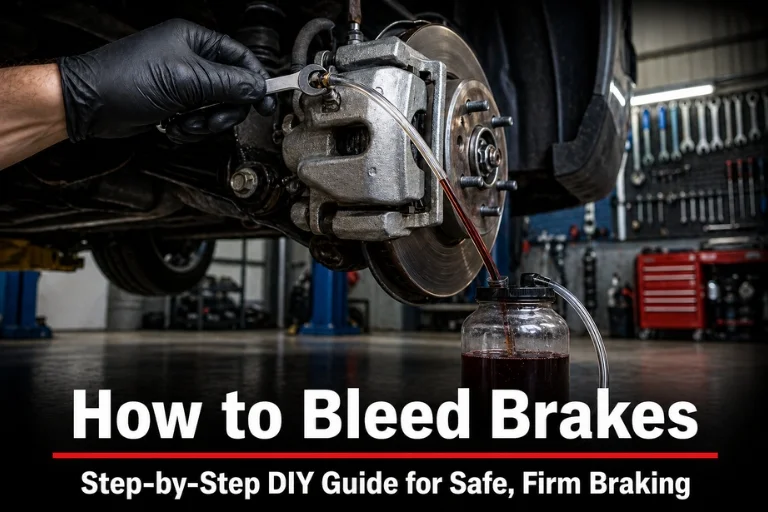

Spongy brake pedal. Longer stopping distances. A soft, mushy feeling when you press the brakes. These are not just inconveniences — they are warning signs of a brake system that has air trapped inside the lines, and they represent a genuine safety risk every time you get behind the wheel. The solution is a procedure called How to Bleed Brakes, and it is one of the most important maintenance tasks any vehicle owner can learn. This comprehensive guide walks you through everything — what bleeding brakes means, why it is necessary, how to bleed car brakes step by step, how long the process takes, and whether you bleed brakes with the car on or off.
What Does It Mean to Bleed Brakes?
Bleeding brakes is the process of purging trapped air bubbles from your vehicle’s hydraulic brake lines. Your brake system relies entirely on hydraulic pressure — when you press the pedal, brake fluid transmits that force from the master cylinder through the brake lines to the calipers, which squeeze the brake pads against the rotors to stop the car.
Brake fluid is incompressible, which is what makes this system work. Air, however, is very compressible. When air enters the brake lines — through a fluid change, a component replacement, or simply through gradual moisture absorption over time — that air compresses instead of transmitting force. The result is a pedal that feels soft, spongy, or travels further than normal before resistance builds. In extreme cases, enough air in the system can cause brake failure entirely.
Bleeding brakes removes that air and restores full, firm hydraulic pressure throughout the system.
Signs You Need to Bleed Brakes
Knowing when your brakes need bleeding prevents small problems from becoming dangerous situations. Watch for these clear warning signs:
Spongy or Soft Brake Pedal This is the most common and obvious symptom. If your pedal compresses further than normal before braking resistance builds, air is almost certainly present in the lines.
Longer Stopping Distances If you notice your vehicle taking more distance to come to a complete stop than it normally does, compromised hydraulic pressure is often the root cause.
Brake Pedal Sinks to the Floor A pedal that travels all the way to the floor under sustained pressure — or after coming to a stop — indicates significant air contamination or a failing master cylinder.
Dark, Dirty, or Contaminated Brake Fluid Brake fluid should be clear to light golden in color. If the fluid in your reservoir appears dark, gritty, or milky white, it has absorbed moisture and should be flushed and replaced during a full bleed.
After Any Brake System Work Any time you open the hydraulic brake system — replacing calipers, brake lines, master cylinder, or even brake pads on some systems — air enters. Always bleed the system afterward to restore proper function.
Should You Bleed Brakes With Car On or Off?
This is one of the most frequently asked questions from first-time DIYers: should you bleed brakes with the car on or off?
The answer is clear — bleed brakes with the engine off. For the vast majority of vehicles, the brake bleeding procedure is performed with the engine switched off. The car’s engine is not needed to generate hydraulic pressure during this process because the assistant pumping the brake pedal creates all the necessary pressure manually.
Running the engine while bleeding brakes on vehicles equipped with brake boosters or ABS systems can actually introduce complications, as the booster and ABS pump may interfere with the fluid flow and pressure during the bleed cycle. The only exception is if a manufacturer’s specific service procedure explicitly requires the engine running — in which case your owner’s manual will state this clearly.
For most standard passenger cars, SUVs, and trucks: engine off, parking brake engaged, wheels chocked.
What You Need to Bleed Brakes
Gather these tools and supplies before you begin:
- Fresh brake fluid in the correct specification (DOT 3, DOT 4, or DOT 5.1 — check your owner’s manual or the reservoir cap)
- Clear plastic tubing approximately 1/4 inch in diameter
- A clean catch bottle or container
- A brake bleeder wrench or box-end wrench in the correct size for your bleeder screws
- A hydraulic floor jack and jack stands
- Wheel chocks
- An assistant to pump the brake pedal
Never reuse old brake fluid that has been expelled during bleeding. Always top up from a fresh, sealed bottle throughout the procedure to prevent the master cylinder from running dry.
How to Bleed Car Brakes – Step-by-Step
Follow this proven sequence to bleed your brakes correctly from start to finish:
Step 1 — Prepare the Vehicle Park on a flat, level surface and engage the parking brake. Place wheel chocks behind and in front of a non-jacked wheel for added security. Jack the vehicle up using the manufacturer-recommended lift points and place it firmly on jack stands. Never work under a vehicle supported only by a floor jack.
Step 2 — Remove the Wheels Remove all four wheels using a lug wrench. This gives you full, unobstructed access to each brake caliper and the bleeder screw on each one.
Step 3 — Check and Fill the Master Cylinder Open the hood and locate the master cylinder reservoir — typically a translucent white plastic container near the firewall on the driver’s side. Check that the fluid level is at the maximum mark. Top up with fresh brake fluid if needed. Keep the cap loosely placed on top throughout the procedure to allow airflow while preventing debris from entering.
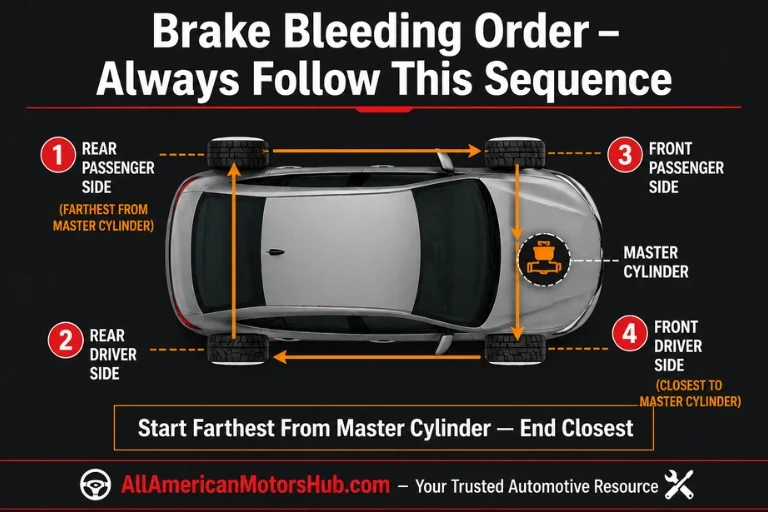
Step 4 — Identify the Correct Bleeding Order Always bleed brakes starting from the wheel furthest from the master cylinder and working toward the closest. For most American-market vehicles this means: right rear → left rear → right front → left front. Always verify the correct order for your specific vehicle in the owner’s manual, as some models differ.
Step 5 — Attach the Tubing to the First Bleeder Screw Locate the bleeder screw on the rear passenger caliper — it is a small bolt typically found at the top of the caliper housing. Secure one end of your clear plastic tubing snugly over the bleeder screw and place the other end into your catch bottle. Add a small amount of fresh brake fluid to the bottom of the catch bottle so the tubing end is submerged — this prevents air from being sucked back into the line during the process.
Step 6 — Have Your Assistant Pump the Brake Pedal With the engine off, instruct your assistant inside the vehicle to slowly pump the brake pedal several times until they feel firm resistance pushing back against the pedal, then hold it fully depressed and maintain steady pressure.
Step 7 — Open the Bleeder Screw Using your brake bleeder wrench, turn the bleeder screw counterclockwise approximately a quarter turn to open it. Fluid will begin flowing through the clear tubing. Watch carefully for air bubbles traveling through the tube with the fluid — these are the contaminants you are removing. Your assistant will feel the pedal slowly drop toward the floor as pressure releases.
Step 8 — Close Before Releasing the Pedal The critical rule of brake bleeding: always close the bleeder screw before your assistant releases the brake pedal. Have your assistant notify you the moment the pedal reaches the floor. Close the bleeder screw immediately by turning it clockwise — do not release the pedal first. Releasing the pedal with an open bleeder screw sucks air directly back into the brake line, undoing your work.
Step 9 — Repeat Until Bubble-Free Instruct your assistant to release the pedal only after the screw is closed. Repeat steps 6 through 8 approximately five times at each wheel, or until the fluid flowing through the tubing is completely clear with no visible air bubbles.
Step 10 — Top Up the Reservoir After completing each wheel, check the master cylinder fluid level and top it up immediately. Never allow the master cylinder to run dry during bleeding — if it empties, air enters the top of the system and you will have to bleed the master cylinder itself as an additional step, significantly extending the job.
Step 11 — Move to Each Remaining Wheel in Order Repeat the full process at the left rear, right front, and left front wheels in sequence. Keep topping up the reservoir after each wheel is completed.
Step 12 — Final Checks Once all four wheels are bled, tighten all bleeder screws firmly and securely. Reinstall the wheels and torque the lug nuts to the manufacturer’s specified torque. Lower the vehicle from the jack stands. Press the brake pedal firmly — it should feel solid and firm with significantly reduced travel compared to before you began.
How Long Does It Take to Bleed Brakes?
How long does it take to bleed brakes? For a first-timer working methodically with a single assistant, expect the full four-wheel process to take between 30 and 60 minutes. Experienced mechanics can complete the same job in 15 to 20 minutes.
The time varies based on several factors: how much air is in the system, how corroded or stubborn the bleeder screws are, how frequently you need to top up the reservoir, and whether any screws require penetrating oil treatment before they will turn.
If a bleeder screw is severely corroded and will not budge with standard wrench pressure, apply penetrating oil liberally and wait 20 to 30 minutes before attempting to turn it again. Never force a stripped or over-torqued bleeder screw — if it snaps off, the caliper will require replacement or professional extraction, which is a far more expensive outcome than a simple bleed.
4 Methods to Bleed Brakes
The two-person pump method described above is the most reliable for beginners, but there are additional approaches worth knowing:
Two-Person Pump Method The traditional and most reliable method for most DIYers. One person pumps and holds the pedal while the other manages the bleeder screws. Ideal for first-timers.
Gravity Bleeding Open each bleeder screw and allow gravity to draw fluid and air out slowly on its own. This works but is slow and less effective at purging stubborn air pockets in complex systems.
Vacuum Pump Bleeding A hand-operated vacuum pump connects directly to each bleeder screw and draws fluid out without requiring an assistant. This method allows one person to bleed brakes solo. Vacuum bleeder kits are available at most auto parts stores and are a worthwhile investment for regular DIY mechanics.
Pressure Bleeding A pressure bleeder kit pressurizes the master cylinder reservoir, pushing fluid through the system without pedal pumping. This is the method most professional shops use and produces the most consistent results.
Regardless of method, the correct bleeding order — starting farthest from the master cylinder — always applies.
How Often Should You Bleed Brakes?
As a general maintenance guideline, brake fluid should be flushed and the system bled every two years or every 30,000 miles — whichever comes first. Some manufacturers specify different intervals, so always reference your owner’s manual for the precise recommendation.
Beyond scheduled maintenance, bleed the brakes any time you service any component of the hydraulic brake system. This includes caliper replacement, brake line repair, master cylinder replacement, or ABS actuator service.
Keeping your brake fluid fresh not only maintains pedal feel but also protects internal brake system components from corrosion caused by moisture-contaminated fluid over time.
For more guidance on keeping your vehicle’s mechanical systems in top condition, explore our full car maintenance checklist to stay on top of every service interval that keeps your car safe and reliable.
Common Brake Bleeding Mistakes to Avoid
Even experienced DIYers sometimes fall into these traps:
Letting the Master Cylinder Run Dry This introduces a fresh air pocket directly into the top of the brake system, requiring additional bleeding effort to purge. Check and top up the reservoir after every single wheel.
Releasing the Pedal Before Closing the Bleeder Screw This is the single most common beginner mistake. Releasing the pedal with an open bleeder screw creates suction that pulls air directly back in. Always close the screw first — then release.
Using the Wrong Brake Fluid Mixing brake fluid types — DOT 3, DOT 4, DOT 5 — can damage seals and rubber brake components. Always confirm the correct specification on the reservoir cap or in the owner’s manual and use only that type.
Skipping the Test Drive After completing all four wheels, always take the vehicle for a careful test drive in a safe area before considering the job done. The pedal should feel firm and consistent. If it still feels spongy, repeat the bleed on any wheel still producing bubbles.
If your brakes were recently serviced and your vehicle has other underlying drivetrain symptoms, it may be worth checking for related issues. Our signs your transmission is going bad guide can help you identify whether additional drivetrain attention is needed alongside your brake service.
When to Seek Professional Help
Bleeding brakes is well within the capability of any careful DIYer. However, there are situations where professional service is the right call:
- Your vehicle has ABS, EBD, or electronic stability control systems — these may require specialized scan tools to cycle the ABS pump during the bleed procedure to ensure all air is removed from the ABS actuator
- A bleeder screw snaps off — professional extraction or caliper replacement is required
- The pedal remains spongy after multiple full bleeding cycles — this may indicate a failing master cylinder, a brake line leak, or a damaged caliper that requires replacement
If your vehicle needs component replacements after a brake system inspection, explore our selection of quality used engines for sale and used transmissions for reliable, cost-effective replacements across all makes and models.
Conclusion
Knowing how to bleed brakes is one of the most valuable safety skills any vehicle owner can develop. A firm, responsive brake pedal is not a luxury — it is the most fundamental safety system your car has. Whether you are dealing with a spongy pedal from trapped air, refreshing old contaminated fluid, or restoring brake performance after a caliper replacement, the two-person pump method outlined in this guide gives you everything you need to complete the job correctly and confidently.
Always bleed brakes with the engine off, always follow the correct bleeding order from farthest to closest wheel, always close the bleeder screw before releasing the pedal, and always top up the master cylinder after every wheel. Follow these rules and your braking system will deliver the firm, reliable stopping power that keeps you and everyone around you safe on the road. For comprehensive vehicle care beyond brake maintenance, our full car components and tools guide covers every system you need to understand as a confident vehicle owner.
Frequently Asked Questions
What does bleeding brakes mean?
Bleeding brakes is the process of removing trapped air bubbles from the vehicle’s hydraulic brake lines. Air in the system causes a soft, spongy pedal and reduced braking power because air compresses under pressure while brake fluid does not. Bleeding restores firm, consistent hydraulic pressure throughout the system.
Should you bleed brakes with the car on or off?
For the vast majority of vehicles, you should bleed brakes with the engine off. The engine is not needed for manual brake bleeding, and running it on vehicles with ABS or power-brake booster systems can interfere with the procedure. Only run the engine during brake bleeding if your vehicle’s manufacturer specifically requires it in the service manual.
How long does it take to bleed brakes?
A full four-wheel brake bleed typically takes between 30 and 60 minutes for a first-time DIYer working with an assistant. Experienced mechanics can complete the process in 15 to 20 minutes. The time can increase if bleeder screws are corroded and require penetrating oil treatment before they will turn.
What order do you bleed brakes?
Always bleed brakes starting from the wheel furthest from the master cylinder and working toward the closest. For most American-market vehicles the correct order is: right rear, left rear, right front, left front. Always verify the specific order for your vehicle in the owner’s manual.
How do you know when brakes are fully bled?
Brakes are fully bled when the fluid flowing through the clear tubing at each wheel is completely free of air bubbles and runs clear with no dark contamination. After all four wheels are complete, the brake pedal should feel firm and solid with noticeably reduced travel compared to before the procedure.
Can you bleed brakes by yourself without an assistant?
Yes. Using a vacuum pump brake bleeder kit, one person can bleed brakes without an assistant. The vacuum pump connects directly to the bleeder screw and draws fluid out without requiring pedal pumping. Gravity bleeding is another solo method, though slower and less effective at purging stubborn air pockets.
How often should you bleed brakes?
Brake fluid should generally be flushed and the system bled every two years or every 30,000 miles as a standard maintenance interval. Additionally, bleed the brakes any time you open the hydraulic brake system to replace any component — calipers, brake lines, master cylinder, or brake hoses.

