
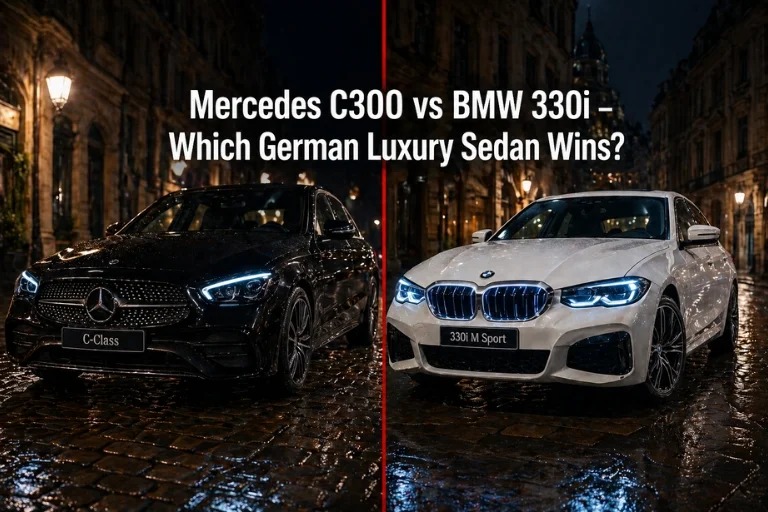

Few rivalries in the automotive world run as deep, as passionate, or as fiercely competitive as the one between the Mercedes-Benz C300 and the BMW 330i. These two German luxury sedans have been trading blows for decades, each generation pushing the other to be better, smarter, and more refined. Both represent the pinnacle of compact luxury engineering. Both are backed by legendary badges. And both will cost you a similar amount of money at the dealership. But they are profoundly different cars with different philosophies — and choosing the wrong one for your lifestyle can mean years of mild disappointment.
This guide breaks down every critical difference between the Mercedes C300 and the BMW 330i — performance, technology, interior quality, MSRP pricing, AWD systems, and long-term ownership — so you can walk into any dealership fully informed and fully confident.
Mercedes C300 vs BMW 330i — The Core Philosophy
Before diving into specifications, it is essential to understand what each car is designed to be at its core, because this philosophical difference shapes every single decision the engineers made.
The Mercedes-Benz C300 is built around luxury, comfort, and visual opulence. It is a car designed to pamper. The interior is a technological showpiece with sweeping curves, premium materials, and a dual-screen MBUX infotainment layout that looks like something from the future. Mercedes buyers tend to prioritize how a car makes them feel sitting in it — and the C300 delivers that feeling in abundance.
The BMW 330i is built around the driver. Every system, every setting, every design decision connects back to the philosophy that driving itself should be engaging, precise, and rewarding. The cockpit is angled toward the driver, the steering communicates road texture with impressive clarity, and the chassis is tuned to make corners feel like something to be enjoyed rather than simply survived.
Both philosophies are valid. Neither is wrong. But understanding which one resonates with you is the fastest path to making the right choice.
Engine & Performance — BMW 330i Horsepower vs Mercedes C300
Both cars share the same headline specification on paper — and that is where the similarity ends.
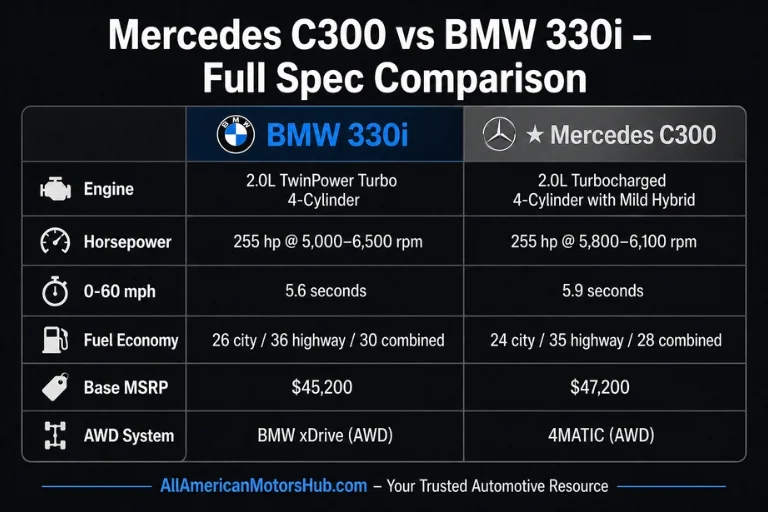
The BMW 330i is powered by a 2.0-liter turbocharged four-cylinder engine producing 255 horsepower and 295 lb-ft of torque, paired with an 8-speed automatic transmission. From a standing start, the 330i reaches 60 miles per hour in approximately 5.3 seconds with Sport mode engaged. The engine pulls with impressive linearity across the rev range, and the 8-speed gearbox shifts with a precision and speed that genuinely adds to the driving experience. BMW 330i horsepower may match the C300 on paper, but the way that power is delivered feels sharper and more purposeful.
The Mercedes C300 also uses a 2.0-liter turbocharged four-cylinder engine producing 255 horsepower, but with a slightly higher 295 lb-ft of torque figure matched by a similarly equipped 9-speed automatic transmission. The C300’s zero-to-60 time comes in at approximately 5.7 seconds — a touch slower than the 330i but smooth and effortless in character. The C300 is tuned for seamless, hushed acceleration rather than the exciting surge the BMW delivers. Where the 330i engine feels eager, the C300 engine feels composed.
For fuel economy, the BMW 330i holds a measurable edge — averaging around 31 miles per gallon combined compared to the C300’s approximately 29 mpg combined. Over thousands of miles, that gap adds up meaningfully at the pump.
BMW 330i xDrive vs Mercedes C300 4MATIC — AWD Comparison
All-wheel drive is one of the most important buying decisions within this segment, particularly for buyers in northern climates or states with harsh winter conditions.
The BMW 330i xDrive uses BMW’s intelligent torque vectoring all-wheel-drive system that monitors road conditions in real time and distributes power between the front and rear axles dynamically. Critically, the xDrive system maintains a strong rear-wheel-drive bias under normal conditions — preserving the engaging, balanced feel that defines the BMW 330i driving experience. When grip is needed, xDrive responds in milliseconds. The BMW 330i xDrive adds approximately $2,000 to the base price and is widely considered one of the most sophisticated AWD systems in the compact luxury segment.
The Mercedes C300 4MATIC uses a permanent all-wheel-drive system that provides exceptional all-weather confidence and stability. The 4MATIC system prioritizes traction and security over driver engagement — making it exceptionally planted during wet or slippery conditions. Some reviewers note that the 4MATIC setup introduces a degree of understeer that the xDrive system manages more gracefully, but for buyers whose primary concern is all-weather safety rather than dynamic driving, the C300 4MATIC is a superb choice.
The price of C300 Mercedes-Benz with 4MATIC AWD starts at approximately $2,000 above the rear-wheel-drive base model — virtually identical to the xDrive premium on the 330i, making this a true apples-to-apples comparison at the all-wheel-drive level.
Interior Quality — Technology, Comfort & Design
The interior is where the C300 and 330i diverge most dramatically in character, and where personal preference plays the largest role in the buying decision.
Inside the Mercedes C300, the cabin is an architectural statement. The dashboard features Mercedes’ dual-screen MBUX layout — a 12.8-inch central touchscreen and an 11.9-inch digital instrument cluster — creating a widescreen visual experience that remains one of the most visually striking interiors in the luxury sedan segment. The system includes a fingerprint scanner for personalized driver profiles, voice command recognition, 5G connectivity, ambient interior lighting in 64 color options, and available Burmester 3D surround sound. Every surface feels deliberate and premium. Noise isolation is class-leading — the C300 cabin at highway speeds is impressively hushed. The Mercedes C300 is designed for passengers as much as it is for the driver, with generous rear legroom and exceptional ride comfort.
Inside the BMW 330i, the cockpit is angled toward the driver in a way that immediately communicates the car’s sporting intent. The latest iDrive infotainment system is centered on a curved display combining a 12.3-inch instrument cluster and a 14.9-inch central screen on higher trims. The system is widely praised for intuitive operation, wireless Apple CarPlay and Android Auto, and fast response times.
The BMW M Sport steering wheel — available in the BMW 330i M Sport package — is a particular highlight, thick and well-shaped, with paddle shifters that transform every gear change into a tactile event. Ambient lighting, premium leather, and heated seats are available across multiple trim levels. While the 330i’s interior lacks some of the visual drama of the C300, it rewards the driver with a sense of purposeful, well-crafted functionality that grows on you with every mile.
BMW 330i M Sport — The Performance Package Explained
For buyers who want the BMW 330i to look and feel as sporty as it drives, the BMW 330i M Sport package is the single most popular configuration in the lineup — and for good reason.
The M Sport package adds sport-tuned adaptive suspension that sharpens body control without sacrificing daily ride quality, M Sport aerodynamic bodywork with a front splitter and rear diffuser, unique 18-inch M alloy wheels, M Sport brakes, a sport steering wheel, and M-specific interior trim with contrast stitching throughout. The visual transformation from a standard 330i to an M Sport model is significant — the car looks genuinely aggressive and purposeful rather than simply elegant.
The BMW 330i M Sport adds approximately $3,500 to $4,000 to the base 330i price but represents exceptional value for buyers who prioritize the complete performance-oriented package. It is by far the most recommended configuration for driving enthusiasts.
MSRP Pricing — Mercedes C300 Price vs BMW 330i
One of the most common questions buyers ask is how these two cars compare on price. The answer is that they are remarkably close in base configuration, with pricing diverging meaningfully as options are added.
The BMW 330i starts at approximately $43,800 MSRP for the rear-wheel-drive configuration. Adding xDrive brings the price to approximately $45,800. The M Sport package adds another $3,500 to $4,000, placing a well-equipped 330i M Sport xDrive comfortably in the $50,000 range before additional options.
The price of the C300 Mercedes-Benz begins at approximately $44,600 MSRP for the rear-wheel-drive model. The Mercedes C300 4MATIC adds approximately $2,000, with the AMG Line package and technology bundles pushing well-equipped examples past $55,000.
Both vehicles occupy the same pricing tier, and both offer exceptional value relative to what they deliver. The 330i holds a modest advantage in base pricing, while the C300 generally retains slightly less resale value over a five-year period — the 330i depreciates at approximately 51.4% versus the C300’s 52.5% over five years.
To understand how ownership costs compare beyond the purchase price, including engine replacement costs and long-term maintenance planning, our rebuilt vs used engine guide offers practical insights for luxury car owners planning ahead.
Safety Ratings — How Do They Compare?
Both the Mercedes C300 and BMW 330i earn perfect five-star overall safety ratings from the NHTSA — reflecting the serious engineering investment both brands make in passive and active safety systems.
Standard safety technology across both models includes automatic emergency braking, lane-keeping assist, blind-spot monitoring, adaptive cruise control with stop-and-go capability, rear cross-traffic alert, and a 360-degree camera system. Both vehicles also offer driver attention monitoring that detects fatigue and inattentiveness.
The Mercedes C300 adds a center airbag between the front seats as standard — a segment-first feature that earned significant attention when introduced. The BMW 330i counters with the available Driving Assistance Professional package, which adds extended hands-free driving capability and lane-change assist on mapped highways.
Long-Term Ownership — Reliability & Maintenance
Both German luxury sedans require premium unleaded fuel, manufacturer-approved synthetic engine oil, and adherence to service schedules that reflect the complexity of their engineering.
BMW’s TeleServices system monitors vehicle health in real time and proactively schedules maintenance appointments before problems develop. Mercedes-Benz offers a similar connected diagnostic system through the Mercedes Me platform. Both brands have expanded dealership service pickup and drop-off programs that bring significant convenience to ownership.
In long-term reliability studies, both the C-Class and 3 Series score competitively, though individual model years can vary. Buyers should always review reliability data for the specific year they are considering and factor in the cost of extended warranty coverage for vehicles purchased beyond the standard four-year bumper-to-bumper warranty period.
When engine components eventually need attention on either model, our BMW 330i engine guide and Mercedes-Benz engine options provide trusted replacement resources to keep your investment performing at its best.
Which Car Should You Choose?
The honest answer is that neither the Mercedes C300 nor the BMW 330i is definitively better — they are the best versions of two very different visions of what a luxury sedan should be.
Choose the Mercedes C300 if:
- You prioritize interior visual drama and opulence over driving engagement
- Passenger comfort and cabin refinement matter as much as driver enjoyment
- The MBUX dual-screen technology experience excites you
- You prefer a quieter, more comfort-biased ride character
Choose the BMW 330i if:
- Driving itself is a priority and you want the car to reward your inputs
- You value precise, communicative steering and rear-wheel-drive dynamics
- The M Sport package’s athletic appearance appeals to your aesthetic
- Fuel efficiency at 31 mpg combined is a meaningful consideration
For buyers who want the very best of the sporty side, add the M Sport package. For those who want the maximum luxury experience, the C300 with the AMG Line interior package is hard to argue with.
Our full used engine price guide by car type helps prospective buyers understand long-term component costs for both German luxury models before making a final decision.
Conclusion
The Mercedes C300 vs BMW 330i debate has no wrong answer — only a right answer for you personally. The C300 is a masterpiece of luxury and technology designed to make you feel pampered every time you sit inside it. The 330i is a masterpiece of driver engagement and athletic precision designed to make every road feel like it was built specifically for your enjoyment.
Both start at under $45,000, both deliver world-class engineering, and both will serve their owners exceptionally well for years with proper maintenance. The choice ultimately comes down to one question: do you want to be transported, or do you want to drive? Whichever direction you choose, explore our used transmissions for reliable, cost-effective drivetrain solutions that keep both German luxury vehicles performing at the level they were engineered to deliver.
Frequently Asked Questions
What is the main difference between the Mercedes C300 and BMW 330i?
The fundamental difference is philosophy. The Mercedes C300 is comfort and luxury-focused, with a stunning interior and plush ride character. The BMW 330i is driver-focused, with sharper steering, more engaging dynamics, and a cockpit designed to reward the person behind the wheel. Both produce 255 horsepower but deliver that power in distinctly different ways.
What is the BMW 330i horsepower?
The BMW 330i produces 255 horsepower and 295 lb-ft of torque from its 2.0-liter turbocharged four-cylinder engine. It reaches 60 mph in approximately 5.3 seconds. Buyers wanting more power can step up to the M340i, which uses a 3.0-liter inline six-cylinder producing 382 horsepower.
What is the price of the C300 Mercedes-Benz?
The Mercedes-Benz C300 starts at approximately $44,600 MSRP for the rear-wheel-drive base model. The Mercedes C300 4MATIC adds approximately $2,000 to that figure. Well-equipped examples with AMG Line packages and technology bundles typically land in the $55,000 to $60,000 range before taxes and fees.
What is the difference between BMW 330i xDrive and Mercedes C300 4MATIC?
The BMW 330i xDrive uses a rear-biased torque-vectoring AWD system that preserves BMW’s signature rear-wheel-drive feel while adding all-weather capability. The Mercedes C300 4MATIC uses a permanent AWD setup that prioritizes traction and stability. The xDrive system is generally considered sportier; the 4MATIC system is considered more security-focused.
What does the BMW 330i M Sport package include?
The BMW 330i M Sport package adds sport-tuned adaptive suspension, M aerodynamic bodywork, 18-inch M alloy wheels, M Sport brakes, a performance steering wheel with paddle shifters, and M-specific interior trim. It costs approximately $3,500 to $4,000 above the standard 330i base price and is the most recommended configuration for driving enthusiasts.
Which is more fuel efficient — the C300 or 330i?
The BMW 330i holds a meaningful fuel economy advantage, averaging approximately 31 mpg combined versus the Mercedes C300’s approximately 29 mpg combined. On highway routes, the 330i can achieve up to 36 mpg, making it a more economical choice for high-mileage drivers.

