
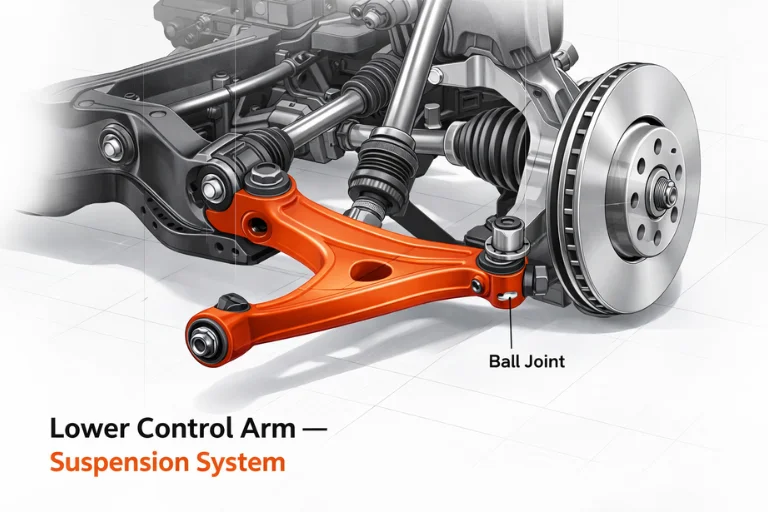

If your car has been making a clunking sound over bumps, pulling to one side, or wearing through tires faster than expected, your control arm could be the problem. This suspension component quietly does one of the most important jobs in your vehicle — keeping your wheels properly connected to the frame — and when it starts to fail, you’ll feel it immediately.
This guide covers everything you need to know about the control arm: what it is, how it works, the top bad control arm symptoms to watch for, what causes failure, and exactly when to replace it.
Table of Contents
What Is a Control Arm?
A control arm is a structural suspension component that acts as the physical link between your vehicle’s frame (the chassis) and its wheel hub assembly or steering knuckle. Without it, your wheels would have no controlled, stable connection to the rest of the car.
Most vehicles have at least one lower control arm on each front wheel. Vehicles with a double wishbone suspension design use both upper and lower control arms per side. The control arm moves up and down as your car travels over road imperfections, allowing the wheel to rise and fall with the terrain while keeping the tire flat and firmly in contact with the road.
Each control arm has two key sub-components that tend to fail before the arm itself:
- Bushings — Rubber (or polyurethane) inserts at the frame mounting points that absorb vibration and allow controlled pivot movement.
- Ball joints — Pivot points that connect the arm to the steering knuckle, allowing the wheel to turn and articulate simultaneously.
Most modern cars with strut-type suspensions have one lower control arm on each wheel, front and rear. In most control arms, the two lower parts of the “A” are attached to the frame via control arm bushings, while the top of the “A” is attached to the steering knuckle by way of a ball joint.
Control arms are typically made from stamped steel, forged steel, or aluminum. Each material has different strength and weight tradeoffs — aluminum arms are lighter and common on performance vehicles, while steel arms are more common on trucks and heavy-duty platforms.
How a Lower Control Arm Works
The lower control arm specifically handles the heaviest job: it bears much of the vehicle’s weight load while simultaneously allowing up-and-down wheel travel. When you hit a pothole, the lower control arm compresses and pivots, absorbing the impact before it reaches the frame or cabin. This is why bad lower control arm symptoms tend to be more severe and dangerous than upper arm issues.
The lower control arm is like a bridge that connects the vehicle frame to the wheels. It helps your vehicle drive more comfortably with less jumping over potholes or terrain, making the wheels move up and down on the road for the best angle.
6 Bad Control Arm Symptoms You Shouldn’t Ignore
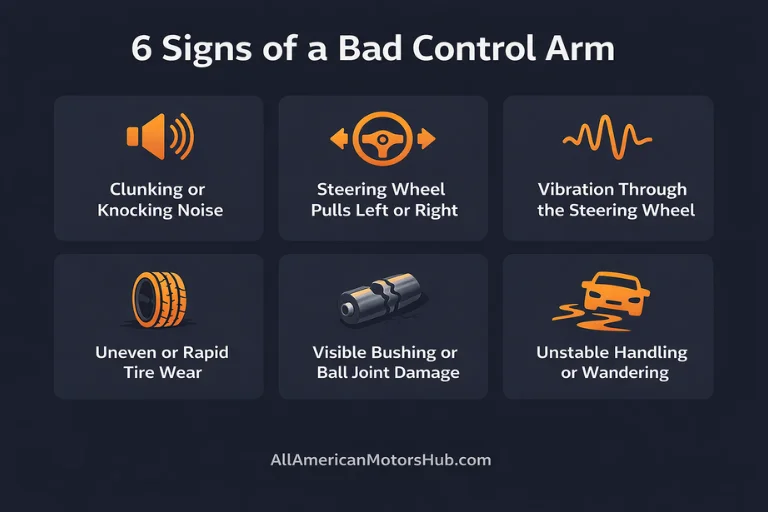
Recognizing bad control arm symptoms early is the key to avoiding costly downstream damage to your tires, alignment, and other suspension components. Here are the six most common warning signs:
1. Clunking or Knocking Noises
This is usually the first symptom drivers notice. A bad control arm sound is typically described as a solid “clunking” noise. Driving over bumps or anything that jostles the suspension puts pressure on the control arm joints. If the joints are worn or loose, they will be unable to control the movement, which is typically followed by a “thunk” as the metal control arm slams into the bad control arm bushing. The noise tends to worsen over potholes, speed bumps, and rough roads. If you hear it consistently, don’t wait — a clunking arm that’s left unaddressed will damage surrounding parts quickly.
2. Steering Wheel Pulling Left or Right
A bad lower control arm may cause your steering wheel to pull too much to the right or left side as you’re driving. This will be more difficult to keep your vehicle straight on the road — it won’t be impossible, but it will require more effort on your part to stabilize the steering wheel. This symptom is especially dangerous at highway speeds where even small steering corrections matter.
3. Vibration Through the Steering Wheel
A failing control arm can cause a continuous vibration that can be felt through the steering wheel. Changes in speed can cause the vibration to fluctuate. Worn bushings often cause wheel shimmy. If the vibrations increase when you accelerate, the control arm — or its bushings specifically — is a likely culprit.
4. Uneven or Premature Tire Wear
When a control arm fails to hold proper wheel geometry, the tire contacts the road at an incorrect angle. Inner tread wear typically means you have issues with the lower control arm. Outer tread wear means you have problems with an upper control arm. If you notice premature tire wear, don’t just replace the tires — find the cause of the tire wear, as a bad control arm can be throwing off your wheel alignment.
5. Wandering or Loose Steering Feel
Loose control arm joints can make steering seem loose or delayed. Steering linkage relies on pushing and pulling the wheel hubs to change the tire angle so you can go around corners. If a portion of that movement is absorbed by worn out control arm bushings, it won’t move the tires in a way the driver expects. Vehicles with wandering steering can be extremely dangerous during emergency maneuvers.
6. Rough, Bouncy Ride Quality
If the control arms are going bad, they no longer have the ability to reduce the impact of driving over a bump, resulting in a rougher ride. If your car suddenly feels like it’s floating or bouncing excessively over roads it used to handle smoothly, degraded control arm bushings are a common cause alongside worn shocks or struts.
Bad Lower Control Arm Symptoms vs. Upper Control Arm
While both upper and lower arms share similar failure symptoms, there are some meaningful differences:
| Symptom | Lower Control Arm | Upper Control Arm |
| Clunking over bumps | Very common | Common |
| Steering pull | Common | Less common |
| Inner tire wear | Primary indicator | Less common |
| Outer tire wear | Less common | Primary indicator |
| Vibration at speed | Common | Common |
| Vehicle nose-diving when braking | Common | Less common |
| Steering vagueness/wander | Less common | More common |
The lower control arm fails more frequently because it carries the vehicle’s weight load. Lower control arm failure more commonly causes clunking and tire wear issues, while upper arm wear tends to produce more steering vagueness and instability.
What Causes Control Arm Failure?
Control arms are built to last — under normal driving conditions, control arms can last 100,000 miles or more, sometimes lasting the vehicle’s lifetime with only ball joint replacement needed. However, several factors accelerate failure:
Normal Wear and Tear — Over tens of thousands of miles, rubber bushings dry out, crack, and lose their elasticity. Ball joints wear down from constant pivoting under load.
Road Impacts — Hitting a deep pothole, a curb, or a raised median can bend the control arm itself or immediately damage the ball joint. A single hard impact can cause instant failure in an otherwise serviceable arm.
Environmental Corrosion — Steel control arms in salt-belt states are particularly prone to rust. The metal body of a steel control arm can corrode to the point of failure, though aluminum control arms are fairly robust against this.
Deferred Maintenance — Once one bushing starts to fail, the increased play it allows accelerates wear on adjacent components. Catching bushing wear early prevents the damage from spreading to ball joints and other suspension parts.
How to Diagnose a Bad Control Arm
You don’t need a lift to perform a basic diagnosis. Here’s a quick at-home inspection process:
- Listen on rough roads — Drive over a speed bump at low speed. A clunking sound from the front end is a red flag.
- Feel the steering wheel — Note any pulling, vibration, or looseness at varying speeds.
- Inspect the tires — Check for uneven tread wear along the inner or outer edges.
- Visual inspection under the car — With a flashlight, look for cracked, torn, or collapsed bushings. Any visible deformation is a sign of failure.
- Wheel movement test — With the vehicle safely lifted on jack stands, grab the wheel at the 6 and 12 o’clock positions and try to rock it vertically. As a general rule of thumb, some experts say 1/8″ of movement or more indicates a rubber control arm bushing is worn and should be replaced.
According to MOOG Parts, a leading OEM suspension component manufacturer, regular suspension inspections — especially any time other suspension maintenance is performed — are the best way to catch control arm wear before it becomes dangerous.
Control Arm Replacement: What to Expect
Cost
Control arm replacement can cost $200 to $800 for parts and labor at a repair shop, depending on the vehicle. DIY replacement typically costs $50 to $400 for parts. Labor typically runs $100 to $300 depending on your car, so the total is usually $150 to $500 per arm. Luxury or performance cars can run higher.
Replace in Pairs
You should replace control arms in left/right pairs to prevent uneven handling. If one bushing or ball joint on a control arm needs replacement, replace the others as well. If one side has worn to the point of replacement, the other side is typically close behind.
Always Get an Alignment
You’ll still need a wheel alignment after replacement. New parts change the angle of the wheels, and realigning them ensures even tire wear and safe handling. Skipping the alignment after a control arm replacement is one of the most common and costly mistakes drivers make.
Bushing-Only vs. Full Assembly Replacement
If the problem is limited to the rubber bushings, the special tools and time required to replace the bushings may lead your mechanic to suggest a new control arm (with new bushings already installed) as a more cost-effective solution. Full assembly replacement is often faster and more practical on newer vehicles where the arm, bushings, and ball joint come as one unit.
Can You Drive with a Bad Control Arm?
In short: not safely, and not for long.
A mildly worn bushing might be drivable for a short period if the symptoms are subtle. But a failing ball joint or severely degraded bushing is a different matter entirely. Bad control arms could potentially cause a loss of control, resulting in a collision. If the ball joint separates at highway speed, you lose the ability to steer or brake effectively.
If you’re experiencing any of the symptoms listed above — especially clunking, pulling, or vibration — have your vehicle inspected by a professional before taking it on the highway.
Maintenance Tips to Extend Control Arm Life
- Avoid hard impacts — Slow down over potholes and rough terrain when possible.
- Regular suspension checks — Have control arms inspected during tire rotations or brake service.
- Replace worn bushings early — Catching bushing wear before it spreads to ball joints saves money.
- Keep up with alignment — Proper alignment reduces lateral stress on control arm components.
- Rust prevention — In salt-belt climates, undercoating treatments can significantly extend the life of steel control arms and mounting hardware.
For broader vehicle care, explore our engine and vehicle maintenance guide covering the full range of preventative service practices that keep your car running long-term.
Conclusion
The control arm is one of the most critical components in your vehicle’s suspension system — quietly maintaining wheel alignment, absorbing road impacts, and keeping you safe every time you steer. Recognizing bad control arm symptoms like clunking, pulling, vibration, and uneven tire wear early gives you the opportunity to address the problem before it becomes an expensive or dangerous failure.
Bad lower control arm symptoms in particular deserve prompt attention. The lower arm carries the vehicle’s weight load and fails more frequently than the upper arm. If you’re experiencing any of the warning signs covered in this guide, schedule a suspension inspection as soon as possible.
Need help sourcing replacement parts or evaluating your vehicle’s mechanical condition? Browse our full selection of used engines or reach our team directly at 1-888-799-0188 — we’re here to help you find the right parts at the right price.
Frequently Asked Questions
What is a control arm on a car
A control arm is a suspension component that connects your vehicle’s frame to the wheel hub or steering knuckle. It allows the wheel to move up and down with road conditions while maintaining proper alignment and tire contact. Most cars have at least one lower control arm per front wheel.
What are the symptoms of a bad lower control arm?
The most common bad lower control arm symptoms include a clunking or knocking noise over bumps, steering wheel pulling to one side, vibration at speed, uneven inner tire wear, and an overall rough or unstable ride feel. If you notice more than one of these symptoms, a professional inspection is recommended.
How long do control arms last?
Control arms typically last 90,000 to 150,000 miles under normal driving conditions. Aggressive driving, frequent pothole impacts, and wet or salty road environments can shorten this lifespan significantly. Bushings often wear before the arm itself does.
Do I need to replace both control arms at once?
Not always required, but it is strongly recommended. If one control arm has worn to the point of replacement, the other side is likely near the same wear threshold. Replacing both ensures balanced handling and prevents an uneven repair job from causing new alignment issues.
How much does it cost to replace a lower control arm?
Expect to pay $150 to $500 per arm, including parts and labor, for most standard vehicles. Luxury, European, or high-performance vehicles can cost more. Always budget an additional $75 to $150 for a wheel alignment after the replacement.
Can I drive with a bad control arm?
Short distances with mild symptoms may be possible, but driving with a failing control arm — especially one with ball joint wear — is genuinely dangerous. A complete ball joint failure while in motion can cause an immediate loss of steering control. Replace worn control arms as soon as they’re diagnosed.

