
Table of Contents
Driving should be effortless, intuitive, and enjoyable — and nothing makes that more achievable than understanding your vehicle’s transmission. Whether you are shopping for your next car, troubleshooting a current one, or simply curious about what happens beneath the gear shifter, this guide covers everything you need to know about the automatic transmission, how it compares to a manual, what AMT means, and which option suits your driving lifestyle best.
What Is an Automatic Transmission?
An automatic transmission, often referred to simply as AT, represents a marvel of modern automotive engineering that simplifies the driving experience. Unlike manual transmissions, which require drivers to manually shift gears using a clutch pedal and gear lever, automatic transmissions handle gear changes automatically, allowing for a smoother and more convenient drive.
At its core, an automatic transmission is a self-operating gearbox. The transmission’s computer system continuously monitors various parameters, such as vehicle speed, engine speed, and throttle position, to determine the optimal time to shift gears. This ensures that the engine runs at its most efficient speed range, providing a balance between power and fuel efficiency.
The technology has come a long way since General Motors introduced the first mass-produced automatic — the Hydramatic four-speed — back in 1939. Today, automatic transmissions are now the norm, with an estimated 90% of vehicles on the road featuring automatic gearboxes.
How Does an Automatic Transmission Work?
The magic behind automatic shifting lies in several key components working in harmony:
The Torque Converter Automatic transmissions use a torque converter attached to the drivetrain which acts like a clutch on a manual transmission. Fluid is used to lock and unlock planetary gears to shift between gear ratios. This shifting happens automatically — the driver doesn’t have to do anything.
The Planetary Gear Set A hydraulic automatic transmission uses planetary gear sets instead of the manual transmission’s design of gears lined up along input, output, and intermediate shafts. To change gears, the hydraulic automatic uses a combination of internal clutches, friction bands, or brake packs. These devices are used to lock certain gears, thus setting which gear ratio is in use at a given time.
The Valve Body The valve body is the hydraulic control center. It routes pressurized transmission fluid to the correct clutch packs and bands at precisely the right moment — all without any input from the driver.
The ECU (Electronic Control Unit) Modern automatic transmissions rely heavily on the ECU, which processes real-time sensor data — vehicle speed, throttle angle, engine load — and determines when to shift, how firmly, and how quickly.
5 Types of Automatic Transmission Explained
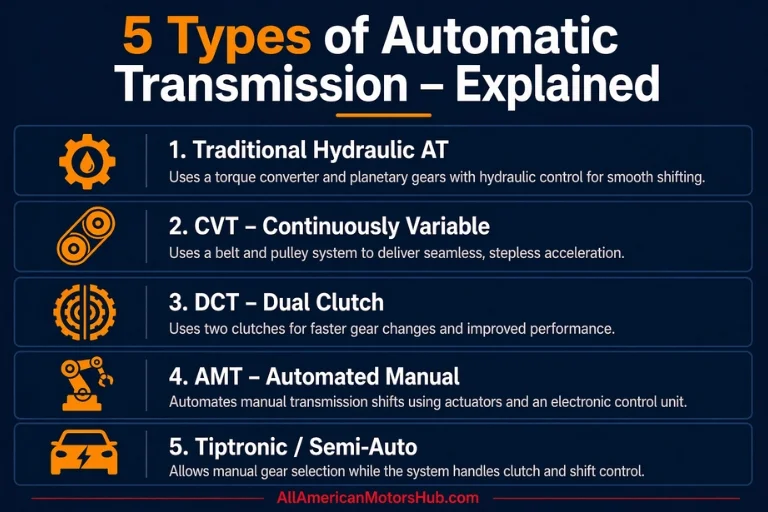
Not all automatic transmissions are created equal. Each type offers a distinct driving experience and set of trade-offs:
1. Traditional Hydraulic Automatic (AT) This is the most widely used type of automatic transmission. It utilizes a planetary gear system and hydraulic controls to shift gears. These transmissions are known for their reliability and smooth operation. GM EnVolve Ideal for daily commuting, long highway drives, and family vehicles.
2. Continuously Variable Transmission (CVT) Unlike traditional automatic transmissions, CVTs do not use fixed gear ratios. Instead, they employ a system of pulleys and a belt to provide an infinite range of gear ratios. This allows for seamless acceleration and improved fuel efficiency. GM EnVolve CVTs are popular in compact cars, hybrids, and fuel-economy-focused vehicles.
3. Dual-Clutch Transmission (DCT) This type of transmission uses two separate clutches for odd and even gears, allowing for faster and more efficient gear changes. DCTs are often found in high-performance vehicles due to their quick response times.
4. Automated Manual Transmission (AMT) An Automated Manual Transmission (AMT) is essentially a manual transmission equipped with robotic actuators and sensors. These automated systems handle the clutch operation and gear shifting automatically, removing the need for a clutch pedal and manual gear changes from the driver. Business AMTs are especially popular in budget-friendly and entry-level vehicles worldwide.
5. Tiptronic / Semi-Automatic This hybrid system allows the driver to manually select gears using paddle shifters behind the steering wheel while retaining the automatic option whenever desired — giving drivers the best of both worlds.
Automatic vs Manual Transmission – The Real Difference
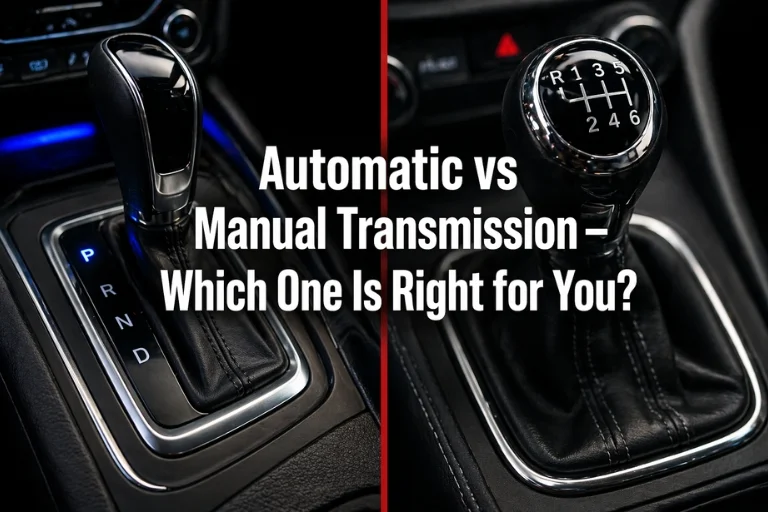
This is the question every car buyer eventually asks: should I choose an automatic or manual transmission? The honest answer depends entirely on how and where you drive.
Automatic transmissions are popular in the US — 95% of the cars sold have automatic transmissions. They are easy to use, great in stop-and-go traffic, and good for beginners, though they come at a higher purchase price and historically higher repair costs.
Manual transmissions, on the other hand, offer something automatics cannot fully replicate — driver engagement. With greater control over gear shifting, skilled drivers can optimize fuel consumption, often outperforming automatics by three to four miles per gallon. Manual transmissions are also simpler and often cheaper to maintain due to fewer moving parts.
However, the fuel economy advantage of manuals is shrinking fast. Modern automatic transmissions are designed to optimize gear shifts, and in many cases, they offer fuel efficiency equal to or better than manual transmissions, especially during city driving and stop-and-go traffic.
Here is a quick at-a-glance comparison:
| Feature | Automatic | Manual |
| Ease of Use | ✅ Very Easy | ❌ Requires Practice |
| Fuel Economy | ✅ Modern AT = Comparable | ✅ Slight Edge Traditionally |
| Purchase Cost | ❌ Higher | ✅ Lower |
| Repair Cost | ❌ Higher | ✅ Lower |
| Driver Control | ❌ Less | ✅ More |
| City/Traffic | ✅ Excellent | ❌ Tiring |
| Performance | ✅ DCT is Very Fast | ✅ Engaging Feel |
| Availability | ✅ Widely Available | ❌ Becoming Rare |
If you are shopping for a used transmission to replace a failing unit, explore the used transmission price guide by car type to understand fair market pricing before making any purchase.
AMT vs Manual – Which Is Better?
The AMT vs manual debate is particularly relevant for buyers in budget-conscious markets and commercial fleet operations.
AMT systems offer more precise gear shifting than automatic systems, which leads to reduced drivetrain losses and better vehicle performance. These systems are easier to use than manual transmission and more adaptable to driving conditions than automatic transmission.
AMTs offer a unique blend of manual control and electronic convenience. AMT systems also boast advantages in maintenance and fuel economy, making them a solid choice for demanding vocational fleets.
However, AMTs are not without drawbacks. The most common complaint about AMTs is their often jerky or slow shifts, especially at low speeds or during aggressive acceleration, as the system momentarily disengages the clutch.
AMT vs Manual — Summary:
- AMT wins on convenience, especially in heavy traffic
- Manual wins on driver engagement and shift feel
- AMT wins on cost vs traditional automatic
- Manual wins on long-term simplicity and repairability
For a deeper breakdown, read the full AMT vs manual transmission comparison on our website.
Benefits of Choosing an Automatic Transmission
Modern automatic transmissions not only enhance comfort but also shift gears more quickly and precisely, improve efficiency, and have proven to be highly reliable over the years.
The key advantages include:
Ease in Traffic — Automatic transmissions shine in urban stop-and-go conditions. No clutch fatigue, no stalling, no rolling back on hills.
Beginner Friendly — New drivers can focus entirely on steering, mirrors, and road awareness without managing clutch timing simultaneously.
Higher Resale Value — In most markets, automatic vehicles command a premium resale price because demand far outstrips manual availability.
Hybrid & EV Compatibility — Automatic transmissions work seamlessly with mild-hybrid and plug-in hybrid drivetrains, allowing functions like coasting with the engine off and regenerative braking.
Consistent Performance — Unlike a human shifting a manual, an automatic ECU never misses a shift, never over-revs, and always selects the optimal gear ratio for the conditions.
Signs Your Automatic Transmission Needs Attention
Even the most reliable automatic transmission can develop problems over time. Watch for these warning signs:
- Slipping gears — The engine revs but speed doesn’t increase proportionally
- Delayed engagement — A pause or lurch when shifting from Park to Drive
- Unusual noises — Clunking, humming, or whining sounds from the gearbox area
- Burning smell — Overheated or degraded transmission fluid
- Warning light — A transmission temperature or check engine light appearing on the dashboard
If you notice any of these symptoms, have your transmission inspected immediately. Catching problems early can save thousands in repair costs. You can also learn more about signs your transmission is going bad to act before the damage escalates.
Automatic Transmission Maintenance Tips
Proper care significantly extends the life of any automatic transmission:
- Change transmission fluid regularly — Most manufacturers recommend every 30,000–60,000 miles for conventional fluid and up to 100,000 miles for synthetic
- Never skip inspections — Have the pan gasket, filter, and fluid checked during routine service
- Avoid overloading — Towing or hauling beyond rated capacity overheats the transmission fluid rapidly
- Warm up in cold weather — Allow the vehicle to idle briefly before driving aggressively in sub-zero temperatures
- Use the correct fluid — Using the wrong ATF specification can damage seals and clutch packs
For hands-on guidance, the transmission fluid change guide walks you through everything step by step.
Should You Buy Automatic or Manual in 2025?
The share of automatic gearboxes in new car purchases continues to rise. In the case of models like the Octavia, 80% of all units sold in 2024 were equipped with an automatic transmission.
The trend is undeniable — automatics are winning the global market. But manual transmissions are not dead. Enthusiasts, track drivers, and budget-conscious buyers still find real value in the stick shift experience.
Choose automatic if you: commute daily in traffic, are a new driver, prioritize comfort, or live in a hilly urban area.
Choose manual if you: enjoy driver involvement, want lower purchase and maintenance costs, or drive primarily on open roads with consistent speeds.
Choose AMT if you: want budget-friendly automatic convenience without paying full AT prices.
Conclusion
The automatic transmission has fundamentally changed how the world drives — making cars accessible, safer, and more comfortable for millions of people globally. Whether you are choosing between automatic vs manual, evaluating AMT vs manual for a fleet purchase, or simply maintaining your current gearbox, understanding how these systems work empowers you to make smarter decisions and avoid costly surprises. If your transmission has already failed or is showing serious signs of wear, explore quality used transmissions to find a reliable, cost-effective replacement and get back on the road confidently.
Frequently Asked Questions
What is an automatic transmission?
An automatic transmission is a gearbox that changes gears automatically based on vehicle speed, engine load, and throttle input — without requiring the driver to manually operate a clutch or shift lever.
What are the main types of automatic transmission?
The five main types are: Traditional Hydraulic Automatic (AT), Continuously Variable Transmission (CVT), Dual-Clutch Transmission (DCT), Automated Manual Transmission (AMT), and Tiptronic/Semi-Automatic. Each offers a different balance of performance, efficiency, and driver engagement.
Is automatic transmission better than manual?
It depends on your driving habits. Automatics are better for city traffic, beginners, and comfort-focused drivers. Manuals offer more driver control, typically lower purchase costs, and simpler long-term maintenance. Neither is universally superior.
What is AMT and how is it different from a regular automatic?
AMT (Automated Manual Transmission) is a manual gearbox fitted with robotic actuators that automate clutch and gear changes. It is cheaper to produce than a traditional automatic but can feel jerky at low speeds — unlike the smooth shifts of a hydraulic AT or DCT.
How long does an automatic transmission last?
A well-maintained automatic transmission typically lasts 150,000 to 200,000 miles. Regular fluid changes, avoiding overloading, and prompt attention to warning signs are the key factors in transmission longevity.