
Table of Contents
What Is an AMT (Automated Manual Transmission)?
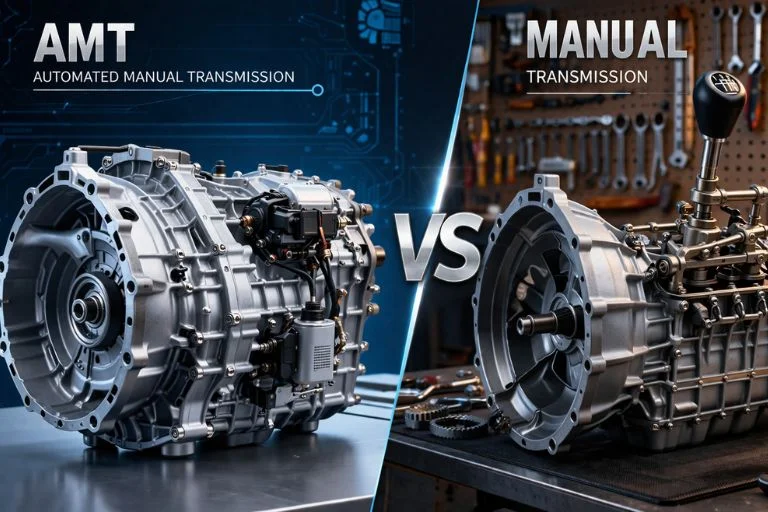
An Automated Manual Transmission (AMT) is essentially a standard manual gearbox fitted with an electronic actuator system that automates the clutch and gear-change process. Unlike a traditional automatic transmission that uses a torque converter, an AMT retains the mechanical architecture of a manual but removes the need for the driver to manually operate the clutch pedal.
AMTs work by using sensors and an Electronic Control Unit (ECU) to detect the optimal moment to shift gears, then actuate the clutch and shift automatically. The driver can either leave the transmission in full automatic mode or use paddle shifters or a gear selector to make manual inputs without touching a clutch.
This technology became widely popular in budget-segment cars across markets like India, Europe, and parts of the United States because it bridges the gap between the cost-efficiency of a manual and the convenience of an automatic. This article is for anyone — car buyers, vehicle owners, or mechanics — trying to understand the real difference between AMT vs manual transmission before making a buying, repair, or replacement decision.
At All American Motors Hub, we supply quality used engines and used transmissions of all types — including manual and AMT units — to customers across all 48 states.
What Is a Manual Transmission?
A manual transmission — also called a standard transmission or “stick shift” — is the traditional gearbox design where the driver manually selects gears using a gear lever while simultaneously operating a clutch pedal to disengage and re-engage the engine’s power flow. It is the oldest, most mechanically straightforward transmission type still in widespread use.
In a manual transmission, gear selection happens entirely at the driver’s discretion. The clutch pedal disengages the flywheel from the input shaft, allowing the driver to change gears without grinding. Release the clutch smoothly, and the engine torque flows through to the wheels at the new gear ratio.
Manual transmissions are available in 5-speed, 6-speed, and even 7-speed configurations depending on the vehicle. They remain popular in sports cars, trucks, and budget vehicles because of their simplicity, durability, and lower manufacturing cost.
AMT vs Manual: Key Differences at a Glance
| Feature | AMT | Manual |
| Clutch Operation | Automated (no pedal) | Driver-operated clutch pedal |
| Gear Shifting | Automatic or semi-auto | Fully manual |
| Ease of Use | High — no clutch fatigue | Low — requires skill |
| Fuel Economy | Slightly better in city traffic | Better on open highways |
| Purchase Price | $500–$2,000 more than manual | Lower upfront cost |
| Repair Complexity | Higher (electronic components) | Lower (mechanical) |
| Driver Engagement | Low to moderate | High |
| Best For | City driving, traffic-heavy routes | Highway, sports driving, budget vehicles |
| Transmission Weight | Lighter than full automatic | Lightest of all types |
Performance: AMT vs Manual
Acceleration & Response
In terms of raw acceleration, a manual transmission still has a slight edge for experienced drivers. A skilled driver can time gear changes precisely — particularly during launch — in a way that even the most sophisticated AMT algorithms can’t always replicate perfectly. This is why most high-performance sports cars and track vehicles are still offered with traditional manual gearboxes or dual-clutch transmissions (DCTs) rather than AMTs.
That said, modern AMTs have closed the gap significantly. The latest generation of AMT systems from manufacturers like Maruti Suzuki, Renault, Tata Motors, and others shift in under 200 milliseconds, faster than most human drivers. In everyday driving conditions, the difference in acceleration response is virtually imperceptible to the average driver.
Driving Comfort
Here, the AMT clearly wins for city and stop-and-go traffic scenarios. The elimination of the clutch pedal removes one of the most fatiguing driving tasks in heavy urban traffic. Drivers who regularly commute in congested areas report significantly less leg fatigue and lower stress levels with AMT vehicles compared to manuals.
On winding roads and mountain passes, however, many drivers prefer the tactile feedback and predictability of a manual gearbox.
Fuel Economy: AMT vs Manual
Fuel economy is one of the most debated aspects of the automatic vs manual conversation. The traditional wisdom — that manuals always get better gas mileage — is no longer universally true.
In city driving, AMTs often deliver 2–5% better fuel economy than manual transmissions because the automated system optimizes shift points based on real-time sensor data, eliminating the common human errors of late shifting or over-revving in stop-and-go traffic.
On open highways, a well-driven manual transmission can match or slightly outperform an AMT, since experienced drivers can hold higher gears and manage engine RPM efficiently without electronic assistance.
According to data from the U.S. Department of Energy’s fueleconomy.gov, the fuel efficiency gap between manual and automatic transmission vehicles has narrowed to under 5% in most modern vehicles, with some automatic and AMT vehicles actually outperforming their manual counterparts in EPA testing.
For most daily drivers in the United States who spend significant time in urban traffic, an AMT will deliver comparable or slightly better fuel economy than a manual.
Cost: AMT vs Manual
Purchase Price
A manual transmission vehicle is almost always cheaper to buy — typically $800 to $2,500 less than the equivalent AMT variant of the same model, depending on make and trim level. This makes manual transmissions attractive for budget-conscious buyers and fleet operators.
Repair & Maintenance Cost
This is where the comparison gets more nuanced. Manual transmissions have fewer electronic components, making individual repairs cheaper and more straightforward. Common manual transmission services include:
- Clutch replacement: $500–$1,500 (every 60,000–100,000 miles depending on driving style)
- Gear synchronizer replacement: $300–$800
- Transmission fluid change: $80–$150
AMT repairs, by contrast, involve both mechanical and electronic components. A failed actuator motor, position sensor, or ECU module in an AMT system can cost $400–$1,200 per component — and often requires specialized diagnostic equipment to troubleshoot.
Replacement Cost
When either transmission type reaches the end of its service life, replacing it with a quality used unit is the most cost-effective option. All American Motors Hub carries a wide inventory of used transmissions — both manual and AMT — with verified mileage, tested performance, and warranty protection, shipped to any address in the USA.
Reliability & Maintenance
Manual Transmission Reliability
Manual transmissions are among the most durable drivetrain components in any vehicle. With no torque converter and minimal hydraulic complexity, a well-maintained manual gearbox can last 200,000+ miles. The most common failure points are the clutch disc (a wear item), the release bearing, and gear synchronizers. All of these are relatively inexpensive to replace.
AMT Reliability
AMTs are built on the reliable mechanical architecture of manual transmissions, so the fundamental gearbox itself is durable. The electronic actuator system, however, introduces additional failure points. Common AMT issues include:
- Actuator motor wear — typically occurs after 80,000–100,000 miles
- Position sensor drift — causes jerky or delayed shifts
- ECU faults — can cause the AMT to default to manual mode or refuse to shift
- Clutch wear — similar to standard manuals; replacement intervals of 60,000–80,000 miles
Regular transmission fluid changes every 30,000–45,000 miles are essential for both AMT and manual gearbox longevity.
Which Transmission Is Right for You?
The right choice between an AMT vs manual depends entirely on how, where, and how often you drive:
Choose an AMT if:
- You drive primarily in urban or suburban traffic
- You want automatic convenience without the premium price of a full automatic
- You frequently drive in hilly terrain where clutch fatigue is an issue
- You’re buying a budget vehicle and want semi-automatic ease
Choose a Manual if:
- You enjoy an engaged, hands-on driving experience
- You drive mostly on highways or open roads
- You want the absolute lowest upfront cost and simplest long-term maintenance
- You’re purchasing a sports car or performance vehicle where driver control matters
Consider a Full Automatic or CVT if:
- Maximum effortless driving convenience is your top priority
- You are willing to pay a premium for the smoothest possible ride
- You tow heavy loads regularly (torque converters handle towing better than AMTs)
What Happens When Your Transmission Fails?
Whether you drive an AMT or manual, transmission failure is a reality for high-mileage vehicles. Signs your transmission may need replacement include grinding or slipping gears, delayed engagement, unusual noises during shifting, burning smell from the transmission fluid, or dashboard warning lights.
When a transmission fails, you have three main options: rebuild it (expensive, $1,500–$3,500), buy new (very expensive, $3,000–$6,000+), or replace it with a quality used transmission (most cost-effective, typically $400–$1,500 for the unit itself).
For authoritative guidance on transmission types and what to look for when replacing one, the Car and Driver Transmission Guide is an excellent reference from one of America’s most trusted automotive publications.
Conclusion
The AMT vs manual transmission debate doesn’t have a single winner — it comes down entirely to your driving habits, budget, and priorities. AMTs deliver superior convenience and reduced fatigue for city drivers, while manual transmissions offer unmatched driver control, lower cost, and mechanical simplicity for highway and performance driving. Both are legitimate, durable choices when properly maintained.
What matters most is that when either transmission type wears out or fails, you have a reliable, affordable replacement option. All American Motors Hub is your trusted nationwide source for quality used engines and used transmissions — including both manual and AMT units — delivered to your door anywhere in the United States.
Frequently Asked Questions
What is the main difference between AMT and manual transmission?
An AMT (Automated Manual Transmission) is a manual gearbox with an automated clutch system — you don’t need to press a clutch pedal. A traditional manual requires the driver to manually operate the clutch pedal and select gears. AMTs offer automatic convenience while retaining the fuel efficiency and mechanical simplicity of a manual gearbox.
Is AMT better than manual for city driving?
Yes. In stop-and-go city traffic, an AMT is significantly more comfortable than a manual because it eliminates the need to repeatedly engage and disengage the clutch pedal. This reduces driver fatigue and often results in slightly better fuel economy in urban conditions due to optimized electronic shift points.
Does AMT last as long as a manual transmission?
The core gearbox of an AMT is mechanically similar to a manual and can last 150,000–200,000 miles with proper maintenance. However, AMT electronic components — such as actuator motors and position sensors — are additional wear items that can fail between 80,000–120,000 miles and may require costly replacement.
Is a manual transmission cheaper to repair than AMT?
Generally yes. Manual transmissions have fewer electronic components, making diagnosis and repair simpler and cheaper. Clutch replacement — the most common manual transmission repair — costs $500–$1,500. AMT actuator or sensor failures can cost $400–$1,200 per component and require specialized diagnostic tools.
Can I replace my AMT transmission with a used unit?
Absolutely. Replacing a failed AMT with a quality used transmission is the most cost-effective solution available. All American Motors Hub carries used transmissions from popular makes and models across the USA, all tested and warranted before shipping.
What is a car transmission — automatic or manual — and which is most common in the USA?
A car transmission is the mechanical system that transfers engine power to the wheels at different gear ratios. Automatic transmissions are by far the most common in the United States, accounting for over 96% of new vehicle sales in 2023. Manual transmissions remain popular in performance vehicles, entry-level cars, and among driving enthusiasts.