
Key Takeaways:
- A V4 engine has four cylinders arranged in a V-shape, unlike the more common inline-4 which places all cylinders in a straight row.
- V4 engines are extremely rare in cars — only a handful of manufacturers ever used them in production vehicles.
- Notable V4 engine cars include the Lancia Lambda, Ford Taunus, Saab Sonett, Ford Capri, and Porsche 919 Hybrid.
- The V4 was largely replaced by the simpler, cheaper inline-4 in passenger cars — but remains common in motorcycles.
- The V4’s main advantages are its compact length and packaging flexibility; its downsides are higher manufacturing cost and balance challenges.
You’ve heard of V6 engines. You know what a V8 is. You’ve probably owned a car with an inline-4. But have you ever stopped to think about the V4 engine — the four-cylinder layout arranged in a V-shape? Most people haven’t. And that’s exactly the point. The V4 is one of the rarest engine configurations in automotive history, used in only a handful of production cars across more than a century of manufacturing.
This guide covers everything: what a V4 engine actually is, how it compares to an inline-4, which cars used it, why it never became mainstream, and whether it still has a future.
Table of Contents
What Is a V4 Engine?
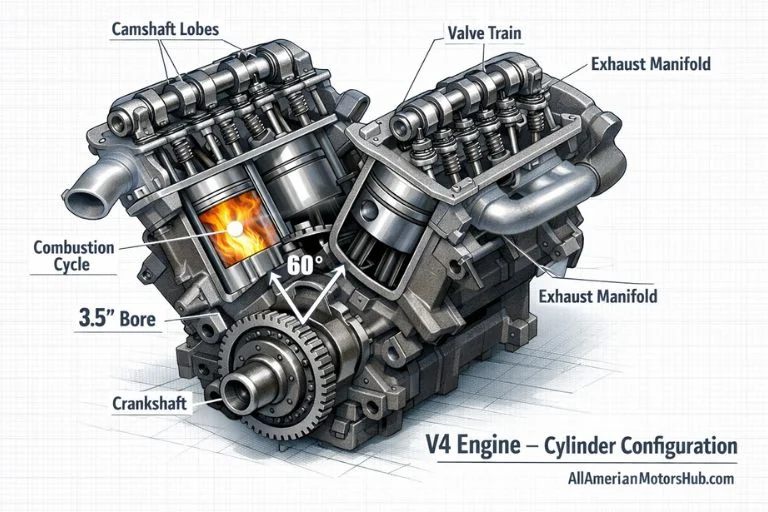
A V4 engine is an internal combustion engine with four cylinders arranged in two banks of two, set at an angle to each other — forming a “V” shape when viewed from the front. The angle between the two cylinder banks typically ranges from 60 to 90 degrees, depending on the design.
This layout is fundamentally different from the inline-4 (also written as I4 or 4-cylinder), which arranges all four cylinders in a single straight row. The V4 sits closer to the architecture of a V6 or V8 than it does to the four-cylinders most modern drivers are familiar with.
The first documented use of a V4 engine in an automobile dates back to 1898, when French carmaker Mors used the layout in a Grand Prix prototype — chosen specifically because its even firing intervals produced less vibration than competing designs at the time. The first production V4 engine appeared in the 1922 Lancia Lambda, according to Wikipedia’s V4 engine history — making it one of the oldest mass-produced four-cylinder configurations on record.
Yet despite this early start, the V4 never caught on the way the inline-4 did. Today, you’re far more likely to find a V4 in a Honda CBR1000RR motorcycle than in any car on the road.
How Does a V4 Engine Work?
Like all four-stroke internal combustion engines, a V4 goes through the same cycle in each cylinder: intake → compression → combustion → exhaust. The difference is in the geometry of the block.
In a V4, the two cylinder banks share a single crankshaft at the bottom of the V. Each bank fires alternately, creating a firing order that differs significantly from an inline-4. Because the cylinders are split between two banks rather than arranged sequentially, the firing intervals can produce an uneven pulse — which is one of the key balance challenges that has historically plagued V4 engine design.
To counteract this vibration, most V4 engines — including the Ford Taunus and Essex V4 — used balance shafts to smooth out the engine’s inherent roughness. This adds mechanical complexity and cost, which is one reason V4 engines were never as economically attractive as the inline-4.
The V4 also requires two cylinder heads (one per bank), two exhaust manifolds, and two separate valvetrains — essentially doubling several of the most complex and costly engine components compared to a straight-four that accomplishes the same basic task.
V4 Engine vs Inline-4: What’s the Difference?
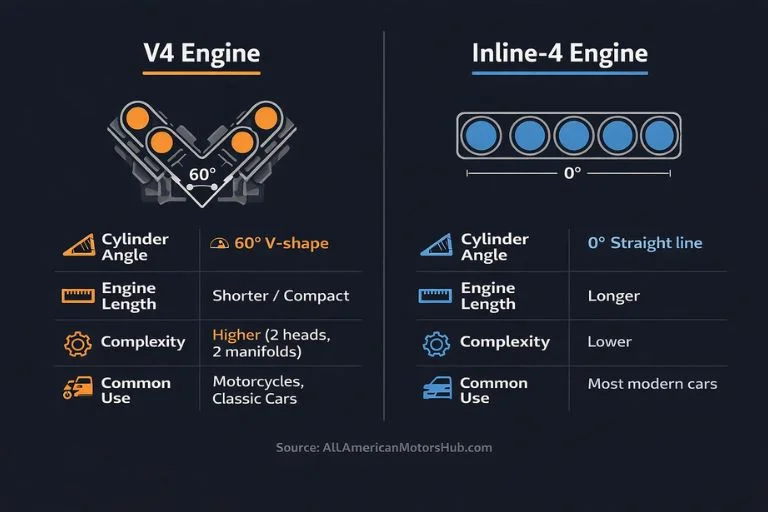
Most people confuse the V4 with the inline-4 — or assume they’re the same thing. They’re not. Here’s a direct comparison:
| Feature | V4 Engine | Inline-4 Engine |
| Cylinder Layout | Two banks of 2, angled (V-shape) | Four in a straight line |
| Engine Length | Shorter / more compact | Longer |
| Engine Width | Wider (two banks side by side) | Narrower |
| Cylinder Heads | Two (one per bank) | One |
| Exhaust Manifolds | Two | One |
| Balance | More complex to achieve | Naturally more balanced |
| Manufacturing Cost | Higher | Lower |
| Common Use | Motorcycles, select classic cars | Most modern passenger cars |
| Fuel Economy | Comparable when well-tuned | Proven, efficient, widely optimized |
The key practical difference is length vs. width. The V4 is significantly shorter than an inline-4 of the same displacement — which was originally seen as a major packaging advantage. However, its extra width often created fitment problems, especially as front-wheel-drive cars with transversely mounted engines became dominant from the 1970s onward.
If you’re evaluating engine configurations for a swap or replacement project, our complete engine swap guide walks through compatibility, fitment, and what to consider before pulling the trigger on any engine change.
What Cars Use V4 Engines?
This is the question most people land on this page asking — and the honest answer is: not many. Only three manufacturers ever produced a V4 engine specifically for automobile use at scale: Lancia, Ford of Europe, and ZAZ (the Soviet Ukrainian manufacturer). Here’s a complete look at the notable cars that used V4 engines:
Lancia Lambda (1922–1931)
Engine: 2.1L, 2.4L, and 2.6L narrow-angle V4 (20-degree bank angle) Power: 49–69 HP
The Lancia Lambda holds the distinction of being the first production car powered by a V4 engine. Designed by Vincenzo Lancia himself, this narrow-angle V4 used a single cylinder head spanning both banks — a clever design that minimized the “two cylinder heads” complexity penalty. The Lambda was also the first production car to feature a monocoque chassis, independent suspension on all four wheels, and brakes on all four corners. The V4 engine was central to making the Lambda so light and advanced for its era.
Lancia continued producing V4 engines under various forms through the 1960s, powering models including the Augusta, Artena, Aprilia, Ardea, Appia, and — most famously — the Fulvia.
Lancia Fulvia (1963–1976)
Engine: 1.1L–1.6L narrow-angle V4 Power: 58–130 HP (road car to full rally spec)
The Lancia Fulvia is arguably the most celebrated V4-powered automobile ever built. The Fulvia HF Rallye 1.6 — known as “Fanalone” for its distinctive large auxiliary headlights — was a homologation special built for Lancia’s rally program. In full rally specification, the 1.6-liter V4 produced up to 130 HP in a car weighing barely 900 kg (1,980 lbs), making it devastatingly quick on stage. The Fulvia became a legend of 1970s rally racing, demonstrating that a small-displacement V4 could be a genuinely competitive performance engine.
Ford Taunus V4 (1962–1981) — Germany
Engine: 1.3L–1.7L 60-degree V4 Power: 45–75 HP
Ford’s German division developed this 60-degree V4 for use in the Ford Taunus 15M starting in 1962. What made it notable beyond its home market was its adoption by Saab for the 95, 96, and Sonett models from 1967 onward — an engine sourcing deal that saved Saab from its commercially disastrous two-stroke engines. The Taunus V4 was also used by Matra in the M530 sports car.
Ford Essex V4 (1965–1977) — United Kingdom
Engine: 1.3L–2.0L 60-degree V4 Power: 52–92 HP
Developed separately from the German Taunus, Ford’s British Essex V4 was used in several models including the Ford Corsair, Ford Capri Mk I, Ford Consul, and select Ford Transit vans. The most powerful version — the 2.0-liter Essex V4 with crossflow cylinder heads — produced 92 HP and could push the Capri MkI past 100 mph.
Saab 95, Saab 96 & Saab Sonett (1967–1980)
Engine: 1.5L Ford Taunus V4 (sourced from Ford Germany) Power: 65–73 HP
After years of producing cars with two-stroke three-cylinder engines — which ran on a fuel/oil mixture and smoked considerably — Saab licensed the Ford Taunus V4 in 1967. The move dramatically improved the reputation of Saab’s products in the United States. The Saab Sonett III, revealed at the 1970 New York Auto Show, used the 1.5-liter V4 to reach a top speed of 106 mph in a lightweight fiberglass-bodied sports car body, becoming one of the fastest and most recognizable V4-powered cars ever sold.
Ford Capri Mk I (1969–1973)
Engine: 1.3L–2.0L Essex V4 Power: 52–92 HP
Ford’s European answer to the American muscle car offered V4 power as an option alongside inline-4 and V6 choices. The V4-equipped Capri was positioned as the sporty, affordable trim — and it sold extremely well. Over 400,000 Capris were sold in just the first two years of production, and the V4 variants were popular enough to remain in production until 1973 when the oil crisis prompted Ford to consolidate around the V6.
Ford Mustang I Concept (1962)
Engine: 1.7L Ford Taunus V4 (mid-mounted, rear-wheel drive) Power: ~90 HP
Few people know that the car that became the iconic Ford Mustang began life as a mid-engined concept powered by a V4 engine. The 1962 Mustang I concept used the German Ford Taunus V4 mounted amidships in a lightweight two-seater roadster, producing around 90 HP. Management ultimately rejected the concept — primarily due to estimated production costs — and the production Mustang that debuted in 1964 was a completely different vehicle with a conventional inline-6 or V8. Still, the V4-powered concept represents one of automotive history’s most intriguing “what ifs.”
ZAZ Zaporozhets (1960–1994) — Soviet Union
Engine: 0.7L–1.2L air-cooled rear-mounted V4 (MeMZ 965) Power: 23–50 HP
The ZAZ Zaporozhets was the Soviet Union’s budget city car — and it used an unusual air-cooled V4 engine mounted in the rear of the vehicle, similar in concept to the Volkswagen Beetle’s layout. The MeMZ 965 engine featured a magnesium alloy block for weight savings and was produced in displacements ranging from 0.7 to 1.2 liters. While not a performance car by any measure, the Zaporozhets represents the longest production run of any V4-powered automobile.
Porsche 919 Hybrid (2014–2017) — Le Mans Prototype
Engine: 2.0L turbocharged DOHC V4 Power: ~500 HP (combustion) + ~400 HP (electric) = 900+ HP combined
The most modern and most extreme V4-powered vehicle ever built, the Porsche 919 Hybrid was Porsche’s factory Le Mans prototype racer. Its 2.0-liter turbocharged V4 — developed in-house specifically for the 919 project — featured direct fuel injection, could rev to 9,000 rpm, and produced approximately 500 HP from the combustion engine alone. Mated to an electric hybrid system producing an additional 400 HP, the 919 won at Le Mans in 2015, 2016, and 2017. Porsche called it “the most efficient combustion engine in the history of Porsche” at the time of its retirement.
Why Did the V4 Engine Disappear from Cars?
Despite its technical merits, the V4 engine faded from automobile production for several well-documented reasons:
1. Manufacturing Complexity and Cost The V4’s two-bank layout requires two cylinder heads, two exhaust manifolds, and two valvetrain assemblies. This essentially doubles the most expensive, precision-critical components in the engine. The inline-4 accomplishes the same displacement goals with half the cylinder head count, making it dramatically cheaper to manufacture at scale.
2. Width Packaging Problems While the V4 was shorter than an inline-4, it was also wider. When the automotive industry shifted to front-wheel drive in the 1970s and 1980s — requiring engines to be mounted transversely (sideways) across the engine bay — the V4’s extra width became a serious liability. A transversely mounted V4 simply didn’t fit well in the compact engine bays of the era’s front-drivers.
As CarBuzz’s V4 engine breakdown notes, the rising dominance of the inline-4 combined with these packaging challenges effectively ended the V4’s automotive relevance by the early 1980s.
3. Balance and Vibration Issues Achieving smooth running from a V4 is genuinely harder than it sounds. The firing order of a V4 produces primary and secondary vibration forces that are difficult to cancel without adding balance shafts — which add weight, cost, and mechanical complexity. The Porsche 919’s V4 was famously described by test driver Neel Jani as producing so much vibration at high RPM that it made it difficult for him to see and breathe clearly, until Porsche corrected the issue by revising the firing order.
4. The Inline-4 Won the War By the 1980s, inline-4 engines had been refined to a point where they were smooth, efficient, powerful, cheap to manufacture, and easy to package in any orientation. There was simply no compelling reason for a mainstream automaker to absorb the added cost and complexity of a V4 when the inline-4 did the job better in every commercially relevant metric.
V4 Engine Pros and Cons
Advantages
- Compact length — shorter than an equivalent inline-4, which benefits packaging in specific applications
- Packaging flexibility — particularly useful in mid-engine layouts and motorcycles
- Distinctive sound and character — V4 motorcycles in particular are prized for their exhaust note
- Proven in extreme performance — the Porsche 919 V4 demonstrated elite-level power density and reliability
Disadvantages
- Higher manufacturing cost — two cylinder heads, two exhaust manifolds
- Balance complexity — inherently uneven firing intervals require balance shafts or engineering solutions
- Width packaging — wider than an inline-4, problematic for transverse front-drive layouts
- Limited supplier/aftermarket ecosystem — rare in production means limited parts availability and tuning knowledge
- No modern production car examples — zero current mainstream passenger car applications
Where Is the V4 Engine Used Today?
The V4 engine didn’t die — it migrated. Today, the V4 is one of the dominant performance motorcycle engine configurations, used by manufacturers including Honda (VFR800, RC213V MotoGP bikes), Aprilia (RSV4, RS-GP), and Ducati (Panigale V4, Desmosedici). Its compact length, packaging advantage for narrow motorcycle frames, and distinctive power delivery make it a natural fit for superbike and MotoGP applications.
In the automotive world, no current production passenger car uses a V4. The configuration lives on primarily in racing (certain LMP and prototype applications), marine outboard motors (where Johnson, Evinrude, and Yamaha have produced V4 two-strokes for decades), and specialty industrial engines.
Could the V4 Make a Comeback in Cars?
It’s unlikely in conventional gasoline applications — but hybrid powertrains could theoretically revive interest. The Porsche 919 demonstrated that a compact, high-output V4 can work exceptionally well when paired with electric motors, where packaging efficiency of the combustion engine matters more than in a traditional drivetrain layout.
As automakers develop increasingly compact hybrid combustion engines, the V4’s short block length could once again be an asset.For now, though, if your vehicle needs a four-cylinder engine replacement, you’re firmly in inline-4 territory.
Browse our full selection ofused engines for your vehicle to find the right replacement engine for your make, model, and budget — or give us a call at 1-888-799-0188 and our team will help you identify the right fit.
Conclusion
The V4 engine is one of the most fascinating footnotes in automotive engineering history — technically interesting, historically significant, and almost completely absent from modern roads. From the pioneering Lancia Lambda to the Saab Sonett’s borrowed Ford V4, to the 900-HP Porsche 919 Hybrid, the V4 has had a longer, more storied career than most people realize.
It never became mainstream because the simpler, cheaper, better-balanced inline-4 rendered it redundant for most automotive applications. But in the right context — a compact mid-engine layout, a high-revving motorcycle, a Le Mans prototype — the V4’s unique characteristics made it the right tool for the job.
Whether you’re researching engine types, planning a build, or looking for a replacement engine for a four-cylinder vehicle, knowing your configurations is the first step. Explore our full range of used engines for your vehicle or start with our engine swap guide to understand your replacement and upgrade options.
Frequently Asked Questions
What is a V4 engine?
A V4 engine is a four-cylinder internal combustion engine with its cylinders arranged in two banks of two, set at an angle to each other forming a “V” shape. Unlike the more common inline-4, which places all four cylinders in a single row, the V4 uses a split-bank layout similar in architecture to a V6 or V8 engine.
What cars use a V4 engine?
Very few production cars have ever used a V4 engine. The most notable examples include the Lancia Lambda (1922–1931), Lancia Fulvia (1963–1976), Ford Taunus (1962–1981), Saab 95 and 96 (1967–1980), Saab Sonett III (1970–1974), Ford Capri Mk I (1969–1973), and the ZAZ Zaporozhets (1960–1994). In racing, the Porsche 919 Hybrid (2014–2017) is the most modern example.
Why is the V4 engine so rare in cars?
The V4 engine never became mainstream in cars for three primary reasons: it requires two cylinder heads and two exhaust manifolds, making it more expensive to manufacture than an inline-4; it is wider than an inline-4, creating packaging problems in front-wheel-drive transverse layouts; and its firing order creates balance challenges that require complex engineering solutions to resolve.
Is a V4 engine the same as an inline-4?
No. A V4 engine has four cylinders arranged in two banks at a V-angle, while an inline-4 places all four cylinders in a single straight row. Most modern cars with four-cylinder engines use an inline-4, not a V4. The V4 was common in motorcycles but has never been a mainstream automotive configuration.
Do any modern cars still use a V4 engine?
No current production passenger car uses a V4 engine. The configuration is most commonly found today in performance motorcycles from brands like Honda, Aprilia, and Ducati. The last notable automotive use was the Porsche 919 Hybrid racing prototype (2014–2017).
What are the advantages of a V4 over an inline-4?
The V4’s main advantage is its shorter engine length compared to an inline-4 of the same displacement. This compact length was valuable in certain packaging scenarios — particularly mid-engine layouts and motorcycle frames. However, the V4’s extra width, manufacturing cost, and balance complexity have consistently outweighed this advantage in mainstream passenger car applications.