
Table of Contents
Understanding how a vehicle sends power to its wheels is important when buying or maintaining a car. You may often see expressions such as AWD, FWD, and 4WD, but many drivers are unsure what they actually mean.
These drivetrain systems determine how engine power reaches the wheels, which affects traction, fuel efficiency, handling, and performance. In simple terms, the drivetrain decides which wheels move the vehicle forward.
In this guide, we’ll explain the difference between AWD vs FWD vs 4WD, how each system works, its advantages and disadvantages, and which one might be best for different driving situations. The explanations are beginner-friendly but still technically accurate.
What Is a Vehicle Drivetrain?
Before comparing AWD, FWD, and 4WD, it helps to understand the drivetrain.
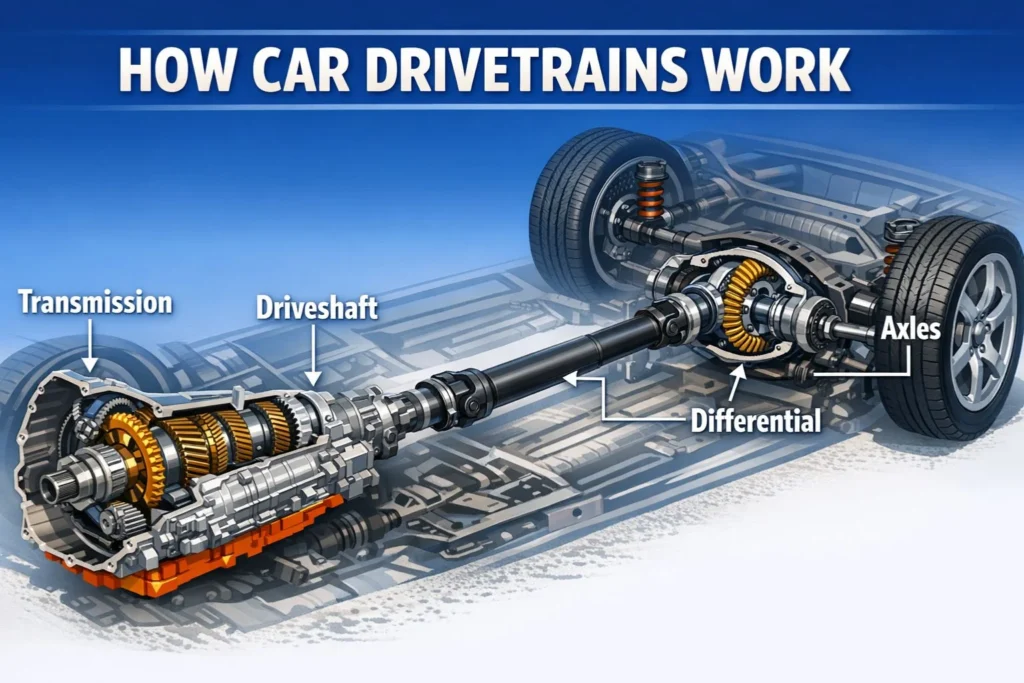
A drivetrain is the group of components that delivers power from the engine to the wheels. According to information commonly referenced by automotive engineering sources such as the Society of Automotive Engineers, drivetrain systems typically include:
- Transmission
- Driveshaft
- Differential
- Axles
The transmission converts engine power into rotational force that moves the wheels. Different drivetrain layouts distribute this power differently.
Understanding drivetrain systems like AWD, FWD, and 4WD is important for vehicle safety and performance. According to the National Highway Traffic Safety Administration, traction control, drivetrain layout, and proper vehicle maintenance all play significant roles in how safely a vehicle performs under different road conditions.
Their safety guidelines emphasize that drivers should understand their vehicle’s drivetrain system, especially when driving in snow, rain, or off-road environments. You can learn more about drivetrain-related safety recommendations through official resources on vehicle safety and traction systems provided by the agency.
What Is FWD (Front-Wheel Drive)?
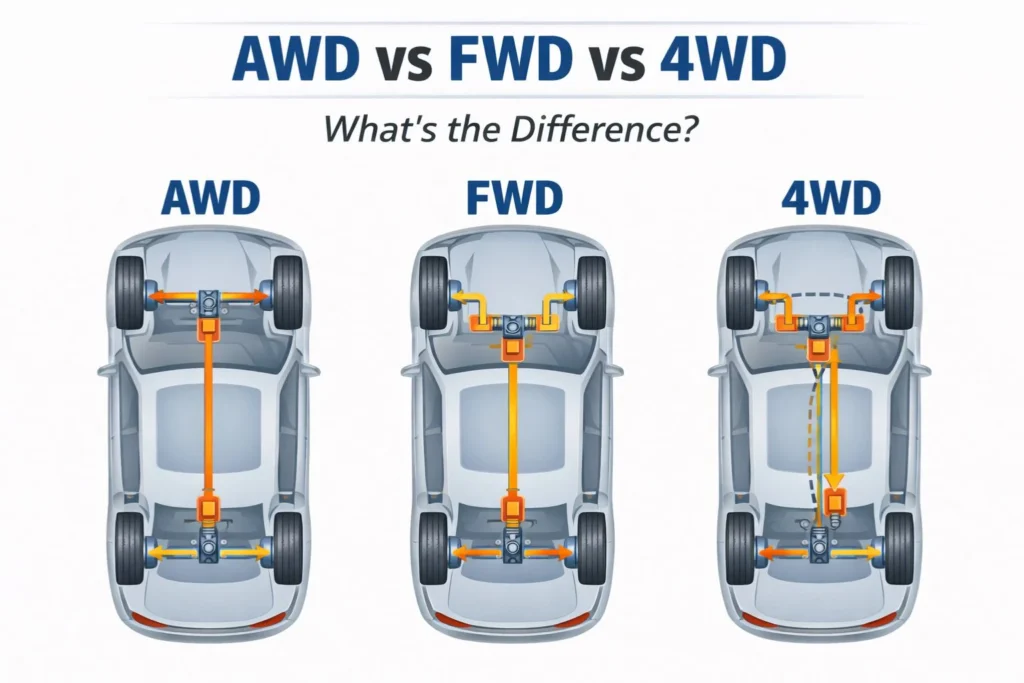
Front-Wheel Drive (FWD) is one of the most common drivetrain systems used in modern vehicles. In an FWD vehicle, the front wheels receive all the engine’s power and pull the vehicle forward.
How FWD Works
The engine and transmission sit at the front of the vehicle. Power goes directly to the front wheels through a differential and axle shafts.
Because the system is compact, manufacturers can save space and reduce vehicle weight.
Many vehicles from manufacturers like Honda and Toyota commonly use FWD platforms for sedans and compact SUVs.
Advantages of FWD
Better fuel efficiency
FWD systems weigh less and have fewer drivetrain components.
Lower production cost
This helps manufacturers keep vehicle prices affordable.
Good traction in light snow or rain
Since the engine weight sits over the front wheels, traction improves during slippery conditions.
Disadvantages of FWD
Limited performance capability
FWD systems may struggle with high horsepower because the front wheels must both steer and deliver power.
Less effective for off-road driving
FWD vehicles do not have the traction needed for rugged terrain.
What Is AWD (All-Wheel Drive)?
All-Wheel Drive (AWD) systems send power to all four wheels automatically. Unlike 4WD, AWD does not require driver activation.
AWD is commonly found in crossovers and SUVs.
Brands like Subaru have built their reputation around AWD systems.
How AWD Works
AWD vehicles use a center differential or electronic control system to distribute power between the front and rear wheels.
When the system detects wheel slip, it automatically shifts power to wheels with better traction.
Modern AWD systems rely heavily on sensors and electronic control units.
Advantages of AWD
Improved traction in rain, snow, or slippery roads
Better stability and handling
Automatic operation (no driver input required)
These benefits make AWD popular in regions with frequent bad weather.
Disadvantages of AWD
Lower fuel efficiency
More drivetrain components increase weight.
Higher maintenance costs
More complex system
What Is 4WD (Four-Wheel Drive)?
Four-Wheel Drive (4WD), also called 4×4, is designed primarily for off-road vehicles and trucks.
Unlike AWD, most 4WD systems require the driver to manually engage the system when needed.
Vehicles like the Jeep Wrangler and Toyota Land Cruiser are famous for using 4WD systems.
How 4WD Works
4WD systems use a transfer case to split power between the front and rear axles.
Many systems offer multiple modes, such as:
- 2H (two-wheel drive)
- 4H (four-wheel drive high)
- 4L (four-wheel drive low)
4L provides maximum torque for climbing steep terrain or driving through mud and rocks.
Advantages of 4WD
Best performance for off-road driving
Excellent traction on mud, snow, and rocky terrain
High torque capability
Disadvantages of 4WD
Higher fuel consumption
Heavier drivetrain components
Not necessary for most daily driving situations
AWD vs FWD vs 4WD: Key Differences
| Wheels Powered | Front wheels only | All wheels automatically | All wheels (manual control) |
| Fuel Efficiency | Best | Moderate | Lowest |
| Off-Road Capability | Low | Moderate | Excellent |
| Complexity | Simple | Moderate | Complex |
| Maintenance Cost | Lowest | Medium | Highest |
This comparison highlights why each drivetrain type meets different driving needs.
Which Drivetrain Is Best for You?
The best drivetrain depends on your driving conditions and priorities.
Choose FWD If:
- You drive mostly in cities or on highways.
- Fuel efficiency is important.
- You want lower maintenance costs.
Choose AWD If:
- You live in areas with snow or heavy rain.
- You want better traction without manual controls.
- You drive an SUV or crossover.
Choose 4WD If:
- You frequently drive off-road.
- You need maximum traction in extreme environments.
- You drive a truck or a rugged SUV
Maintenance Tips for Drivetrain Systems
Regardless of drivetrain type, proper maintenance is critical.
Key maintenance tasks include:
- Regular transmission fluid changes
- Checking differential fluid
- Inspecting CV joints and driveshafts
- Maintaining proper tire pressure
Neglecting drivetrain maintenance can lead to expensive repairs.
If a drivetrain failure occurs, replacing the transmission may become necessary. For reliable replacements, many vehicle owners consider purchasing a used transmission from a trusted supplier.
How Drivetrain Systems Affect Vehicle Performance
The drivetrain directly influences:
- Acceleration
- Handling
- Traction
- Fuel consumption
For example:
FWD vehicles prioritize efficiency and affordability. AWD systems improve safety and stability in poor weather. Meanwhile, 4WD systems deliver unmatched capability for off-road driving.
Understanding these differences helps drivers choose the right vehicle for their lifestyle.
Future of Drivetrain Technology
Automakers continue to develop smarter drivetrain systems.
Electric vehicles often use dual motor AWD systems, where separate motors power the front and rear wheels.
This technology eliminates many traditional drivetrain components and allows faster torque distribution.
Manufacturers like Tesla and Rivian already use advanced AWD setups in electric vehicles.
As EV adoption grows, drivetrain technology will continue evolving.
Conclusion
Understanding AWD vs FWD vs 4WD helps drivers make smarter decisions when choosing or maintaining a vehicle.
Each drivetrain offers unique benefits:
- FWD provides efficiency and simplicity
- AWD offers improved traction and stability
- 4WD delivers maximum off-road capability
For most daily drivers, FWD or AWD is usually the best choice. However, off-road enthusiasts and truck owners often prefer 4WD.
Knowing how these systems work also helps you maintain your vehicle and identify potential drivetrain problems before they become costly repairs.