
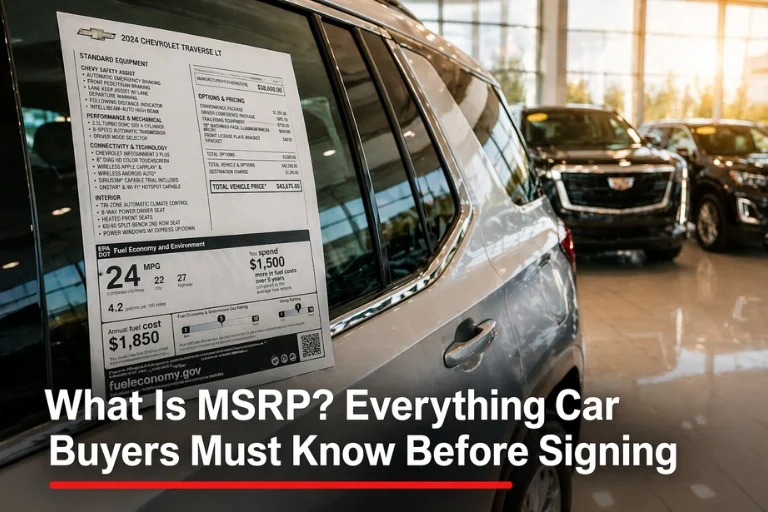

Every time you walk into a car dealership or browse a manufacturer’s website, one acronym appears on every single listing, sticker, and advertisement — MSRP. It is one of the most important numbers in the entire car buying process, yet most buyers do not fully understand what it means, how it is calculated, or how to use it strategically. This guide breaks down exactly what MSRP is, what MSRP stands for, how it applies to cars and automobiles, and how to leverage it during your next vehicle negotiation.
What Is MSRP? The Simple, Clear Answer
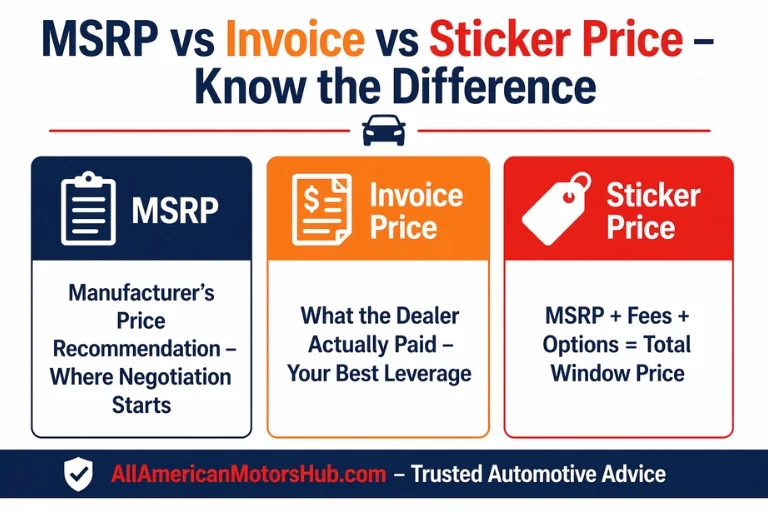
MSRP stands for Manufacturer’s Suggested Retail Price. It is the recommended selling price that the automaker — whether Ford, Toyota, Chevrolet, or any other brand — sets for a specific vehicle model and trim level. This price is calculated at the factory level before the car ever reaches a dealer’s lot.
The keyword in the acronym is “suggested.” MSRP is a recommendation from the manufacturer, not a legal price cap. Dealers are free to sell above or below it based on market conditions, inventory levels, and customer negotiation. However, they are legally required to display the MSRP on every new vehicle they offer for sale in the United States, thanks to federal law.
Think of MSRP as the manufacturer’s official opening statement in the car pricing conversation — it is where negotiations begin, not where they end.
What Does MSRP Mean — The Legal Background
The legal requirement to display MSRP on every new vehicle comes from the Automobile Information Disclosure Act of 1958. This act was championed by Oklahoma Senator Almer Stillwell “Mike” Monroney, which is why the window sticker displaying MSRP is officially known as the Monroney label or Monroney sticker.
Before this law existed, dealers had no obligation to disclose pricing information, which led to widespread overcharging and consumer confusion. The Monroney sticker changed everything by requiring a standardized breakdown of every new vehicle’s pricing — including MSRP, factory options, destination charges, and fuel economy ratings — to be displayed prominently on the car’s window.
Only the buyer of a new vehicle is legally permitted to remove the sticker from the window. The dealer cannot legally take it down before a sale is completed.
What Is MSRP for Cars — What the Sticker Actually Shows
When you look at the Monroney sticker on any new car, you will see more than just a single number. The sticker provides a full pricing breakdown that typically includes:
- Base MSRP — The manufacturer’s recommended price for the vehicle in its standard configuration
- Factory-Installed Options — The cost of additional features like panoramic roofs, upgraded audio, or advanced safety packages
- Destination and Delivery Fee — The cost to transport the vehicle from the factory to the dealership, which is non-negotiable and paid by all buyers
- Fuel Economy Ratings — EPA-estimated city and highway miles per gallon
- Total MSRP — The base MSRP combined with all added options
It is critical to understand that the total MSRP shown on the window sticker is still not your out-the-door price. Sales tax, registration fees, title fees, and any dealer documentation charges are added on top of the sticker price at the point of sale.
What Is Vehicle MSRP — How Manufacturers Calculate It
Automakers do not set MSRP numbers randomly. A detailed internal calculation goes into determining every vehicle’s suggested price. The primary factors that shape vehicle MSRP include:
Manufacturing and Labor Costs The raw cost of building the vehicle — materials, engineering, factory labor, and quality control — forms the foundation of any MSRP calculation. When supply chain costs rise, MSRP figures often follow.
Trim Level and Equipment Every vehicle model is offered in multiple trim levels. The base trim carries the lowest MSRP, while each step up in trim — adding technology, performance, or luxury features — increases the MSRP accordingly. This is why the same model name can carry vastly different price points across a dealer’s lineup.
Market Demand and Positioning Manufacturers consider how competitive the segment is and what consumers are willing to pay. High-demand, limited-production models are priced accordingly, while high-volume mainstream models are priced to maximize broad market appeal.
Built-In Dealer Margin The MSRP always includes a profit margin for the dealership. This margin is what gives dealers room to negotiate — and gives buyers an opportunity to pay less than the full sticker price.
What Is a MSRP for an Automobile — MSRP vs. Other Pricing Terms
Understanding MSRP becomes far more powerful when you understand how it compares to the other pricing terms you will encounter at any dealership.
MSRP vs. Invoice Price The invoice price is the amount the manufacturer charges the dealer for the vehicle. It is almost always lower than the MSRP. The gap between the invoice price and MSRP represents the dealer’s gross profit potential. Knowing the invoice price before negotiating gives you a realistic target — aiming to pay somewhere between invoice and MSRP is a reasonable and achievable goal for most buyers.
MSRP vs. Sticker Price Although these terms are used interchangeably, they are technically different. The sticker price is the total figure shown on the window sticker, which includes MSRP plus destination fees, dealer-installed options, and applicable taxes or surcharges. The MSRP is simply the base component of the sticker price.
MSRP vs. Out-the-Door Price The out-the-door price is the grand total you actually pay — including the negotiated vehicle price, taxes, registration, title fees, and any documentation charges. This is the only number that truly matters when budgeting for a vehicle purchase.
MSRP vs. Market Adjustment In high-demand situations, dealers may add a “market adjustment” figure to the window sticker above the MSRP. This is pure dealer profit added due to scarcity or strong demand — most commonly seen on newly launched or limited-edition models.
For a full breakdown of how vehicle pricing affects your budget, our car maintenance checklist helps you plan total ownership costs well beyond the initial purchase price.
Does MSRP Include Taxes and Destination Charges?
Two questions that trip up almost every first-time buyer:
Does MSRP include taxes? No. MSRP reflects the manufacturer’s suggested price before sales tax, registration fees, or any government-imposed charges. These are always added separately at the point of purchase.
Does MSRP include the destination fee? No. The destination charge — the cost to transport the vehicle from the manufacturing plant to your local dealership — is listed separately on the Monroney sticker and is non-negotiable. Every buyer pays it regardless of how much they negotiate on the vehicle price itself.
How to Negotiate Using MSRP to Your Advantage
The single most important thing to understand about MSRP is that it is a starting point, not a final price. Here is how to use it strategically:
Start From the Invoice Price, Not the MSRP When you begin price discussions with a dealer, start from the invoice price and negotiate upward — not downward from MSRP. This psychological shift gives you a stronger foundation and often results in a lower final price.
Research Average Transaction Prices The actual price other buyers paid for the same vehicle in your area is called the transaction price. This figure is the most practical benchmark because it reflects real-world market conditions rather than manufacturer recommendations.
Target Slower-Moving Inventory Vehicles that have sat on a dealer’s lot longer than average are costing the dealer carrying charges every day. Identifying older inventory gives you meaningful leverage to negotiate a steeper discount below MSRP.
Time Your Purchase Strategically Dealers work toward monthly sales quotas. Shopping in the final days of any month — especially the final quarter of the year — creates pressure on the dealer to close deals and can result in significantly better pricing for the buyer.
Separate Negotiation Items Always negotiate the vehicle price first and reach an agreement before discussing your trade-in or financing. Blending all three into one conversation gives the dealer too much room to offset gains in one area with losses in another.
If you are evaluating a used vehicle alongside a new purchase, understanding fair component pricing matters just as much as MSRP. Our used engine price guide by car type and used transmission price guide by car type help you benchmark realistic replacement costs when assessing total vehicle value.
Can You Pay Below MSRP in 2025?
Yes — in most cases, buyers can negotiate below MSRP. For average-demand vehicles, discounts of 3% to 5% below MSRP are realistic. For slower-selling models or older dealer inventory, discounts of up to 10% are achievable. The exception is during periods of high demand or limited supply, where dealers may legitimately sell at or above MSRP.
The best strategy is to walk in knowing the invoice price, the average transaction price in your area, and the vehicle’s days on the dealer’s lot. Armed with that information, most buyers can negotiate a fair price below the MSRP sticker.
MSRP and Used Cars — Does It Apply?
MSRP is a new-car concept. Used vehicles are not required to display a Monroney sticker, and their prices are set by market demand, vehicle condition, mileage, accident history, and regional factors.
However, a vehicle’s original MSRP does influence its resale value. A car that originally carried a $60,000 MSRP will depreciate from a much higher base than a car that launched at $25,000 — which directly affects trade-in value, private-sale pricing, and insurance replacement cost calculations.
For those looking to save significantly on vehicle ownership, buying quality used components is one of the smartest financial moves available. Explore our used engines for sale to find reliable, inspected engines at a fraction of the cost of new.
Conclusion
MSRP — Manufacturer’s Suggested Retail Price — is the most fundamental pricing concept in the entire car-buying experience. It is the automaker’s official recommended selling price, displayed by federal law on every new vehicle’s Monroney sticker. It is not the final price you will pay, not a non-negotiable ceiling, and not the same as the sticker price, invoice price, or out-the-door price.
Understanding what MSRP means, what MSRP stands for, and how it compares to every other pricing term at the dealership gives you genuine negotiating power. Whether you are buying your first car or your tenth, knowing how to use MSRP as a starting point — rather than treating it as the final word — is the difference between paying too much and walking away with a genuinely great deal.
Frequently Asked Questions
What is MSRP?
MSRP stands for Manufacturer’s Suggested Retail Price. It is the price an automaker recommends that dealers charge for a new vehicle. It is displayed by law on the Monroney window sticker of every new car sold in the United States and serves as the starting benchmark for price negotiations.
What does MSRP mean for cars?
For cars, MSRP is the manufacturer’s official recommended selling price for a specific model and trim level. It covers the base vehicle cost plus any factory-installed options. It does not include destination fees, taxes, registration charges, or any dealer-added fees.
What does MSRP stand for?
MSRP stands for Manufacturer’s Suggested Retail Price. The key word is “suggested” — while dealers must display the MSRP, they are not legally required to sell at that exact price. They may price vehicles above or below it depending on market demand and inventory levels.
Is MSRP the same as the sticker price?
No. The sticker price is the total figure shown on the window sticker, which includes the MSRP plus destination and handling fees, dealer-installed options, and applicable surcharges. MSRP is just one component of the total sticker price, though the terms are commonly used interchangeably.
What is vehicle MSRP and does it include taxes?
Vehicle MSRP is the manufacturer’s recommended retail price for a specific model and trim. It does not include sales tax, registration fees, destination charges, or documentation fees. Always ask for the full out-the-door price to understand your complete purchase cost.
Can you negotiate below MSRP?
Yes. For most vehicles, buyers can negotiate 3% to 5% below MSRP under normal market conditions. For slower-selling models or vehicles that have sat on a lot for an extended period, discounts of up to 10% are achievable. High-demand or limited-supply vehicles may sell at or above MSRP.

